

The Golden Compasses
(1969-1972)–Leon Voet– Auteursrechtelijk beschermd
The History of the House of Plantin-Moretus
[pagina 362]
| |
Chapter 12
| |
[pagina 363]
| |
house than with its function as a printing press. To be able to follow and understand this aspect of the history of the Plantin House it is necessary to see it against its background: the evolution of cultural life in Antwerp.Ga naar voetnoot1. Economic expansion usually acts as a strong stimulus to the cultural development of a nation, if only because the economically more advanced areas offer the intellectual greater opportunities. In an economically developed region the native intelligentsia is given the chance to make its influence felt and the best elements are attracted from surrounding countries. In the fifteenth century the Netherlands were one of the principal areas of economic expansion in Europe. It was therefore no coincidence that the new spirit emanating from Italy should have found such fertile soil there. Bruges was still lit by the radiance of its setting sun, but it was already clear that the future belonged to Antwerp. In the fifteenth century Bruges and Antwerp were the financial and commercial foci of the Low Countries, yet at first nascent humanism scorned these rich temples of Mercury and let itself be nurtured in more modest centres. The heroic, Erasmian beginnings of Netherlands Humanism were a pioneering period in which the old medieval traditions were cleared away so that the new seeds could take root. At first humanism in the Netherlands found its principal testing ground in the existing schools, in the university of Louvain, and in the establishments of what would now be termed secondary education in the form of the so-called ‘Latin Schools’. These flourished particularly in the North, which had already been leavened by the pietistic | |
[pagina 364]
| |
movements of the Devotio Moderna and the Brothers of the Common Life; the Latin School at Zwolle and the Chapter School at Deventer were the principal centres of influence. In this pioneer period of the late fifteenth and early sixteenth centuries, Antwerp lagged a long way behind Louvain and Deventer. The town had a Latin School dependent on the chapter of the Church of Our Lady, where in 1480 attempts were already being made to inculcate the new spirit of humanism, but with little result. Not until the early years of the sixteenth century did head-masters of any stature make their appearance: Joannes Custos Brechtanus took over the school in 1510 and wrote his highly esteemed school textbooks in Antwerp. He stayed only five years, however, and in 1515 the ‘vir doctissimus’ Nicolaus Buscoducensis (i.e. of 's-Hertogenbosch [Bois-le-Duc]) took his place. This most learned man did not stay long either. The citizens of Antwerp were not satisfied with this state of affairs, and in response to their pressure three new Latin Schools were set up in 1521 in the parishes of St. Walpurgis, St. George, and St. James ‘to the glory of God, for the increase of religion in the parish churches of the town, and so that the choirs of these churches may sing better than hitherto; and also because the burghers and inhabitants of this town, at great cost and trouble to themselves, had to send their children to school outside the town, as there was only one school here where Latin was taught.’ However, these new Latin Schools did not have much impact either. Unlike Louvain, Deventer, and Zwolle, Antwerp's cultural importance in the early years of humanism did not derive from the presence of great educational centres, but rather from the fact that this wealthy mercantile city could attract within its walls outstanding intellects who were able to earn a livelihood in commerce or administration and devote their leisure time to humanist pursuits. The best examples of this were the two foremost Antwerp humanists of the early sixteenth century, the friends and hosts of Erasmus and Thomas More: Pieter Gillis, otherwise Petrus Aegidius, who became town recorder [griffier] in 1509 and died in 1533; and Cornelius de Schrijver of Alost, alias Scribonius or Grapheus, who was appointed town clerk in 1520 and died in 1558. No school grew up around Aegidius and Grapheus. After them, or more | |
[pagina *101]
| |
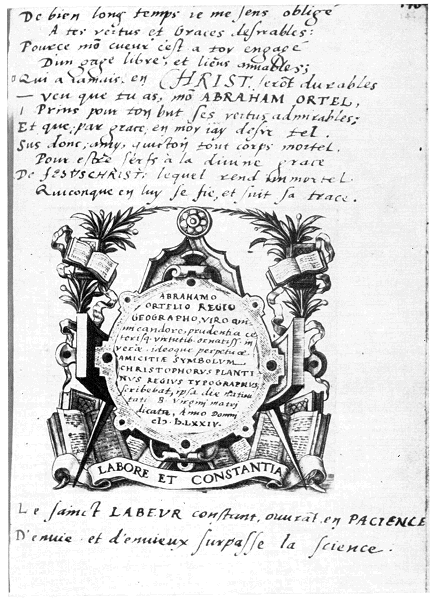 (100) Poem and dedication by Christophe Plantin, dated 8th September 1574, in the Album Amicorum of Abraham Ortelius. The book is now in Pembroke College, Cambridge.
| |
[pagina *102]
| |
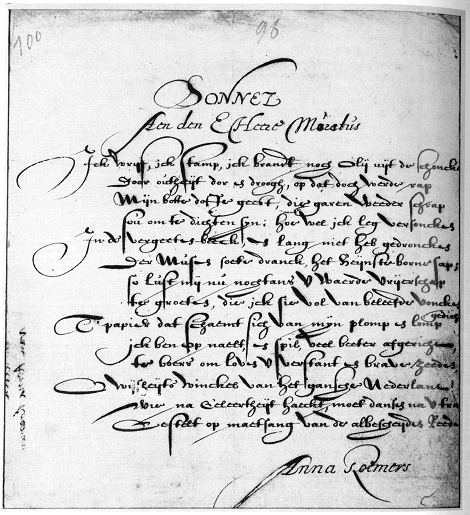 (101) Sonnet by Anna Roemers Visscher, written in her own hand and dedicated to Balthasar I Morctus, c. 1640.
| |
[pagina 365]
| |
accurately in the latter half of their careers, the development of the new humanist scholarship in Antwerp suffered a temporary check. This was due partly to the fact that the town had no more than a fortuitous humanist nucleus which, lacking institutional forms, dissolved when its pivotal figures left or fell silent. But even more it was due to the first rumblings of the Reformation storm. Grapheus, who had followed Erasmus in castigating abuses and disorders in the Church, was severely censured in 1522 and was obliged to utter a humble mea culpa. The departure of Nicolaus Buscoducensis in the same year must also be attributed to a charge of ‘Luthery’. The older humanists were largely scared into silence by this violent reaction on the part of the authorities, whilst the more pugnacious spirits became caught up in religious controversy. In the years 1525 to 1550 humanism in the Netherlands underwent a serious crisis of development. Yet it was in this period that Antwerp rose to become one of the chief centres from which the influence of Renaissance scholarship was radiated through the Low Countries. It was, however, a centre without humanists, exercising its influence through printing and the book trade.Ga naar voetnoot1. During the early days of printing, Deventer and Louvain were the chief centres both of the new learning and of publishing in the Netherlands. In the number of works produced, Antwerp, with 392 known incunabula, came after Deventer with its 596 and before Louvain with its 269, but scarcely thirty of the Antwerp publications can be regarded as humanist. Whereas the Louvain and Deventer printers worked mainly for a scholarly | |
[pagina 366]
| |
public of professors - by whom they were often commissioned - and students, their Antwerp counterparts supplied an affluent, Dutch-speaking (and to some extent also French-speaking) middle class market which was little affected as yet by the new learning, meeting its demand for moral dissertations, religious tracts, dictionaries, lavishly illustrated books, popular romances, and so on. The printing business, then as now, required a comparatively high level of investment, an active money market and, of course, ample outlets. When Antwerp became the ‘great and triumphant merchant city’ of Western Europe in the early sixteenth century, the Netherlands book trade began to be concentrated within its walls. Nijhoff-Kronenberg's Bibliographie enables reasonably accurate figures to be given for the period 1500 to 1540. Of the approximately 4,000 works printed in the Netherlands in this period, about 2,250 were produced in Antwerp, compared with 400 in the rest of the Southern Netherlands and some 1,350 in the Northern centres. Of the 133 printers, publishers, and booksellers reckoned to be active in the Netherlands at that time, sixty-six worked in Antwerp, sixteen in the other towns of the South, and fifty-one in the whole of the Northern Netherlands. This concentration was a gradual process. The early sixteenth-century Antwerp editions were still remarkably like the Antwerp incunabula which had preceded them both in content and production. However, when the concentration of printers in the Brabantine port caused a typographical vacuum in the rest of the Netherlands, the Antwerp printers began to take over the specialities of their incoming colleagues. From the 1520s onward an increasing number of editions of classical authors and academic and philosophical works by humanist innovators (including the whole gamut of Erasmus's writings) were published, as well as dictionaries and geographical, medical, and botanical treatises. In 1528 Grapheus printed the De sculptura, a study of classical sculpture by the Neapolitan scholar Pomponius Ganricus. In 1539 Pieter Coecke van Aalst brought out Iris richly illustrated Inventie der Colommen, derived from Vitruvius and intended for painters, woodcarvers, sculptors, and all others ‘who take delight in the edifices of the Ancients’. This was the situation when the French bookbinder, Christophe Plantin, | |
[pagina 367]
| |
settled in 1548 or 1549 in Antwerp, where he went over to printing in 1555 and in spite of the difficulties of the period worked his way up in a few years to become the greatest typographer of his day and one of the greatest of all times. Plantin was a realist and published anything that was likely to be profitable, but his personal preference went to whatever was of service and benefit to the ‘Christian commonwealth’. He was for the second half of the sixteenth century what Aldus Manutius had been for the late fifteenth and early sixteenth century: the great humanist printer. And with Plantin's advent Antwerp became once more a humanist centre with humanists. Plantin did not have the erudition of an Aldus Manutius or a Robert Estienne, but his writing was by no means without merit and he had a keen and inquiring mind. In and around the Plantin house, around Plantin and his two learned sons-in-law, Jan Moretus and Frans Raphelengius, the great specialist in Oriental languages, there formed Antwerp's second important nucleus of humanists and scholars. Some were associated with the house as proof-readers. The best known of these was Cornelis van Kiel, or Kiliaan (1528-1607), who earned a lasting fame in the history of Dutch linguistics with his dictionaries.Ga naar voetnoot1. Other scholars were temporarily enlisted for special tasks and lodged in the Gulden Passer. Joannes Isaac Levita, a German-Jewish professor at Cologne who had been converted to Christianity, lived in Plantin's house from 10th November 1563 to 21st October 1564, and received, in addition to his board and lodging, the quite considerable sum of 11 pond 15 schellingen and 6 stuivers (about 70 fl.) for a new edition of his Hebrew grammar and the revision of Sante Pagnini's Thesaurus linguae sanctae.Ga naar voetnoot2. In 1568 Guy Le Fèvre de la Boderie, the famous French linguist (1541-1598), and his brother Nicholas came to help with the preparation of the Polyglot Bible.Ga naar voetnoot3. | |
[pagina 368]
| |
The great Spanish theologian and philologist Benedictus Arias Montanus (1527-98) was put in charge of this gigantic enterprise; when the work had been completed he stayed on for a few years in Antwerp and made the Plantin press his headquarters for the whole of this period.Ga naar voetnoot1. Other eminent Antwerp figures became associated with this Plantinian nucleus: Abraham Ortelius (1527-98),Ga naar voetnoot2. the great cartographer, who was also widely known for his ‘museum’ and whose circle of friends was just as international as that of Plantin (and in fact largely coincided with it); Theodoor Poelman (1512-81),Ga naar voetnoot3. the retiring but worthy humanist who carned a living first as a fuller, then as a customs official, devoting his free time to annotating and publishing classical writers; the engraver Philip Galle (1537-1612),Ga naar voetnoot4. of the Witte Lelie [White Lily], the foremost publisher of prints of his time; Joannes Goropius Becanus (1518-72/3),Ga naar voetnoot5. Plantin's | |
[pagina 369]
| |
partner from 1563 to 1567, a physician and amateur philologist who tried to prove in his Origines Antwerpianae that Adam and Eve conversed in Antwerp dialect in the Garden of Eden, but nevertheless signalled the start of modern comparative philology with this and other similarly doughty assertions; Pieter Heyns (1537-97),Ga naar voetnoot1. the learned schoolmaster at the Lauwerboom [Laurel Tree] girls' school and member of a rederijkerskamer or chamber of rhetoric; Alexander Grapheus (c. 1519-after 1585), the son of Cornelius and his successor as town clerk of Antwerp. Grapheus was himself a humanist of some distinction who apparently helped the young Plantin financially, but in about 1572 he fled to Germany, suspected of heresy. This group did not include all the scholars, important or not so important, then living within the walls of Antwerp,Ga naar voetnoot2. but it represented a tightly-knit nucleus with an international influence. Plantin and Ortelius, and Montanus while he was in Antwerp, were its principal supports. Writing to a friend, Plantin said that the letters he received came in like flocks of starlings.Ga naar voetnoot3. He answered his letters promptly: nine octavo volumes, representing more than 1,500 letters, were needed when Plantin's extant correspondence was published. This correspondence shows Plantin in contact with the greatest minds of | |
[pagina 370]
| |
his time. There is hardly a single scholar of any distinction from the Netherlands who does not figure in these letters in some degree of relationship with the Plantin house. Some appear occasionally or casually, others with greater frequency: Louvain professors, bishops and abbots, theologians and humanists in clerical garb, doctors in medicine and law; scholars who had remained in the Low Countries, scholars who wandered through Europe or had found their spheres of activity at the Imperial courts of Vienna or Prague, in Spain or Italy. Many of these scholars - and not the least of them - appear as intimate friends of the Plantin family: Stephanus Winandus Pighius (1520-1604), who as Granvelle's librarian in Brussels had introduced the young Plantin into the cardinal's circle;Ga naar voetnoot1. Andreas Masius (1514-73), an Orientalist and a counsellor of the Duke of Cleves;Ga naar voetnoot2. the great and world famous Justus Lipsius (1547-1606), who was to become, and remain, the family friend par excellence;Ga naar voetnoot3. Rembert Dodoens or Dodonaeus (1517-85),Ga naar voetnoot4. Carolus Clusius (1526- | |
[pagina 371]
| |
1609),Ga naar voetnoot1. and Mathias Lobelius (1538-1616),Ga naar voetnoot2. the three greatest botanists of the second half of the sixteenth century; Livinus Torrentius (1525-95), Archdeacon of Liège and later Bishop of Antwerp, a humanist and theologian of stature, who constantly watched over the printer's interests;Ga naar voetnoot3. Jan Mofflin († 1589), chaplain to Philip II in Spain, who was to end his days in his homeland as Abbot of Bergues; Andreas Schottus (1552-1629), who became a Jesuit in Spain in 1586;Ga naar voetnoot4. and Nicolas Oudartius († 1608), a canon at Malines who appears in Plantin's immediate circle in the latter years of the printer's life.Ga naar voetnoot5. As an ‘intimate foe’ of Plantin might be described Willem Lindanus (1525-88), Bishop of Roermond, who dabbled in Oriental languages, launched an offensive against the Polyglot Bible and Arias Montanus, and thus indirectly against Plantin and Raphelengius, exchanged many acrimonious letters and engaged in many angry conversations with Plantin, and yet regularly sought to have his works published by the Officina Plantiniana.Ga naar voetnoot6. | |
[pagina 372]
| |
Lindanus was, however, the exception which proves the rule: affection and cordiality - notwithstanding occasional arguments, differences of opinion, and reproaches - suffuse Plantin's correspondence with numerous humanists of the Low Countries. There was Petrus Bacherius (1517-1601), a Dominican monk and a professor at Louvain; Michel Baius (1513-89), Dean of St. Peter's, Louvain; Hugo Blotius of Delft, Imperial librarian at Vienna; Petrus Brughelius or Bruhesius († 1570/71), Eleanor of Austria's physician who had retired to Bruges; Adrianus Burchius († 1606) of Utrecht; Ogier Ghislain de Busbecq (1522-91), the erudite Imperial ambassador who returned from his stay in Constantinople with a rich harvest of valuable scientific information, besides discoveries as the tulips, lilacs, and daffodils which he introduced into the West;Ga naar voetnoot1. Henricus Buschey († 1600), the Minorite from Bastogne who died in Antwerp - Plantin published a mystery play by him; Joannes Buyssetius who corresponded with Plantin from Rome; Petrus Canisius (1521-97) from Nijmegen, the prolific Jesuit author, canonized in 1925; Jean Capet († 1599), Canon of St. Peter's, Lille; and Ludovicus Cario or Carrio (1547?-95), professor of law at Louvain. The list can be continued with Henri Cock (bom c. 1554), the adventurous scholar who joined the Spanish royal life-guard;Ga naar voetnoot2. Dirk Volckertszoon Coornhert (1522-90), the sympathetic Dutch notary and literary figure from Haarlem who paid a heavy price for his ideal of religious toleration;Ga naar voetnoot3. Franciscus Costerus (1532-1619), the ardent Jesuit polemist and one of the | |
[pagina 373]
| |
chief protagonists of the Counter-Reformation in the Netherlands;Ga naar voetnoot1. Jacobus Cruquius of Messines, a teacher at Bruges; Henricus Cuyckius (1546-1609), Vicar-General of the Archbishopric of Malines before becoming Bishop of Roermond in 1596;Ga naar voetnoot2. Janus Dousa, lord of Noordwijk and Kattendijk (1549-1604), the Protestant humanist and politician who played an important part in the setting up of the University of Leiden;Ga naar voetnoot3. Andreas Fabricius of Liège (c. 1520-81), a counsellor of the Duke of Bavaria; Gerardus Falkenburgius (1538-78) of Nijmegen, who was in the service of the Count of Nieuwenaar and who died after falling off his horse when drunk; Matheus Galen (c. 1528-73), professor at Ingolstadt, later provost at Douai and chancellor of its university; Hannard Gamerius [van Gameren], who also lectured at Ingolstadt, later teaching at Tongres and Harderwijk; Cornelius Gemma (1535-79), son of Reinier Gemma Frisius, physician, mathematician, and a somewhat confused philosopher;Ga naar voetnoot4. Jan van Gheesdael, the poet and composer born at Berchem near Antwerp; Thomas Gozaeus († 1571), professor of theology at Louvain; Henricus Gravius (1536-91), son of the Louvain printer Bartholomaeus Gravius, a doctor of theology who was appointed head of the Vatican library by Pope Sixtus V; Franciscus Haraeus (c. 1550-1632), theologian and historian, one of the first travellers from the Southern Netherlands to visit Moscow; and Pierre Hassard of Armentières, the physician and astrologer, renowned for his almanacs and predictions. Other scholars with whom Plantin corresponded include the Jesuit theologian Joannes Hayus (1540-1614), professor at Louvain and Douai; Georges de la Hèle (1547-87), the famous composer and choirmaster;Ga naar voetnoot5. Jan Hentenius (1499-1566), theologian and professor at Louvain; Pontus Heuterus (1535-1602), the Delft clergyman who distinguished himself as an | |
[pagina 374]
| |
historian;Ga naar voetnoot1. Gregorius Hopper († 1610), son of Joachim Hopper, and like his father an eminent jurist; Augustinus Hunnaeus (1521-78), one of the foremost Louvain theologians; Michael van Isselt († 1597), the historian from Amersfoort who retired to Germany;Ga naar voetnoot2. Hadrianus Junius (1512-1572), the physician, historian, philologist and poet who spent most of his life in Haarlem;Ga naar voetnoot3. Jacobus Latomus (1510/15-96), a canon at Louvain; Joannes Lenseus (1541-93), Louvain professor and theologian; Janus Lernutius (1545-1619), Latin poet;Ga naar voetnoot4. Joannes Livinaeus (1546/7-99), a nephew of Livinus Torrentius, who worked in the Vatican library and then became a canon of Antwerp Cathedral; Franciscus Lucas (1548/9-1619), the Bruges theologian and orientalist who resided at St. Omer during the troubles in the Netherlands;Ga naar voetnoot5. Gerard Mercator (1512-94), the greatest cartographer of the sixteenth century and one of the greatest of all times, who left Louvain in 1554 to settle in Duisburg;Ga naar voetnoot6. Jan Molanus (1533-85), theologian and Louvain professor;Ga naar voetnoot7. Philippe de Monte (1521-1603) from Hainault, composer and Kapellmeister to the emperors Maximilian II and Rudolph II;Ga naar voetnoot8. the theologian Jacobus Pamelius (1536-87) from Bruges; Peter Pantin (1556-1611), the | |
[pagina 375]
| |
theologian who accompanied Andreas Schottus to Spain, not returning to his own country until 1591;Ga naar voetnoot1. Andreas Papius (1542-81), another nephew of Torrentius, a musician and Latin poet who was drowned in the Meuse when not yet forty years old; Georgius Rataller (c. 1518-81), a magistrate and humanist from Leeuwarden; Cornelius Reineri of Gouda, professor at Louvain; Jacobus Revardus (c. 1536-68) from Lissewege, doctor of law at Bruges and for some years a professor at Douai; Martin Antonio del Rio or Delrio (1551-1608), a jurist, magistrate, and humanist born in Antwerp of Spanish parents; Jan Stadius (1527-79), the mathematician and astrologer from Loenhout who died in Paris as mathematician to Henry III of France;Ga naar voetnoot2. Godeschalk Steewech or Stewechius (1557-c. 88), who specialized in Roman antiquity; Petrus Suffridus (1527-97), the historian of Friesland; Gregorius Tegnagel of Louvain, jurist and magistrate at the Imperial chancery at Spiers; Cornelius Valerius orWouters (1512-78) from Utrecht, an ‘orator et poeta’ and professor at Louvain;Ga naar voetnoot3. Simon Verepaeus or Verrijpen (c. 1522-98), a priest and teacher best known for his schoolbooks;Ga naar voetnoot4. Christophorus Vladeraccus (1524-1601), teacher at 's-Hertogenbosch;Ga naar voetnoot5. Jan Vlimmerius or Van Vlimmeren († 1597), a priest from Louvain; and Bonaventura Vul-canius or Smet (1538-1615), the philologist and militant Calvinist from Bruges who was a professor at Leiden in his later years.Ga naar voetnoot6. The letters Plantin exchanged with foreign scholars were no less numerous and cordial. The French are well-represented,Ga naar voetnoot7. although a number of | |
[pagina 376]
| |
important names are missing from the list. Guy Le Fèvre de la Boderie and his brother Nicolas have already been mentioned as collaborators on the Polyglot Bible;Ga naar voetnoot1. they remained in contact with Plantin after this. Guillaume Postel (1510-81), the talented linguist and visionary, advised Plantin on Syriac scriptGa naar voetnoot2. and discussed religious problems with him.Ga naar voetnoot3. Other Frenchmen were Christophe de Cheffontaines (c. 1532-95), General of the Minorites from 1571 onwards and Archbishop of Caesarea; Louis Le Caron or Charondas (1536-1617), the famous jurist; Pierre Daniel (1530-1603), also a jurist and the scholarly editor of Plautus; the Jesuit Guillaume Fournier or Fornerius, professor at Orleans; Gilbert Genebrard (c. 1537-97), professor of Hebrew at the Sorbonne and Bishop of Aix in 1592; François Hotman (1524-90), the wandering jurist who taught at Basle, Lausanne, Strasbourg, Valence, and Bourges; Jean Matal or Matalius Metellus (c. 1520-97), the great philologist; Claude Mignaut (1536-1606), professor of canon law at the Sorbonne; Marc Antoine Muret (1526-85), the philologist and humanist who lived for many years in Italy, dying in Rome; Pierre Pithou (1539-96), the eminent jurist;Ga naar voetnoot4. and Joseph-Juste Scaliger (1540-1609), the great classical philologist and orientalist who entered Dutch humanist circles after becoming a professor at Leiden in 1593. Scholars from the Iberian peninsula wrote many of the letters that arrived at the Plantin House like flocks of starlings.Ga naar voetnoot5. Even before Arias Montanus came to Antwerp, Plantin had exchanged occasional letters with such Spanish humanists as Ferdinand Mena, Philip II's physician and a professor at Alcala, and there were Spaniards and Portuguese who approached the printer | |
[pagina 377]
| |
on their own initiative after the arrival of Arias Montanus; Esteban de Garibay y Zamalloa (1525-93), the Spanish historianGa naar voetnoot1. and Antonio de Sienne (or de la Conception), the Portuguese theologian, are examples. But it was Montanus who established the most important contacts between Plantin and the Peninsula.Ga naar voetnoot2. His departure from Antwerp did not end his friendship with the printer. Back in Spain Montanus not only became the most faithful and intimate of all Plantin's correspondents, but also the chief propagandist for the Plantinian house. Through Montanus, Plantin came in contact with Christoval Calvete de Estrella, chaplain to Charles V; Pedro Juan Lastanosa, secretary to Philip II; Garcia Loaisa, Philip Ill's tutor; Valerius Serenus, librarian to the Bishop of Cuenca; Petrus Serranus, professor of philosophy at Alcala and Abbot of Coria in 1577; Carolus Bartelus Valentinus, a disciple of Montanus; Francisco Valles, physician to Philip II; Alonso de Vera Cruz (or Gutierrez), a scholarly Augustinian; Laurens a Villavicentio, doctor of theology and Philip II's ‘concionator’; and Francisco Sanchez de la Broza, professor at Salamanca. A number of Spanish and Portuguese scholars wrote from Italy: the theologians Martin d'Azpilcueta or Navarrus (1493-1586), Pedro Chacon or Ciacconius (1525-81), Thomas Correa (1536-95), Ludovicus a San Francisco, and Franciscus Turrianus (1504-84); and a number from the German empire, such as Bartholomeus Valverdius, chaplain at Prague to the emperor. These Iberians should really be grouped with the Italian or Central European humanists who corresponded with Plantin. In Italy the great advocate of Plantin and his house was Cardinal Granvelle (1517-86).Ga naar voetnoot3. This bibliophile and patron of the arts put other like-minded cardinals - Caraffa, Sirlet, Madrutius - in touch with Plantin. Through | |
[pagina 378]
| |
these prelates eminent Roman humanists came to correspond with Plantin: Fulvio Orsini (1529-1600),Ga naar voetnoot1. Ercole Ciofano, and Giovanni Antonio Viperana (c. 1540-1610). At the end of his life Plantin himself took the initiative in the matter of a publication which brought him into contact with Cardinal Cesare Baronius (1538-1607). Contacts with the British Isles and their scholars were less numerous and less fruitful. With the exception of the Scot, George Buchanan (1506-82) and his friend Daniel Rogers (c. 1538-91),Ga naar voetnoot2. Plantin seems only to have had dealings with English, Scottish, and Irish scholars who as Catholics had fled from their countries to seek refuge in the Netherlands; for example Alan Cope († 1582),Ga naar voetnoot3. John Sanderson and Richard Stanyhurst (1547-1618).Ga naar voetnoot4. Plantin's relations with scholars in Germany and Central Europe were much more important. These can be divided up into various groups. In the Rhineland there were Herman Cruser (1510-73), counsellor to the Duke of Cleves; Franciscus Fabricius (1524-73), a rector at Dusseldorf; Obertus Gifanius (1534-1604); Petrus Merssaeus, a Franciscan active at Cologne; Henricus Menchenius, a Bonn physician; Henricus Olearius, chancellor to the Duke of Cleves; Joannes Rethius, a Jesuit active in Cologne; and Cornelis Schulting, a Cologne canon (c. 1540-1604). South Germany provided Jeremias Martius at Augsburg and the famous physician and botanist Joachim II Camerarius at Nuremberg. In Bavaria were Simon Eccius, the Duke of Bavaria's chancellor; Joannes Leodius, doctor of theology and ducal councillor; Erasmus Vendius, councillor and secretary to the Duke of Bavaria. North Germany had Henricus Ranzovius (1526-98) who governed Holstein for the Danish king;Ga naar voetnoot5. and Ditlevius Silvius, who was in Ranzovius's | |
[pagina 379]
| |
service. In Brandenburg were Severinus Gobelius, physician, and Michael Scrinius, librarian of the Elector of Brandenburg. Plantin's correspondents in Austria and Bohemia included Johann Craton von Kraftheim (1519-85), Maximilian II's physician; Paul Melissus (Schedius), the poet laureate at Vienna; John Sambucus (1531-84), the learned Hungarian who was a councillor and historian of Maximilian II and Rudolph II;Ga naar voetnoot1. and Andreas Duititius, the Catholic bishop in Hungary who became a Lutheran and fled to Poland - he wrote to Plantin only from Vienna. Polish and Silesian correspondents included Cardinal Stanislas Hosius (1504-79), Bishop of Külm and Papal Legate to Poland; Thomas Treterus, Hosius's secretary; and Jacobus Monaw and Thomas Redinger at Breslau (the present Wroclaw). These were the scholars who exchanged ideas in writing with Plantin. His circle of friends and acquaintances was in fact much more extensive. Chance references in his own letters, or in those of the scholars in question when writing to third parties, show that Plantin conversed in person with such divergent figures as the Italian historian and English secret agent Pietro Bizari (who has a history of Persia and one of Genoa published by Plantin) during his stay in Antwerp;Ga naar voetnoot2. with the ardent Dutch Calvinist leader Adrian Saravia at Leiden;Ga naar voetnoot3. and with the German specialist in Oriental languages Emanuel Trcmelius, when this Heidelberg professor was passing through Antwerp.Ga naar voetnoot4. It also appears that he was friendly with Dominicus Lampsonius (1532-99),Ga naar voetnoot5. the Bruges philologist, poet and painter who, as secretary to the | |
[pagina 380]
| |
Prince-Bishops of Liège, played such an important part in the spiritual life of the Ardent City, and with Pierre Antesignanus, the French grammarian.Ga naar voetnoot1. This by no means exhausts the list. A few lines in the Album Amicorum of Jan van Hout (1542-1609) represent all that is known about the relations between the printer and the learned town clerk of Leiden, but they show these relations to have been very friendly.Ga naar voetnoot2. That a poem by Michel Aitzinger, the Austrian historian of the revolt of the Netherlands, should have been included in the book of verse dedicated to Plantin's memory suggests that they knew each other very well. Similarly it may be assumed that many native and foreign humanists who do not actually appear in Plantin's correspondence dealt in person with the master of the Gulden Passer when he printed their works,Ga naar voetnoot3. commissioned their editions and translations,Ga naar voetnoot4. or when they sold him books and manuscripts from their libraries.Ga naar voetnoot5. On his many business journeys in the Netherlands, France, and Germany, the printer would sometimes make big detours in order to call on all these learned friends and acquaintances, to settle up with them or discuss new projects. Naturally there are few traces of these conversations in letters or account books but now and again they afford glimpses of Plantin in animated | |
[pagina 381]
| |
conversation in Louvain, Cologne, Frankfurt, or Paris; on the return journey from the Frankfurt Fair, for example, turning off to visit Gerard Mercator, who was living the life of a recluse in Duisburg, and settling acounts with him;Ga naar voetnoot1. or at the house of Livinus Torrentius in Liège, conveying greetings from Antwerp friends or lamenting his financial state;Ga naar voetnoot2. or being entertained at Louvain by Professor Gozaeus, who tried to interest him in an edition of St. Augustine's works.Ga naar voetnoot3. Just as often, or even more frequently, these scholars visited Antwerp to talk with the printer. Justus Lipsius was such a regular guest in the Plan-tinian house that the Moretuses came to call their guest room or vrienden-kamer the Lipsius room.Ga naar voetnoot4. In his Plantarum stirpium historia (1576), Mathias Lobelius described the botanical excursions he made around Antwerp, for which it may be supposed he used Plantin's villa as his headquarters.Ga naar voetnoot5. Esteban de Garibay y Zamalloa came to Antwerp specially to watch with jealous care over the printing of the Historia de España, the monumental result of his scholarly endeavours.Ga naar voetnoot6. Hadrianus Junius stayed with Plantin in 1567, eating three meals and receiving 27 ells of velvet, as the printer carefully noted in his accounts.Ga naar voetnoot7. This entry was made in order to justify the expenditure of 27 ells of velvet to Plantin's partners (it was given as an author's fee) rather than for the sake of keeping a record of the board and lodging. Plantin was not so niggling as that: the fact that he invited Professor Tremelius of Heidelberg to dinner on his return journey from England to Germany;Ga naar voetnoot8. that he received Clusius | |
[pagina 382]
| |
with open arms when the great botanist was also returning from England to the Continent;Ga naar voetnoot1. that Jan Mofflin chose to lodge at the Golden Compasses, rather than find greater comfort and a more lavish table with Antwerp patricians who would have liked nothing better than to entertain the influential Abbot of BerguesGa naar voetnoot2. - all this is revealed not by Plantin's account books but by casual references in letters. It is the very casualness of these allusions which suggests that such events were by no means rare and that the Golden Compasses in the Kammenstraat and the Vrijdagmarkt offered hospitality through the years to an unending succession of scholars. It is always difficult to make positive assessments of cultural influence and exchange. The main sources are usually letters; certainly any measurement of the significance of the Plantinian house as a cultural centre must be based on extant correspondence. But letters are only written when the correspondent is out of reach. Hardly any letters were exchanged between Plantin and Ortelius, Poelman, Galle, Heyns, or other Antwerp friends, as they could meet and talk with each other at any time. Even when letters are exchanged, the correspondents may leave matters of mutual knowledge unwritten, or may be reluctant to commit everything to paper for fear of prying eyes. Plantin's copious correspondence shows him in contact with European humanism of those years, but the nature of the source material makes it hard to define the exact significance of the Plantinian house in the cultural life of the time. Plantin's letters deal mainly with the practical problems which have beset printers and publishers down the centuries: costing; answering the clamour of difficult authors who thought their works were being neglected; complaints and protests to recalcitrant authors who sent in badly corrected or incomplete texts; polite refusals of proffered manuscripts, and so on. Now and again reference is made to some friendly service. Plantin watched over the interests of Stephanus Winandus Pighius, who was in danger of losing a large amount of money through the bankruptcy of an Antwerp financier (he lost it in spite of the printer's intervention). He sent | |
[pagina 383]
| |
some of Dodoens's household effects from Leiden to Hamburg at the request of the botanist's widow, invoking the aid of the German scholar Camerarius.Ga naar voetnoot1. Hubert Languet, the French Protestant publicist who died in Antwerp on 30th September 1581, called Plantin to his death-bed and asked the printer to open any confidential letters which arrived for him without the knowledge of the executors who had been appointed by the city authorities, to read them, and to take whatever action seemed most suitable.Ga naar voetnoot2. The Golden Compasses also functioned as a kind of post office. Plantin took with him on his numerous business trips hundreds of letters and documents abroad for friends and acquaintances, or distributed incoming mail in the Low Countries.Ga naar voetnoot3. Not all those helped in this way were as ungrateful as the always touchy Pamelius, who angrily accused Plantin of opening letters entrusted to him.Ga naar voetnoot4. In a letter of 2nd November 1587 to Ortelius, Dominicus Lampsonius refers to a manuscript of Petrus Simenius which Lampsonius was sending Ortelius with the request that it should be passed on to Plantin, who was to dispatch it to Philippe de Mornay, seigneur of Duplessis, who was to hand it over to Antonius Sadelius.Ga naar voetnoot5. In this manner letters and documents - and conversations and ideas - were passed on. In most of Plantin's letters it is the businessman who speaks. In many letters, however, the cultural life of the time also takes shape, with the printer playing a very active role which was not simply that of a hard-headed businessman, covetous of gain. Plantin himself took the initiative in publishing certain works, badgering authors, urging them on, and this to an extent which is only partially expressed in his letters. He asked Postel's advice about the structure of Syriac charactersGa naar voetnoot6. and thus was able to use in the Polyglot Bible one of the most elegant Syriac types ever designed. He hunted down manuscripts for his own use or on behalf of others. He asked Duititius at Vienna for two Greek manuscripts the existence of which he had | |
[pagina 384]
| |
heard of through Pierre Antesignanus.Ga naar voetnoot1. He had Arabic manuscripts sent from Spain for his son-in-law Raphelengius.Ga naar voetnoot2. He went to the Abbey of Tongerlo to borrow Hebrew Talmudic manuscripts for Arias Montanus,Ga naar voetnoot3. and it was probably at the latter's request that he negotiated with Thomas Redinger for the loan of an old manuscript.Ga naar voetnoot4. With Arias Montanus he travelled through the Netherlands buying books and manuscripts for the library which Philip II was setting up in the Escorial.Ga naar voetnoot5. After the theologian had returned to Spain, Plantin continued to send books, manuscripts, scientific instruments, seeds and plants.Ga naar voetnoot6. Mofflin wrote from Spain asking him to look at a manuscript collection in Brussels and, possibly, to buy it on his account. Philip II's chaplain also requested him to act on his behalf in the purchase of Flemish tapestries intended for the Peninsula and to have a damaged clock repaired by Michel Coignet, the well-known Antwerp instrument maker and geographer.Ga naar voetnoot7. Plantin helped Gerard Mercator on his map of France.Ga naar voetnoot8. He consulted theologians about how to illustrate particular religious subjects.Ga naar voetnoot9. He advised the Duke of Bavaria's counsellors | |
[pagina 385]
| |
on the appointment of professors at Ingolstadt.Ga naar voetnoot1. Lipsius invited him to Louvain when he presented his doctor's thesis.Ga naar voetnoot2. Years later Ludovicus Carrio invited Plantin for the same purpose, but the printer had to excuse himself because of sickness.Ga naar voetnoot3. Plantin discussed religious questions with the tolerant CoornhertGa naar voetnoot4. and the Calvinist Saravia.Ga naar voetnoot5. He put the mystic prophet Barrefelt in touch with Arias Montanus.Ga naar voetnoot6. In 1574 the printer attended the second synod of the Netherlands ecclesiastical province as Requesens's mandatary, taking part in a session and conveying the governor-general's instructions to the assembled bishops and abbots in a Latin address; he also negotiated with them over the publication of choirbooks.Ga naar voetnoot7. Although it is difficult to prove cultural influence in terms of figures and charts, there can be no doubt that the Plantinian house in the time of its founder showed itself to be a cultural centre of international importance. Its role was not merely passive; it was forceful and dynamic, helping to determine and direct the intellectual life of the period. This description of Plantin's relations with the scholars of his time would not be complete without some consideration of how far these were affected by political and religious events. For most of his life Plantin belonged to heterodox sects - first Hendrik Niclaes's Family of Love and later Hendrik Janssen Barrefelt's kindred group - which were not opposed to either Catholicism or Protestantism, but rather placed themselves above established churches, dogma, or ritual, preaching toleration and an intensely spiritual faith in Jesus Christ.Ga naar voetnoot8. These sects, however, operated in the greatest secrecy. Their member- | |
[pagina 386]
| |
ship was small, confined to a limited flock of the chosen. Only a very few of Plantin's circle were adherents, although it should be pointed out that these were his most intimate friends. The Antwerp humanists nearest to Plantin and Ortelius were steeped in the mysticism of these heterodox sects. But Plantin also had many friends and acquaintances who were not numbered in this small esoteric company. The printer was primarily concerned with the man and not with the label he wore: Catholic or Protestant seem to have been all the same to him, as long as they amounted to something as people. Yet he also had to take account of the environment in which he lived, and that environment was initially Catholic - if not always in spirit, then at least in externals. Plantin's circle was therefore predominantly Catholic. Until 1576 the Protestants among his acquaintances could be counted on the fingers of one hand, and naturally they were almost exclusively foreignersGa naar voetnoot1. or fellow-countrymen abroad.Ga naar voetnoot2. In 1576 the Southern Netherlands too rose in revolt against Spanish rule and it became possible for its citizens to proclaim their religious convictions with less risk to life and property. In these years Plantin seems to have been on friendly terms with many eminent Protestant scholars: with the Scot George Buchanan, and die Englishman Daniel Rogers; with such Frenchmen as Philippe de Mornay and Hubert Languet; and of course with native Protestants, particularly with those in the Northern Netherlands he had come to know from 1579 onwards during his first reconnaissances in Holland. These included Janus Dousa, Jan van Hout, and Saravia. Nevertheless it was the Catholic element in Plantin's circle which continued to set the tone, and he himself remained rather averse to humanism with a Calvinist tinge. This is clearly expressed in the attitude he adopted at Antwerp in the period 1579 and 1585 (or at least to 1582).Ga naar voetnoot3. In 1577 Antwerp went over to the rebels; in 1579 to 1580 the Calvinists seized power. At once a new group of humanists appeared, militant Calvinists who regarded the study of classical Antiquity and its culture as a weapon to be used in the service of their religion. There was a Flemish, or | |
[pagina 387]
| |
more precisely, a Brabantine group with Marnix van Sint-Aldegonde and Hendrik Ackermans van Brecht (Brechtanus) as its central figures; and a French-speaking group with Pierre Villiers l'Oiseleur, the ‘Calvinist pope’ of Antwerp, and Jan Taffin, Granvelle's former librarian and a sort of Calvinist librorum censor for the city, as its principal representatives. In 1580 these Calvinists founded a schola publica, a grammar school where Latin, Greek, and Hebrew were taught. The first headmaster was Bonaventura Vulcanius who was to continue his turbulent career at Leiden; the first pupil registered was Marnix's son Jacob. Jan Taffin was already known to Plantin. The printer had made his acquaintance at Antwerp in 1558, before he had gone over openly to Calvinism and become a preacher in Lorraine. It was Taffin who had introduced Plantin to his colleague Pighius, thereby giving him access to Granvelle's circle.Ga naar voetnoot1. But between 1579 and 1582 Plantin appears to have studiously avoided any contact with this old acquaintance. Vulcanius was also in contact with Plantin for a considerable time - at least from 1573 - but the printer made no particular effort to strengthen the ties between them during his stay in Antwerp. Towards the Calvinist newcomers Plantin and Moretus and their associates maintained a fairly cool neutrality.Ga naar voetnoot2. There is one exception who may have come under the influence of these Calvinists: the conversion of Plantin's son-in-law Raphelengius to the reformed religion should be placed in this period and is perhaps to be ascribed to his dealings with Vulcanius and other scholars of his persuasion. The recapture of Antwerp by Spanish forces in 1585 put an end to the brief existence of the schola publica and sent the Calvinist scholars fleeing to the North. The reconquest also meant the beginning of a new phase in the history of humanism in Antwerp and the Southern Netherlands - and in the role and importance of the Plantin house as a cultural centre. Antwerp's heyday was past, but the decline only made itself felt gradually. The arts experienced another splendid revival and humanism and the sciences were to blaze up once more in glory in the slow economic decay of | |
[pagina 388]
| |
the Brabantine port. This late Antwerp humanism was wholly different in character from that which ‘la preclara et famosa citta di Anversa’ had experienced in the palmy days of Plantin and his circle. After 1585 Antwerp was made into a bastion of Catholicism. If Plantin was the great typographer of the new learning, then Jan and Balthasar I Moretus were the great printers of the Counter-Reformation. Antwerp printing became an adjunct of the militant Catholicism which set its seal on the whole later flowering of humanism in Antwerp. The initiators were the Jesuits who after the surrender took over the educational legacy of the Calvinists and opened a college in 1585; it was primarily the presence of the great humanist Andreas Schottus (1552-1629) which attracted students there. In 1605 the Dominicans opened a second college for the humanities where the ‘sacred’ languages were taught. A third was founded by the Augustinians in 1608. Its first rector, Nicasius Bax (1581-1640), was also a most distinguished humanist scholar.Ga naar voetnoot1. At the end of the sixteenth century Antwerp became what it had never been before - an important centre for what might be termed advanced secondary education whose influence eclipsed even that of the university of Louvain. It was this combination of educational and printing facilities which shifted the centre of gravity of the Counter-Reformation from the university towns of Louvain and Douai to Antwerp. For the Antwerp Jesuits, Augustinians, and Dominicans it was the faith which was of prime importance, but like the Antwerp Calvinists before them, and their Protestant contemporaries in the North, they sought to reconcile Christianity with the cultural values of Antiquity. They laid great emphasis on the classics in their schools, which became a source of Christianized, or more accurately Catholicized humanism. It was largely through the stimulating influence of these schools that this new humanism permeated a larger section of the upper classes in Antwerp than ever before. Once more, as in the time of Erasmus, officials and magistrates who were humanists of national or even international importance appeared in Antwerp, including Jan Boch or Bochius (1555-1609), town clerk from 1585 until his | |
[pagina 389]
| |
death,Ga naar voetnoot1. and Gaspar Gevartius (1593-1666),Ga naar voetnoot2. griffier or recorder from 1622 to 1666, who commemorated state visits and other public occasions in elegant carmina, gratulationes, and epithalamia; Jan Brandt (1559-1639), Rubens's father-in-law who became griffier in 1591; Philip Rubens, the painter's brother, successor to Bochius as town clerk, who died in 1611 at the age of 38 before his full potential as a scholar had been realized; Jan Woverius (1576-1635), an alderman of the city, councillor of Brabant and a diplomat in the service of the Archdukes Albert and Isabella; Nicolaas Rockox (1560-1640), burgomaster, art patron, and collector; Jacob Edelheer (1597-1657), who became stadspensionaris (pensionary of the city, the most important city official) in 1622 and was the possessor of an internationally renowned collection of globes and scientific instruments. Besides these, other active laity were Frans Sweerts (1567-1629), who wrote the Athenae Belgicae and published many biographies; Petrus Scholirius (1582-1635), a Latin poet of merit who wrote one of the first cookery books in Dutch under a pen-name; Franciscus Schottus (1579-1622), brother of Andreas, an archaeologist and jurist, and the writer of a guide-book for Italy; Lazarus Marcquis (1574-1647), one of the founders of the Antwerp medical school (1624) and author of an important treatise on the plague; Ludovicus Nonnius (c. 1553-1645/6), a physician of Spanish origin and an eminent numismatist.Ga naar voetnoot3. The Catholic clergy of Antwerp now began to emerge as humanists for the first time. There were the bishops, Livinus Torrentius (1525-95), Plantin's friend; Jean Miraeus or Lemire (1560-1611), who became Bishop of Antwerp in 1603; and Jan Malderus (1563-1633) who succeeded him in 1611. The canons of Antwerp Cathedral are represented by Aubert Miraeus (1573-1640), who published large collections of medieval documents; Jan Hemelaers or Hemelarius (c. 1580-1655), a converted Calvinist;Ga naar voetnoot4. | |
[pagina 390]
| |
and Franciscus Zypaeus or Van den Zype (1578/9-1650), one of the best South Netherlands jurists of his day. Then there was the Augustinian preacher and historian Jan Mantels or Mantelius (1599-1676);Ga naar voetnoot1. the priest Laureis Beyerlinck (1578-1627), autlior of the great Catholic encyclopaedia Magnum Theatrum Vitae Humanae; and Frans van Sterbeeck (1630-93), the chaplain to a beguinage whose Theatrum fungorum oft het tooneel der campernoelien (1675) was highly thought of at the time.Ga naar voetnoot2. But-it was the Jesuits who had the most impact with such figures as Andreas Schottus, who has already been mentioned; Carolus Scribani (1561-1629), rector of the Antwerp college, who was regarded in the Society as a ‘talentum ad regendum, scribendum et conversandum’;Ga naar voetnoot3. François d'Aguilon (1566-1617), Jean Charles della Faille (1597-1652) and Grégoire de Saint-Vincent (1584-1667), who were among the best mathematicians and astronomers of their time;Ga naar voetnoot4. Heribert Rosweyde (1569-1629) and Jan Bollandus (1596-1665), who conceived and set in motion the enormous project of the Acta Sanctorum.Ga naar voetnoot5. Thus Antwerp in the late sixteenth and the first half of the seventeenth century was the principal cultural centre of the Southern Netherlands. Its achievements often equalled the best of what was being done in other European countries, but it was a centre where all scholarship served the Counter-Reformation. Plantin experienced the beginning of this new era, which had fully | |
[pagina 391]
| |
arrived by the time that Jan I Moretus succeeded him. Plantin's son-in-law, however, was himself a transitional figure, too much a part of the past to relish the new age entirely.Ga naar voetnoot1. But around him the old familiar figures were disappearing, making way for the new men. When Jan Moretus died in 1610, the old guard of pre-1585 Netherlands humanism had been replaced by the new generation of the Counter-Reformation. With Balthasar I Moretus the Plantin house too saw the accession of a new generation which was intensely aware of the new humanism of its contemporaries. Jan I Moretus earned a modest place in Dutch literature.Ga naar voetnoot2. Balthasar I Moretus, a student of the revered Justus Lipsius, was a Latin poet of distinction - even if he left most of his works to lie unread in the archives of the house without ever wanting to commit them to his own presses.Ga naar voetnoot3. Father and son could, like Plantin, mingle with the most brilliant intellects of their times as equals, but they were no longer leading figures in their own city as the founder of the officina and his intimates had been. In the wider context of the new Antwerp humanism they can be seen to have retreated from the first rank. This was partly of their own volition; they could have shone more, but Jan Moretus does not seem to have been able to accept the new age completely, while his gifted but physically handicapped son, who was indeed imbued with the new spirit, had too much of an inferiority complex to secure a leading role for himself. A change can be seen to have set in on another level. Under Plantin's immediate successors the horizons of the firm were significantly reduced.Ga naar voetnoot4. | |
[pagina 392]
| |
Letters were still exchanged with Spanish and Portuguese scholars, with the composer Duarte Lobo or Lupus at LisbonGa naar voetnoot1. and the naturalist Juan Eusebio Nieremberg at Madrid. Letters still arrived from Italy and Germany, from the cardinals Cesare Baronius (1538-1607), Roberto Bellarmino (1542-1621), and Federico Borromeo (1563-1631), from Rodrigo Arriaga (1592-1667), the Spanish Jesuit who became chancellor of Prague University, from Jacobus Bosius, from Balthasar Corderius (1592-1650), the Antwerp Jesuit who was professor of theology at Vienna,Ga naar voetnoot2. from Augustin Tornielli (1543-1622), and from Theodoor Moretus (1602-67), the learned kinsman who had become professor of theology and mathematics at Breslau (Wroclaw).Ga naar voetnoot3. This does not exhaust the list, although the most important names have been given. Except for Jean Boyvin (c. 1580-1650), a lawyer and councillor at Dôle, France provided no further correspondents of any significance. The international role of the Plantin house was over. It became a centre for scholars from the Southern Netherlands and for foreigners who had settled there temporarily or permanently - such as the refugee Irish Catholic Richard Stanyhurst and the English Catholic Thomas Stapleton (1535-98); others were die Spanish scholar Caramuel Lobkowitz (1606-82), Mathieu de Morgues, and the Chifflets, of whom more later. It had assumed a more regional character, but at this level its brilliance continued. The humanist elite of Antwerp regularly met in the Golden Compasses in the Vrijdagmarkt, and all the major and minor figures of the cultural life of the Southern Netherlands crossed its threshold at one time or another to talk over the publication of their works or discuss humanist questions. The manuscripts and letters of many of them have been preserved in the archives of the house.Ga naar voetnoot4. | |
[pagina 393]
| |
Mathieu de Morgues, Abbot of Saint-Germain, who had followed the Queen Mother of France, Maria de' Medici, into exile, was a fierce polemist and bitter opponent of Richelieu. He corresponded regularly with Balthasar I from Brussels and had him print his writings in defence of the queen and vilification of his mortal enemy - which was not always an unalloyed pleasure for the Antwerp typographer.Ga naar voetnoot1. Several members of the Chifflet family, which originated from Franche Comté, fulfilled important functions in die central government at Brussels. Jacques Chifflet, Isabella's physician, and the Jesuits Pierre François and Laurent Chifflet, were good friends of the Moretuses, but it was with Philippe Chifflet, chaplain to Isabella and the Cardinal Infante Ferdinand, that the relations were the most intimate and cordial. Philippe Chifflet and Balthasar I exchanged hundreds of letters bearing information, questions and requests (these were sometimes quite delicate, as when Philippe asked his friend to find a good - and rich - wife for one of his nephews, a task in which Balthasar was not successful). There were also reports on contemporary events which throw much light on the political life of the Netherlands in those troubled years.Ga naar voetnoot2. The South had been brought back under Spanish rule; the North had won its independence. In both North and South, however, the first generations | |
[pagina 394]
| |
after the separation remained conscious of the former unity. The Antwerp humanists stayed in touch with kindred spirits in the North, although they naturally felt themselves drawn in the first place to their Catholic co-religionists. Anna Roemers Visscher, the Dutch poetess who had been converted to Catholicism and was called by admiring contemporaries the ‘Northern Sappho’ and ‘Theano of the North’, visited Antwerp regularly, where she was welcomed with open arms. This ‘wijze Visscherin’ (i.e wise fisherwoman, a pun on her name) was often a guest in the house in the Vrijdagmarkt, where at her host's request she wrote out a number of sonnets by such great Dutch poets as P.C. Hooft and Constantijn Huygens in her elegant handwriting, and even composed a sonnet on her ‘worthy courtship’ with Balthasar I Moretus.Ga naar voetnoot1. Foreign scholars also called on their way through Antwerp: through the good offices of Rubens the Earl of Arundel's librarian Francis Junius, was able to consult an Old English manuscript gloss in Balthasar's library.Ga naar voetnoot2. On the death of Rubens in 1640, Mathieu de Morgues wrote to Balthasar: ‘Vostre ville a perdu l'ornament de la peinture muette, vous estes celuy de la parlante.’Ga naar voetnoot3. With the passing of Rubens the great age of Antwerp painting came to an end. When Balthasar I Moretus followed the painter a year later the cultural life of Antwerp was also ebbing swiftly away.Ga naar voetnoot4. The standards of the schools and colleges fell alarmingly; the city was degenerating into a provincial centre of little importance. The Plantinian house shared in this decline. Balthasar II continued to correspond with Philippe Chifflet for a time. In 1642 and 1643 he afforded Anna Roemers Visscher the same generous welcome as his uncle had done.Ga naar voetnoot5. | |
[pagina 395]
| |
Nicolas Heinsius, son of the famous Leiden professor Daniel Heinsius, and himself a considerable classical scholar, consulted a number of manuscripts in Balthasar II's library in 1644.Ga naar voetnoot1. Joost van den Vondel, the great Dutch poet and dramatist who came to know Balthasar II through mutual Catholic friends, although the two probably never met in person, dedicated his well-known ode to ‘De Druckkunst’ (The Art of Printing) to this nephew and successor of Balthasar I.Ga naar voetnoot2. In 1656 Vondel's destitute son came to coax a loan out of his father's friend.Ga naar voetnoot3. But after that all was quiet. The Officina Plantiniana remained a great printing house; its masters went on earning millions of guilders from the publication of service books. They were elevated to the nobility and associated with the greatest families in the land, but culturally speaking there was no longer anything of importance taking place in the Golden Compasses.Ga naar voetnoot4. When in 1670 Jules Chifflet, a nephew of Philippe, visited Antwerp, where Balthasar II acted as his host and guide, he wrote compassionately and at some length in his diary on the cheerless aspect of the once proud commercial city, concluding in a similar vein about its cultural decay. All the scholars who had been its glory thirty-six years before were now dead. All that remained were the fine epitaphs in the churches and their portraits in the house of his host Moretus.Ga naar voetnoot5. The Plantin House, with its memories of a great but irrevocable period, had already become a museum - ‘un des beaux restes de notre ancienne opulence’ as it was expressed in a petition of 1757.Ga naar voetnoot6. |
|