

The Golden Compasses
(1969-1972)–Leon Voet– Auteursrechtelijk beschermd
The History of the House of Plantin-Moretus
[pagina 174]
| ||||||||||||||||||||||||||||||||||||||||||||||||||||||||||||||||||||||||||
Chapter 7
| ||||||||||||||||||||||||||||||||||||||||||||||||||||||||||||||||||||||||||
[pagina 175]
| ||||||||||||||||||||||||||||||||||||||||||||||||||||||||||||||||||||||||||
were proof-readers - which makes it difficult sometimes to track them down among the compositors, pressmen, and other workmen. A number of separate notes and the list of members in the ledger of the proof-readers' fraternity (founded in 1664) makes it possible to draw up a more complete list for the second half of the seventeenth and the eighteenth century, although some gaps may remain. The list of names is given on pp. 176-179. In the period 1563-67 Plantin frequently called in what would now be termed free-lance workers to rewrite texts, translate, or collate, to compile indexes or glossaries, or to carry out similar tasks.Ga naar voetnoot1. In writing about the Plantin House, scholars have usually included these occasional workers among the proof-readers of the officina. They should not be regarded as such for they did no actual correction work and worked only irregularly for Plantin. In this category belong Quintinus Steenhartsius,Ga naar voetnoot2. Guillaume Symon,Ga naar voetnoot3. the schoolmaster Antoine Tyron,Ga naar voetnoot4. Estienne de Wallencourt,Ga naar voetnoot5. and Petrus Kerkhovius.Ga naar voetnoot6. Among the regular proof-readers in that period there were a few who worked occasionally for Plantin and wholly or partially on what amounted to a piece-rate basis, as for example Andreas Madoets, Victor Giselinus, and Theodoor Kemp. These were exceptional cases: then and later, proof-reading in the Plantinian house was a full-time job. Unlike the work in the press itself, proof-reading was reckoned and paid on the basis of working days. This does not mean that no account was taken of average rates of work when it came to fixing standards of achievement and salary. Mathias Ghisbrechts was the first proof-reader engaged after the reorganization of the firm in 1563 and Plantin entered into an agreement with him ‘pour me servir de correcteur à l'imprimerie et est obligé de me servir... pour autant de besogne que six compositeurs pourront composer soit qu'une, deux ou trois presses | ||||||||||||||||||||||||||||||||||||||||||||||||||||||||||||||||||||||||||
[pagina 176]
| ||||||||||||||||||||||||||||||||||||||||||||||||||||||||||||||||||||||||||
| ||||||||||||||||||||||||||||||||||||||||||||||||||||||||||||||||||||||||||
[pagina 177]
| ||||||||||||||||||||||||||||||||||||||||||||||||||||||||||||||||||||||||||
| ||||||||||||||||||||||||||||||||||||||||||||||||||||||||||||||||||||||||||
[pagina 178]
| ||||||||||||||||||||||||||||||||||||||||||||||||||||||||||||||||||||||||||
| ||||||||||||||||||||||||||||||||||||||||||||||||||||||||||||||||||||||||||
[pagina 179]
| ||||||||||||||||||||||||||||||||||||||||||||||||||||||||||||||||||||||||||
| ||||||||||||||||||||||||||||||||||||||||||||||||||||||||||||||||||||||||||
[pagina 180]
| ||||||||||||||||||||||||||||||||||||||||||||||||||||||||||||||||||||||||||
impriment lad[icte] besongne de 6 compositeurs’.Ga naar voetnoot1. Later, on 22nd June 1564, Plantin paid Ghisbrechts a bonus of 3 fl. because he had checked the work of two extra compositors besides his regular six.Ga naar voetnoot2. Presumably a similar arrangement was in operation then for the other proof-readers engaged. They were supposed to match their work with a certain number of presses - normally two or three in Plantin's time. This number could be raised or lowered as need arose. In February 1567, when business grew very slack because of the political and religious troubles, Plantin arranged with Kiliaan, one of his two remaining proof-readers (the other was his son-in-law, F. Raphelengius, and therefore rather an exceptional case), that he should check the work of all the presses for as long as Plantin could keep them in operation. This meant 2, 3, or 4, with the salary adjusted according to the number.Ga naar voetnoot3. The number of proof-readers was therefore conditioned by the number of presses working, but with a certain amount of flexibility. If a number of presses were temporarily stopped, this did not mean that the readers appointed to them were automatically dismissed; conversely a temporary increase in the number could be dealt with by extra efforts on the part of the regular proof-readers, or by roping in auxiliaries - such as the master himself,Ga naar voetnoot4. or his family,Ga naar voetnoot5. or compositors.Ga naar voetnoot6. However, a considerable expansion or regression of any | ||||||||||||||||||||||||||||||||||||||||||||||||||||||||||||||||||||||||||
[pagina 181]
| ||||||||||||||||||||||||||||||||||||||||||||||||||||||||||||||||||||||||||
duration was reflected in the number of proof-readers in service, as may be seen in the table on pp. 182-183. The regression of 1566-67 and 1576, the slump of 1584-85, and the crisis of the following three years are as clearly reflected as the expansion of 1570-75, but not as quickly in the number of proof-readers as in the number of working presses, confirming that this class of employees was not as quickly dismissed nor as easily replaced or augmented as the compositors and pressmen. The normal rate of work of the proof-readers in Plantin's time - the checking of the output of two or three presses, with some variation up or down, and occasional extra tasksGa naar voetnoot1. - seems not to have changed much in the subsequent centuries. The Moretuses began to specialize in the production of service books which had to be run off more slowly and in larger quantities than the average products of Plantin's period. This made it easier to check the work of a larger number of presses, but on the other hand these books had to be read more carefully than ordinary publications and the latter factor largely cancelled out the former. The ratio of one proof-reader to three presses was apparently fairly constant in the seventeenth century. There was, however, an instance of two proof-readers who each checked the work of four presses for a few years, but they received considerably increased pay for this. When a ninth press was brought into operation a third proof-reader made his appearance.Ga naar voetnoot2. The proof-readers' task consisted of carefully reading proof sheets of the set text, watchful for any mistakes that might have crept in, and then handing it back to the compositor for correction if necessary. The archives have many such corrected sheets,Ga naar voetnoot3. but the ordinances of | ||||||||||||||||||||||||||||||||||||||||||||||||||||||||||||||||||||||||||
[pagina 182]
| ||||||||||||||||||||||||||||||||||||||||||||||||||||||||||||||||||||||||||
the house, mainly drawn up for the attention of compositors and pressmen, have little to say about the process or the proof-readers' place in the printing office. They are only mentioned in passing,Ga naar voetnoot3. and only by exception is anything said about their relationship with | ||||||||||||||||||||||||||||||||||||||||||||||||||||||||||||||||||||||||||
[pagina 183]
| ||||||||||||||||||||||||||||||||||||||||||||||||||||||||||||||||||||||||||
compositors and pressmen.Ga naar voetnoot1. Plantin's correspondence affords few concrete facts about them.Ga naar voetnoot2. Fortunately a few other documents are more informative. One of these, in Latin and in the handwriting of Jan i Moretus, can be dated to the beginning of the seventeenth century. Dr. H.D.L. Vervliet, who discovered and published this important piece, suggests that it | ||||||||||||||||||||||||||||||||||||||||||||||||||||||||||||||||||||||||||
[pagina 184]
| ||||||||||||||||||||||||||||||||||||||||||||||||||||||||||||||||||||||||||
was compiled in 1607 or 1608, when the death of the old and tried proof-reader, Kiliaan, made it necessary to codify and write out for the newcomers the practices hitherto followed. In translation it reads:Ga naar voetnoot1.
Proof-readers who work for the Plantin printing press must diligently observe the following rules: [That] in the morning they must be present punctually at the arranged time. They cannot absent themselves during lunch or dinner before the revised copy or the uncorrected proofs have been examined with care and zeal and compared with the marked corrections, so that the printers do not begin, by their fault or by that of compositors or by their negligence, to print before all has been properly corrected and revised. That they take care to possess a knowledge of the Latin and Greek languages; that they study the vernacular tongues in order to respect the spelling of each. That they read attentively not only the small type, but that in reading the large type sizes they look carefully at the syllables and letters of all the words and verbs; that they do not laugh when in very large type, not only letters but entire phrases have been omitted; that they do not reveal by what negligence this might have happened. That they keep count of the exact order of pages in each of the formes of a book. The pagination must be diligently observed; in fact, an unnoticed fault in the pagination makes indexes quite useless, and hinders the reader in his work. The proof-reader must examine the punctuation closely, and he must accustom himself to anticipate the [professional] ‘reader’ by a sentence. The ‘reader’ in fact should read more slowly or stop as soon as he sees that the proof-reader has been overwhelmed and held back by the mistakes. The ends and beginnings of lines must be looked at carefully. In fact a frequent cause of trouble is the repetition of the end of the preceding line at the beginning of the following line. The catchword (that is, the syllables which announce the beginning of the next page) must be examined properly to see if it is not too short or too long. In the smallest sizes, the letters rt, nu, av, ae, oe, ct, &, st, si, fi, require great attention to ensure that one is not substituted for the other. That he watches to see that a letter of a wrong fount is not mixed with the | ||||||||||||||||||||||||||||||||||||||||||||||||||||||||||||||||||||||||||
[pagina 185]
| ||||||||||||||||||||||||||||||||||||||||||||||||||||||||||||||||||||||||||
others. If the cursive ff's or ss's have been turned upside down, the top loop is the bigger. If the ‘o’ is inverted it appears a little above or below the line. That they note also the difference between the letter o and [the numeral] zero. That they follow carefully the spelling of each language; that they take into account, however, that used by wise and competent writers in their manuscripts, and the difference between the letters n and u, which by many authors are written in such a way that the difference cannot be seen, and often the sense [of the sentence] is lost. Similarly for abbreviations which often, in spite of every care, no one can understand; if for this reason faults have now and again been committed, these are not attributable to the proof-readers but to the authors who must furnish the printers with neat and legible copy. Drinking and drunkenness must be carefully avoided; it is like a shameful illness, and very bad for the body and for the eyes.
Most of these hints are fairly obvious: naturally the proof-readers had to look more carefully at easily confused letters and ligatures, and at the end and beginning of lines and pages, and check the pagination. Less obvious is the request that they should not laugh out loud on finding glaring errors or reveal the name of their originators. Presumably the person who made this rule was influenced by actual incidents that had begun with merriment on the part of a proof-reader and had ended with an exchange of words between him and the aggrieved compositor. The most revealing aspect of this document, however, is its presupposition of a lector in addition to the corrector. Such readers are mentioned several times in the Plantinian archives. ‘Ung liseur espaignol’ was among those who in 1562 brought the clandestine printing of a Calvinist pamphlet to light, and the activities of the Plantin press to a standstill for nearly eighteen months.Ga naar voetnoot1. In October 1574 Robertus Valerius was taken on as a lector correctoribus, and Oliverius a Fine on 8th February 1581. Both soon acquired the qualification correcteur beside their names and the appropriate adjustment of salary. This must mean that the function was not a permanent appointment in the house and that ‘apprentice’ proof-readers and | ||||||||||||||||||||||||||||||||||||||||||||||||||||||||||||||||||||||||||
[pagina 186]
| ||||||||||||||||||||||||||||||||||||||||||||||||||||||||||||||||||||||||||
young, untrained ones spent a period as lectores before promotion to the position and salary of proof-reader.Ga naar voetnoot1. Sometimes temporary lectores were recruited: Plantin's daughters worked in this capacity when young.Ga naar voetnoot2. Although the individual lector appeared only briefly in the Plantinian wages accounts, the regulation of c. 1607-08 implies that the function itself was a permanent one and consequently in most cases can only have been fulfilled by a proof-reader. The proof-readers must often have worked in conjunction, one of them reading the text out loud, the other following the proof looking for faults. Probably the reading aloud was omitted if the work was too long or the number of proof-readers too small. This hypothesis concerning the division of labour among the proof-readers is confirmed by a memorandum of about 1760.Ga naar voetnoot3. It is of late date and only concerns the correction of liturgical works (with one proof per set page of red type and one per page of black) but it is probable that the system in broad outline at least was in use in the seventeenth, and possibly the sixteenth century. The English translation of the Dutch text reads as follows:
The practice of the correctors in correcting proofs when there are three proof-readers:
| ||||||||||||||||||||||||||||||||||||||||||||||||||||||||||||||||||||||||||
[pagina 187]
| ||||||||||||||||||||||||||||||||||||||||||||||||||||||||||||||||||||||||||
When there are four proof-readers:
This text poses some problems of interpretation. The author offers a summary by way of clarification.
Proof-readers were given other tasks besides the actual correction. In the seventeenth to eighteenth centuries these were called extraordinaria and included rewriting, collating, and correcting manuscripts, making indexes, compiling glossaries, and so on.Ga naar voetnoot1. An exceptional instance occurred at the reorganization of Plantin's business in 1563, | ||||||||||||||||||||||||||||||||||||||||||||||||||||||||||||||||||||||||||
[pagina 188]
| ||||||||||||||||||||||||||||||||||||||||||||||||||||||||||||||||||||||||||
when Madoets prepared the type-cases of Hebrew type and set the first pages of Isaac's Hebrew grammar.Ga naar voetnoot1. In Plantin's early years these miscellaneous tasks were often done by casual workers - sometimes, as has already been pointed out, wrongly classed as proof-readersGa naar voetnoot2. - and part-time proof-readers. The regular proof-readers seldom did this work, or if they did it was treated as part of their daily work and paid as such, requiring no special entry in the wages accounts.Ga naar voetnoot3. The only special assignments traced for Plantin's period were undertaken by Raphelengius,Ga naar voetnoot4. Kiliaan,Ga naar voetnoot5. Ghisbrechts,Ga naar voetnoot6. Moonen,Ga naar voetnoot7. and Spithals.Ga naar voetnoot8. In the seventeenth century L. ParGa naar voetnoot9. and I. CoppensGa naar voetnoot10. distinguished themselves in this respect. | ||||||||||||||||||||||||||||||||||||||||||||||||||||||||||||||||||||||||||
[pagina 189]
| ||||||||||||||||||||||||||||||||||||||||||||||||||||||||||||||||||||||||||
The proof-readers in fact worked at piece rates, although it was far easier in their case to arrive at a fixed daily wage (sometimes reckoned on a weekly or even annual basis). Distinction has to be made between the resident and non-resident proof-readers. The great number of these more intellectual members of staff in Plantin's dayGa naar voetnoot1. received board and lodging for some length of time from their employer - sometimes for the whole period of their service with him. Manual workers were also engaged on this basis,Ga naar voetnoot2. but the percentage was much higher with the proof-readers. Until 1571 most of them lived in, and after that date the non-residents were the exception rather than the rule.Ga naar voetnoot3. Plantin paid the resident proof-readers a salary calculated on an annual basis and varying between 40 and 60 fl. The upper limit was usually only reached after a few years. Just a few received more, among them KiliaanGa naar voetnoot4. and Nicolaas Le Fèvre de la Boderie.Ga naar voetnoot5. If Plantin was not providing a proof-reader with board and lodging, then the salary was of course higherGa naar voetnoot6. and paid weekly. L. Sterck received 2 fl. per week in 1571 - but left because he could not manage | ||||||||||||||||||||||||||||||||||||||||||||||||||||||||||||||||||||||||||
[pagina 190]
| ||||||||||||||||||||||||||||||||||||||||||||||||||||||||||||||||||||||||||
on this; ‘encore que ie le luy eusse prédict’ was what Plantin phlegmatically added to his note recording Sterck's departure.Ga naar voetnoot1. The other non-resident proof-readers usually earned slightly more than 2 fl. per week: A. Spithals 2 fl. 10 st. in 1571, 2 fl. 14 st. from 1572 to 1574; B. Zelius 2 fl. 5 st. in October 1573, 2 fl. 10 st. from December 1575 to the beginning of 1580, 3 fl. from March 1580 to 1581; M. Sasbout 2 fl. 6 st. in 1582; J. Mert 2 fl. 14 st. when he started on 29th April 1589, 3 fl. per week from 13th May 1589; J. Geesdael 3 fl. per week in 1589. Oliverius a Fine began his career in 1582 as a fully fledged proof-reader ‘without board and lodging’ at 2 fl. per week, reaching 2 fl. 6 st. after six months, 2 fl. 10 st. one week later, 3 fl. in May 1584, and finally - in June 1589 - achieving 4 fl. The lector R. Valerius began in October 1574 at 1 fl. 10 st. per week, rising to 1 fl. 18 st. one year later, and 2 fl. 2½ st. after a further year. J. Moerman's advance was even swifter: 1 fl. 4 st. per week on 25th March 1580, 1 fl. 10 st. on 22nd April 1580, 1 fl. 16 st. on 29th April 1580, 2 fl. on 13th May 1580 - but this was his limit and he stayed on this salary until his departure on 17th March 1582. Because of the small number of proof-readers it is difficult to discover how far their salaries followed the upwards trend that can be shown for the manual workers.Ga naar voetnoot2. The facts do suggest that there were adjustments, and that these, not the proof-readers' personal merits, or an accommodating attitude on the part of the master, were the reason for the 3 fl. and 4 fl. a week that the proof-readers were beginning to earn after 1585. Sometimes there was extra work, paid accordingly. In the seventeenth century energetic proof-readers were able to earn considerable additional amounts in this way. But in Plantin's time such work rarely came the way of the regular proof-readers who, resident or non-resident, had to manage on their ordinary weekly pay. That pay was not particularly high compared to the manual workers. A good compositor or pressman generally took more home.Ga naar voetnoot3. The masters of the Golden Compasses took on quite a number of apprentices, training them up as compositors or pressmen while they | ||||||||||||||||||||||||||||||||||||||||||||||||||||||||||||||||||||||||||
[pagina 191]
| ||||||||||||||||||||||||||||||||||||||||||||||||||||||||||||||||||||||||||
either drew a very low wage or else lived in. A few proof-readers also entered the Plantinian press in this manner. The word apprentice was not used in their contracts but the phrasing and conditions were essentially those of articles of apprenticeship. In the case of Oliverius a Fine, for example ‘s'est accordé à me servir 4 ans pour les despens, présents sa mère, sa seur et le mari d'icelle’. He was given the title not of corrector but of lector lectoribus. From 8th February 1581 until 10th March 1582, Plantin paid sums to a total of 32 fl. which were charged to this reader's account. When Oliverius a Fine married in March 1582, this debt was cancelled, he was given a wedding present of 3 fl. 4 st., and he was promoted to full proof-reader at a weekly salary of 2 fl. Jan i Moretus made an agreement in October 1598 whereby J. Rombauts, son of Herman Rombauts, a doctor from 's-Hertogenbosch, came to live in for six years ‘for his board and lodging’ and a gratuity of 40 fl. at the end of this term (from which was to be deducted any expenses Moretus had incurred on the apprentice's behalf). If at the end of the six years, Rombauts wanted to stay, then he would receive his keep and a yearly salary of 20, 25, or 50 fl. When the six years were up Rombauts decided to stay on - but as a compositor, helping with proof-correcting when necessary, at an annual wage of 120 fl. plus keep. Although they were not the best paid of the Plantinian work force, the proof-readers were considered a step above the compositors and pressmen. Some of them gained a name for themselves outside the Plantin House: Frans Raphelengius, Plantin's learned son-in-law; Cornelius Kiliaan (Kilianus) who, with his Dutch dictionaries, became a pre-eminent figure in Dutch linguistics; Victor Giselinus, the doctor and humanist. Most were less distinguished and their intellectual standing and ambitions more modest. Until the middle of the seventeenth century there were only lay proof-readers, but with the Moretuses' specialization in the publication of service books, priests began to appear in this capacity and eventually largely replaced their lay colleagues.Ga naar voetnoot1. At the end of the seventeenth century and the | ||||||||||||||||||||||||||||||||||||||||||||||||||||||||||||||||||||||||||
[pagina 192]
| ||||||||||||||||||||||||||||||||||||||||||||||||||||||||||||||||||||||||||
beginning of the eighteenth, there was even an aristocratic proof-reader and a person ‘styling himself noble’ (‘se nobilis dicens’). Plantin and his successors did not have the same difficulties with these ‘white collar’ workers as with the turbulent, inky-handed ones. This does not mean that there was never any friction. The little world of the proof-readers was visited by the demon drink. The regulation of c. 1607-08 contains an earnest warning against its dangers and entries in the records show that this admonition was occasioned by actual incidents. For example, A. Spithals was dismissed in October 1574 because of ‘ivrognerie’ (but later taken on again). No details are given of what the ‘meurs fascheuses’ of B. Zelius precisely consisted of, although apparently this proof-reader later mended his ways to some extent. Questions of wages rather than alcoholism presumably lay at the bottom of other expressions of ill humour on the part of the proof-readers or their employer. Oliverius a Fine departed with an angry slam of the door in 1593 after thirteen years with the Plantin House.Ga naar voetnoot1. P.J. Noyens was dismissed without reason given in 1744 after thirty years' service.Ga naar voetnoot2. The hope of better money caused many proof-readers eventually to leave the Golden Compasses.Ga naar voetnoot3. However, in general relations between the master and the proof-readers, and among the proof-readers themselves, were more peaceful and equable than was the case with the manual workers. The higher social standing of the proof-readers also put them on a different footing in the firm. The first of Plantin's ordinances, compiled in 1555-56, laid down that proof-readers had to pay a bienvenue | ||||||||||||||||||||||||||||||||||||||||||||||||||||||||||||||||||||||||||
[pagina *29]
| ||||||||||||||||||||||||||||||||||||||||||||||||||||||||||||||||||||||||||
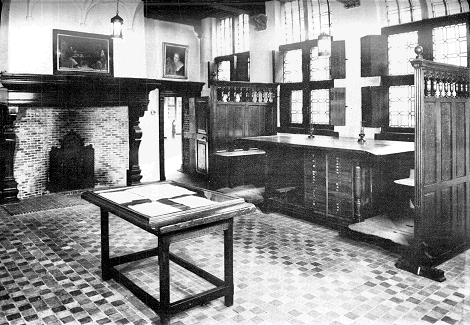 (30) Opposite: Proof-readers' room in the Plantin house. On the large table against the wall the sheets for correction were spread out. The readers sat on the benches fixed to the partitions.
| ||||||||||||||||||||||||||||||||||||||||||||||||||||||||||||||||||||||||||
[pagina *30]
| ||||||||||||||||||||||||||||||||||||||||||||||||||||||||||||||||||||||||||
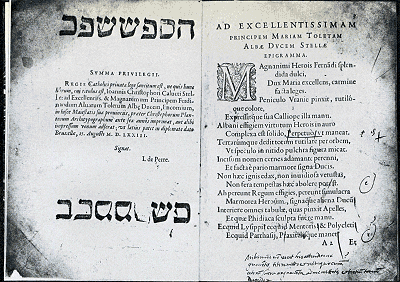 (31) Top: Joannes Christophorus Calvete de Stella, Ad ... Ferdinandum Alvarum Toletum Albae Ducem Encomium, 1573: page-proof with corrections by the readers (A 328). The Hebrew letters on the left-hand page were used as quadrats (see also plate 32). After correction they would have been replaced by quadrats. The ‘summa privilegii’ is a typical example of the way in which privileges were reproduced in Plantinian texts. Apart from these page-proofs in A 328 there is no other known copy of this eulogy of Alva by Calvete.
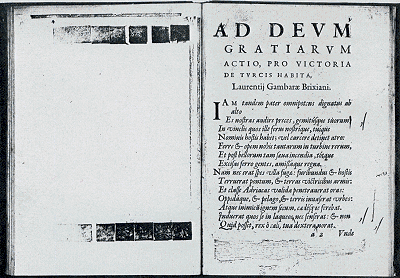 (32) Bottom: Laurentius Gambara, Ad Deum gratiarum actio, pro victoria de Turcis habita, 1572: page-proof with corrections by the readers (A 328). The empty space on the left-hand page where the quadrats were left projecting was probably meant for the text of the privilege (see also plate 31). These proofs are the only known copy of Gambara's eulogy.
| ||||||||||||||||||||||||||||||||||||||||||||||||||||||||||||||||||||||||||
[pagina 193]
| ||||||||||||||||||||||||||||||||||||||||||||||||||||||||||||||||||||||||||
to the chapel when they entered the firm's service,Ga naar voetnoot1. but their official relationship to this association of the pressmen and compositors was confined to this entry fee. Later ordinances enjoined a respectful mode of address to the proof-readers,Ga naar voetnoot2. but complaints and grievances could be uttered in their presence as they were in no sense outsiders.Ga naar voetnoot3. Although treated with respect and recognized as members of the workers' community in the Plantinian house, they remained completely outside the chapel. However, when the sick fund was reorganized in 1653, they were allowed to join the scheme, but as individuals.Ga naar voetnoot4. Not until 1664 did the proof-readers feel the need to form themselves into an association. On 22nd October of that year Maximilianus a Principe, Ignatius Coppens, Joannes Blanckaert, and Antonius Martinus de Coninck signed the rules and articles of the confrérie or Concordia inter correctores typographiae Plantinianae with the motto ‘DVLCIs ConCorDIa Vera CharItate ConstrICta’.Ga naar voetnoot5. However, unlike the chapel, which fulfilled an important and social function in the firm as a trade union and sick fund, the Concordia was little more than a convivial club for the proof-readers. Its immediate purpose remained restricted to saving for and organizing an annual two-day celebration which normally began on 18th October, the feast day of St. Luke, patron of the Antwerp printers.Ga naar voetnoot6. Also unlike the chapel, membership of which was obligatory and a condition of employment, joining the Concordia was optional - in fact a number of later proof-readers remained outside it. |
|