

The Golden Compasses
(1969-1972)–Leon Voet– Auteursrechtelijk beschermd
The History of the House of Plantin-Moretus
[pagina 279]
| |
Chapter 11
| |
[pagina 280]
| |
never published.Ga naar voetnoot1. What happened to the manuscripts of works which did reach the press is a matter for surmise. Some may have been returned to their authors,Ga naar voetnoot2. although this may not have been normal practice.Ga naar voetnoot3. The majority of manuscripts were probably thrown away once they were of no further use; most of them would have been decidedly well-thumbed by the time the compositors had finished with them. The extant manuscripts often make great demands on the palaeo-graphic skills of the present-day expert. The compositors of the time were naturally more familiar with the handwriting of their contemporaries, but even they often found it hard to make sense of some of the scrawls with which they were confronted, or of additions and corrections scribbled in margins or between the lines. In the case of | |
[pagina 281]
| |
the Promptuarium Latinae linguae, 1564, Plantin had to pay his compositors the appreciable bonus of 3 fl. for the trouble they had had ‘because of the words added to the copy’.Ga naar voetnoot1. On another occasion it was Plantin himself who complained to Arias Montanus about a medical treatise, in Spanish, which the latter had passed on to him, a work by the physician Simon a Tovar, and so badly written that Plantin was afraid he would have to call in other doctors to clear up certain points - all of which would mean extra work and expense.Ga naar voetnoot2. In this manuscript it was the medical terms which presented the most difficulty, but for any text in a language and handwriting unfamiliar to the compositors and proof-readers it was advisable to provide a clearly written transcript to work from, otherwise progress was slow and faults numerous, even in non-technical contexts. The Officina Plantiniana seems to have encountered these difficulties particularly with Spanish texts. Esteban de Garibay, the Spanish chronicler who came in person to Antwerp to supervise the printing of his Compendio historial... de todos los reinos de España, noted in his memoirs that, when he discovered that Flemish compositors were more familiar with French than with Spanish styles of handwriting, he had immediately engaged four copyists to rewrite his manuscript ‘in a French hand’Ga naar voetnoot3. in order to facilitate the work and ensure greater accuracy. In July 1587 Plantin wrote to the friar Vincentius, who was translating Ortelius's Theatrum Orbis Terrarum into Spanish for him, urging him to take great care over the handwriting so that u should not be confused with n, or e with c, t with r, ‘et sic de aliis legi possint maxime in dictionibus nobis ambiguis vel incognitis’.Ga naar voetnoot4. When a text was especially important and had to be reproduced with the greatest precision - if for no other reason than to avoid difficulties with the authorities or influential customers - then Plantin did not hesitate to have a manuscript rewritten, at his own expense if | |
[pagina 282]
| |
necessary. This is what happened with the text of the Antiphonarium of 1571.Ga naar voetnoot1. He often entrusted such tasks to his own proof-readers who were able to earn a few extra guilders in this way, or to ‘freelance’ workers.Ga naar voetnoot2. Many manuscripts sent in by authors for printing were not in fact in their own handwriting, but were the work of professional scribes.Ga naar voetnoot3. The idea behind this was not so much to supply the publisher with a clearly written text, as to provide the author with a copy in case the manuscript went astray. This could happen en route to the publisher, while awaiting the granting of an approbatio and privilege,Ga naar voetnoot4. or in the press itself. The last of these eventualities was not unknown: in June 1589 Jan Moretus had to write in some embarrassment to John Sanderson explaining that because of the illness of Plantin he had not been able to find the mislaid index of Sanderson's Dialectica. If the author insisted on publishing this index he would have to send another | |
[pagina 283]
| |
copy.Ga naar voetnoot1. In the letter to Bishop d'Oignies quoted above, Plantin in fact explained that, with regard to the Antiphonarium, it was not only the desire to have a clearer text that caused him to have the work transcribed, but also the fear that the precious manuscript might be lost.Ga naar voetnoot2.
A publishing printer is not a philanthropist. He decides what texts he can print on the basis of their potential sales. If a work seems likely to reward his efforts, he himself may initiate negotiations to obtain it. In other instances it is the authors who take the initiative while the publisher adopts a more passive role, weighing up all the pros and cons of a proposed publication. This question, whether the publisher or the author takes the initiative, is very important to a proper understanding of the financial relationship between them.Ga naar voetnoot3. It is often maintained that authors' fees were unheard-of in the Renaissance, writers then thinking it beneath their dignity to accept money for their works. Not until the seventeenth century are they supposed to have overcome their diffidence and started to bargain with publishers. It is true that Erasmus and Luther expressed themselves to this effect: Otto Braunfeld found it necessary to come to the defence of Ulrich von Hutten when Erasmus accused that author-knight of having accepted payment from his printer. After the middle of the sixteenth century, however, no more of such apologies were heard. In any case, even in the first half of that century Erasmus himselfGa naar voetnoot4. and others did earn money with their writings, although it was not their publishers who paid them, at least not directly. The dedications to influential persons and institutions - especially if they were wealthy and known to be generous - which | |
[pagina 284]
| |
appeared in the prefaces of books were written with rich rewards in mind, and many an author gave bitter vent to his disappointment when his expectations were not fulfilled. Many, like Erasmus, also did a brisk trade in the free copies they received from the publishers. Others found it by no means beneath their dignity to pen the praises of individuals, institutions, and events in return for cash payments - and no one seems to have thought any the worse of them for this. And there is no disputing the fact that even in the first half of the sixteenth century there are instances in Germany and elsewhere of the payment of actual authors' fees, although the occasions were few and the amounts small. The infrequency of the practice was due not to any qualms on the part of writers, but to the disinclination of the publishers to pay them. Abraham Ortelius himself in his letter of 17th November 1586Ga naar voetnoot1. to his nephew Emmanuel van Meteren made it clear enough that he was not averse to financial rewards. Van Meteren had asked his uncle what fee he should solicit for his history of the revolt of the Netherlands which had caused something of a sensation. Ortelius's letter throws a great deal of light on the question of authors' fees in the Renaissance period, and the cartographer's connexion with the Plantin house makes his comments all the more interesting:
It seems to me that, as far as I have been able to find out in our own days, authors seldom receive money for their books, for they are usually given to the printers, the authors receiving some copies if they are printed. They [the authors] also have some expectation from the dedication through the generosity of a Maecenas or patron, in which they are often and indeed, I believe, mostly disappointed. I have also been present when Plantin had one hundred daelders from an author who wanted to have his book printed. This was Adolphus Occo with his book of medallions. It may be that the printer gave him to understand that the work would not sell well. Then again, when books are costly, as when many pictures have to be made for them, this is commonly charged to the author. Sambucus paid for all the figures in his Emblemata. Plantin has recently accepted a little book that will bring him in 200 guilders. Although it seems to me that authors seldom | |
[pagina 285]
| |
receive money from the printers, as I have said, they do receive some copies. The greatest number I have heard of (and that was after prior agreement) was 100. When Plantin had printed my Synonymia he sent twenty-five [copies] to my house, for which I thanked him very much. What he will do with my Thesaurus (which he is now printing), time will show. Some authors, having seen that their work was beautifully printed, have presented him with a silver bowl. All this having been said, it may be that your opinion will be otherwise, and you will say with truth that none of this is appropriate to your case. For these have all written for their own sakes, and for the indulgence of their minds, and this for a variety of reasons, whether for honour, or the winning of friends or the payment by a patron, or to acquire fame (for which many fools are writing books today). This is not so for you, yours being a work commissioned by others, and is therefore worthy of payment.Ga naar voetnoot1. | |
[pagina 286]
| |
Ortelius makes it clear that sixteenth-century publishers, like those of today, were prepared to pay up when they saw potential profit in a particular book. The story has already been told in Volume 1 of how in order to obtain the sole rights of printing and sale in the Netherlands of the revised missals and breviaries, Plantin contracted to pay the Roman monopolists a royalty of 10 per cent, and how eventually he was able to divest himself of this burden.Ga naar voetnoot1. In 1558, at the beginning of his career, he made an agreement with two Ghent printers, Hendrik van den Keere and Cornelis Manilius, whereby he undertook to supply them with a number of free copies of almanacs, on condition that they refrained from issuing any similar publication.Ga naar voetnoot2. When Plantin judged it desirable to publish a particular work, he did not shrink from the expense and effort involved, and set his own specialists to workGa naar voetnoot3. or recruited learned men for the task.Ga naar voetnoot4. If he | |
[pagina 287]
| |
thought a text suitable, he would pay the author considerable fees in money or in kind to secure it: thirty printed copies for the manuscript of the Summa D. Thomae;Ga naar voetnoot1. 45 fl. in money and 100 copies ‘par achapt de la copie et privilège du roy de France’ to Pierre Savonne for his Instruction et manière de tenir livres de raison, 1567;Ga naar voetnoot2. fifty copies and 81 fl. 6½ st. in other books to Guicciardini on the publication in 1581 of the revised and enlarged reprint of his Descrittione di tutti i Paesi Bassi, and another 150 fl. and a number of copies on the publication of the new Italian edition of 1588.Ga naar voetnoot3. Among the expenses incurred in the publication of the Nomenclator Hadriani Junii, 1567, was the item, ‘To Master Hadr. Junius, 3 nights' lodging, 4 meals and 6 Flemish ells of velvet.’Ga naar voetnoot4. In 1572 Molanus received the sum of 20 fl. for the amended text of the Horae B. Mariae Virginis, which he had also supplied to Plantin's rival P. Bellerus.Ga naar voetnoot5. The scholars who collaborated on the Polyglot | |
[pagina 288]
| |
Bible received presents paid for partly by Philip ii, partly by Plantin.Ga naar voetnoot1. Considerable amounts were also paid out for the Opera S. Augustini.Ga naar voetnoot2. Sometimes authors' expenses were wholly or partially made good.Ga naar voetnoot3. On other occasions, as in the case of Ortelius quoted above, Plantin paid only in kind, giving authors fairly large quantities of their books - which of course they were able to sell.Ga naar voetnoot4. As already seen earlier Abraham Ortelius was very grateful to his publisher for the twenty-five copies of his Synonymia. In 1566 A. Hunnaeus received 200 copies of his Dialectica; John Joliffe in 1563 had 100 copies ‘pour la copie et privilège de 6 ans’ of his Responsio ad articulos Anglorum; Dodonaeus was given 50 copies of his Frumentorum historia of 1565; Lobelius in 1581 was paid with 80 copies of his herbal.Ga naar voetnoot5. Scholars who edited or prepared commentaries on Classical authors were occasionally remembered with books or small sums ‘en recognoissance de ses labeurs’.Ga naar voetnoot6. These remunerations, however, were restricted to works where Plantin, confident of a market, had himself initiated publication. | |
[pagina *47]
| |
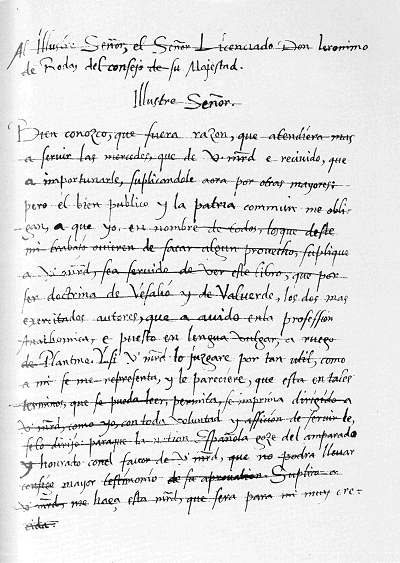 2) Page from the manuscript of Vivas figuras del pso humano with the dedication to Jeronimo de Roda. his dedication was crossed out-quite understandably. Ant werp, where he had continued to work tor the restoration of Philip ii's authority. He bore most responsibility for the ensuing Spanish Fury and as such was one of the most hated persons in Antwerp(cf. plate 53).
| |
[pagina *48]
| |
 | |
[pagina *49]
| |
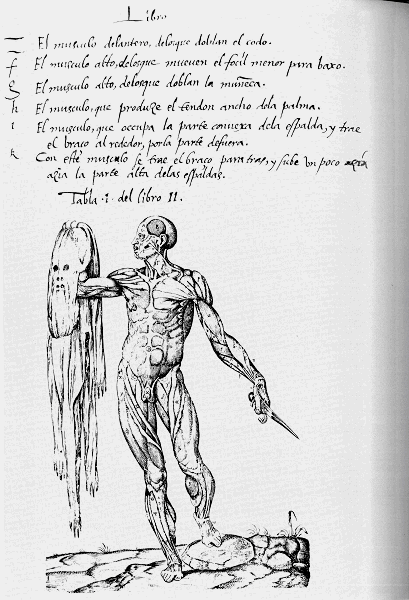
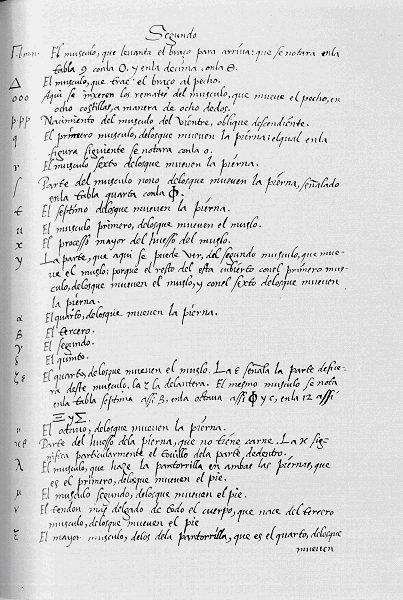 (53) Vivas figuras del cuerpso humano, a series of 42 anatomical plates with explanatory text, by Vesalius and a concise medical exposition by Jacques Grevin. In fact it was an adaptation in Spanish of the Vesalius-Valverde Vivae imaginespartium corporis humani, published by Plantin in 1566. At the end of the manuscript comes the handwritten approbatio of the Antwerp censor Silvester Pardo, dated 28 April 1576. It was not printed, no doubt because of the disturbances during the Spanish Fury of 4 November 1576.
| |
[pagina *50]
| |
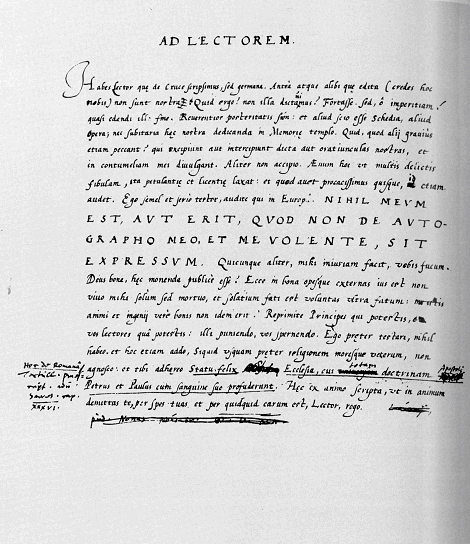 (54) Handwritten foreword to Justus Lipsius's treatise, De cruce libri tres (Arch. 1150 a, fo 21). A copyist wrote out this text in a clear hand for the printer. Lipsius corrected it and made a few alterations (see also plates 55 & 56).
| |
[pagina *51]
| |
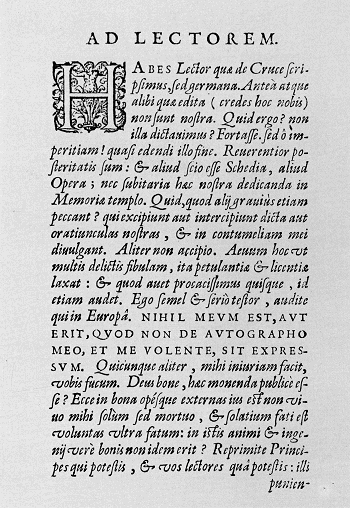 (55) Text of the foreword to Lipsius's De cruce libri tres (cf. plate 54) as printed in the first edition, 1594. See also plate 56 overleaf.
| |
[pagina *52]
| |
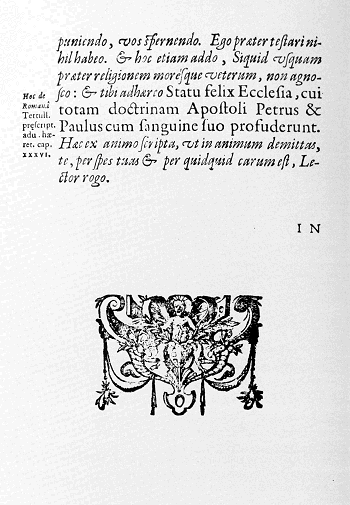 (56) Conclusion of the foreword to De cruce libri tres as it was printed. See also plates 55 & 54.
| |
[pagina *53]
| |
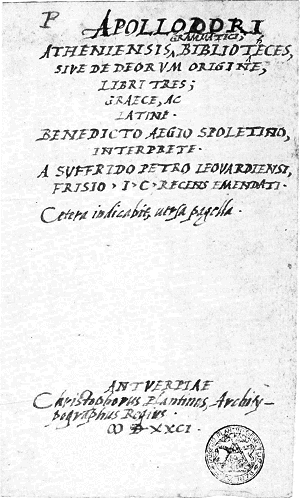 (57) Title-page design for an edition of Apollodorus of Athens (Greek text with Latin translation), 1581 (R. 19.36). The work was not printed. See also plate 58.
| |
[pagina *54]
| |
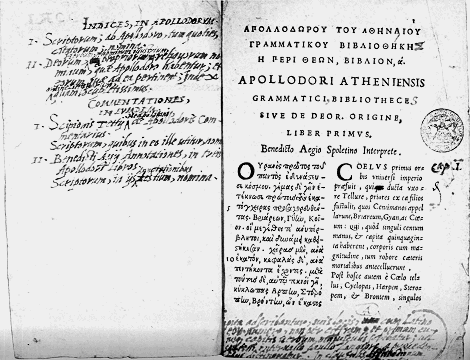 (58) Opposite: First page of the projected edition of Apollodorus of Athens, 1581. The text used as a basis was an earlier printed edition (Rome, Antonius Bladus, 1555) with a few slight revisions. On the left is the handwritten contents table; right, the first page of the text with a few amendments and a note at the bottom to the compositors. The work was not published by Plantin: it is quite likely that he did not take the initiative in the matter but received the manuscript, including title-page, ready for press from the scholar responsible. One indication of this may be the unusual address (cf. plate 51): Plantin was no longer using the title ‘architypographus regius’ in 1581 because of the political circumstances.
| |
[pagina 289]
| |
Plantin approved, he would consider giving a present of some kind or copies of the printed work in return for the manuscript.Ga naar voetnoot1. In the majority of cases, however, translations were commissioned by Plantin. Translation is a relatively mechanical process, but in comparison with a great deal of more original work, reasonable fees have to be paid for it. Plantin and his contemporaries had to be prepared to spend their money if they wanted to publish a translated work.Ga naar voetnoot2. A letter from Jan Moretus to someone who was offering his services as a translator shows that fees were reckoned on the basis of the number of quires to be translated and the size of the type used.Ga naar voetnoot3. Another item which publishers sometimes had to arrange and pay for was the compilation of tables and indexes; this work might be | |
[pagina 290]
| |
done either by the officina's own proof-readers for extra money, or outside the house.Ga naar voetnoot1. Here again Plantin only went to this expense for books the publication of which he had himself initiated, or in which he was greatly interested in some way. In other cases the authors had to see to indexes and tables themselves.Ga naar voetnoot2. Although it is clear that fees for authors, editors, and others who collaborated on texts for publication, were not entirely unknown in the second half of the sixteenth century, for such a large concern as the Officina Plantiniana the list of payments is neither long nor impressive.Ga naar voetnoot3. One of the reasons for this was of course the fact that publishers, then as now, tried to keep their costs as low as possible; and in those days large editions with their correspondingly big returns were not known. But there was another and more compelling reason for this apparent cupidity on the part of publishers, namely the ease and impunity with which works could be and were pirated. As already described in more detail,Ga naar voetnoot4. printers (or authors) were obliged to ask the authorities for a ‘privilege’ which gave them a monopoly of sale of a particular work. However, these privileges were of short duration (generally six years) and were valid only for a limited area: in Plantin's case the Netherlands. There was nothing at all to stop a publisher outside the area from reprinting a work as soon as it appeared and thus playing havoc with the market.Ga naar voetnoot5. In his later | |
[pagina 291]
| |
years Plantin frequently complained about these unethical practices and was at pains to point out that he only issued reprints with the permission of the author and the first printer.Ga naar voetnoot1. In fact Plantin in his early years had been guilty of what the older Plantin condemned.Ga naar voetnoot2. A large proportion of his early publications were reprints of books recently issued in Paris or Lyons, which he then sold mainly in France. As late as 1565, Guillaume de Roville (or Rouillé) asked Plantin most emphatically not to reprint L. Roussart's Corpus juris civilis, which had been published by de Roville at Lyons, as an improved edition was in preparation: ‘Si vous me faictes ce plaisir, je vous en pouveray faire ung autre quelque autrefoys.’ However, Plantin's reprint was already under way and was issued a few months later; by an agreement dated 10th October 1565 one of de Roville's competitors at Lyons had contracted to take 625 copies of the Plantinian version.Ga naar voetnoot3. In these cases of legitimate or pirate reprints, the only extra costs for the second printer lay in the purchase of a few copies of the work in question. Examples are the three copies for 12 fl. of the Roman | |
[pagina 292]
| |
edition which served as a model for Plantin's 1566 publication of the Vivae imagines partium corporis humani by Vesalius and Valverda;Ga naar voetnoot1. two copies, at 2 fl. 14 st., of the Manutius edition of the Opera Ovidii - ‘et en a esté rompu un pour la composition et 1 baillé à Mre. Victor’;Ga naar voetnoot2. four copies at 1 fl. 6 st. of the Colloquia Erasmi;Ga naar voetnoot3. two copies at 2 fl. 2 st. of a Latin Bible.Ga naar voetnoot4. For a careful publisher like Plantin there might also be the cost of correcting or partially re-editing the text.Ga naar voetnoot5. Faced with unfair practices such as these, publishers naturally played safe and did not invest large sums of money in books from which others could reap the financial benefits. This not only meant that authors' interests and desires were subordinated to financial considerations, but that publishers themselves thought twice before putting money into the production of new works, however worthwhile. A study of the list of books in which Plantin invested fairly substantial amounts of money in the form of fees and other extra expenses conveys the impression that in many instances he had taken the problem of pirating into account. Many of these works were aimed at a regional market where Plantin's monopoly could be guaranteed by a privilege.Ga naar voetnoot6. Others were so extensive,Ga naar voetnoot7. required such specialized equipment,Ga naar voetnoot8. or were so lavishly illustrated,Ga naar voetnoot9. that very few publishers would have been capable of issuing anything comparable. While Plantin published many works on his own initiative, even more manuscripts were offered to him by authors. The number chosen was of necessity small. To Jacobus Strada, an Italian resident in Vienna who had put a whole library of propositions before him, Plantin explained that he had to turn down half of what was offered | |
[pagina 293]
| |
him.Ga naar voetnoot1. The percentage rejected must in fact have been much greater. A considerable proportion of the letters from Plantin and his successors to authors consisted of carefully worded refusals of manuscripts.Ga naar voetnoot2. Plantin could afford to be fastidious when so many texts were offered him. Sometimes, however, his attitude was determined by other than purely commercial factors. Living in troubled times, he had to give influential patrons their due. In a letter to d'Assonleville, president of the Privy Council at Brussels, Plantin hints plainly enough that he had only printed and published a small work by the younger d'Assonleville in order to oblige his powerful father.Ga naar voetnoot3. Granvelle's influence had much to do with the fact that Plantin published many books and commentaries by Italian writers, such as Orsini and Viperano, especially in the years 1567-76. These editions were generally profitable - Granvelle had a discerning eye in these matters - but it is unlikely that Plantin would of his own accord have burdened himself with the endless negotiations and misunderstandings which the long and difficult lines of communication with Italy then entailed. It is equally clear that Plantin was not in a position to risk offending his partner Goropius Becanus when the latter wanted to have his Origines Antwerpianae printed on the firm's presses, although Plantin had little enthusiasm for the project.Ga naar voetnoot4. Generally speaking, however, Plantin seldom had to take any but strictly financial arguments into consideration when deciding whether or not to print a work that had been offered him. If authors were willing to pay all the costs of printing and publishing | |
[pagina 294]
| |
their work, then of course few objections, if any, were raised. Plantin simply produced a written estimate of costs and on this basis a contract might be signed.Ga naar voetnoot1. In such cases the authors usually demanded their full pound of flesh, namely the whole printing. Plantin complained that Garibay left him not a single copy of his Compendio.Ga naar voetnoot2. He made a similar remark about Navarrus's treatise Enchiridion sive manuale confessariorum.Ga naar voetnoot3. Garibay's history of Spain was not in fact printed in the Gulden Passer: Plantin's own presses were fully taken up with breviaries and missals for Philip ii. However, as Garibay appeared willing to pay the entire cost of publication, Plantin subcontracted the work to another printer. He became very careful only when he himself had to finance the affair, either wholly or in part. In a politely worded letter of 28th April 1589, Plantin informed Cornelis Schultingius that, as this author had not asked for a fee (a ‘merces pecuniaria’) for his work, he, Plantin, would find someone to advance the necessary money for its publication.Ga naar voetnoot4. For reasons that have not been established, the work did not appear, but Plantin had obviously approved of it and that is why he had personally undertaken to obtain a loan. The agreement would probably have included a number of free copies for the author. Very few authors received such favourable treatment. Mostly they had to be ready to spend a good deal of money if they wanted to see their books printed and published by Plantin's press. Details of the agreements varied from book to book, but all were based on the same principle: authors had to contract to take a certain number of copies of the printed work at trade price. Often they were requested | |
[pagina 295]
| |
to pay for these in advance. In this way Plantin not only safeguarded himself against poor sales but also obtained money to buy paper and pay his workmen. Thus it was that Plantin told the Italian Valverdius that he was prepared to publish his work provided he took 300 copies, to be paid for in advance.Ga naar voetnoot1. One hundred copies were sufficient in the case of the ‘Poesies’ (Laudes illustrissimae Hieronymae Columnae) of Adriaan Burchius; in his letter of 22nd January 1582 to this author, Plantin explains somewhat apologetically that he had had to make the same kind of arrangement with Ranzovius, Livinus Torrentius, Sambucus ‘and some others’.Ga naar voetnoot2. In a letter of 18th July 1586 to the Polish ambassador, who had been acting on behalf of the Jesuit theologian Laurentius Arturus Faunteus of Posen, the figure of 500 copies is quoted together with a down payment of 150 fl. The balance was to be paid as soon as the printing was completed.Ga naar voetnoot3. Plantin's accounts afford many other examples. Even his revered friend Arias Montanus had to contribute towards the publication of several of his works; he paid the sum of 200 fl. for the Elucidationes in omnia Sanctorum Apostolorum scripta of 1588, receiving fifty copies of the book. The influential and powerful Elbertus Leoninus had to pay half the cost of printing his Centuria Consiliorum, 1584 (600 fl.) and received 360 copies. Serranus paid 200 fl. and received 186 copies of a total edition of 300 of his Commentaria in Levitici librum, 1572, which had cost Plantin 240 fl. 18 st. Mameranus had to take 400 out of a printing of 500 copies of his Epithalamia Alexandri Farnesi et Mariae a Portugallia, 1566. Aitzinger contributed 100 fl. towards his Pentaplus regnorum mundi, 1579, and A. Occo 150 fl. for his Imperatorum Romanorum numismata, 1579.Ga naar voetnoot4. | |
[pagina 296]
| |
Occasionally the procedure was varied. On 14th July 1583 Plantin concluded an agreement with Godescalcus Stewechius in which the printer stated that he had received ‘quatorze doubles ducats d'Espagne et ung escu au soleil’, the equivalent of 100 fl. 7 st., ‘pour aide de l'impression de Vegece avec ses Commentaires et figures’ (Flavius Vegetius, De re militari, 1585). Plantin undertook to pay this amount all back when the copies of the book in question had been sold. The sum could if necessary be covered by Stewechius taking copies at trade price (‘au prix qu'ils se vendront aux libraires’).Ga naar voetnoot1. Practically all the composers who had their music published by Plantin had to contract to take a considerable proportion of the edition. However, when it came to settling their accounts, this class of client was not always scrupulous in fulfilling obligations.Ga naar voetnoot2. Authors did not always negotiate in person. In his will, Ludovicus Hillessemius stipulated that his Sacrarum antiquitatum monumenta should be printed by Plantin. His heirs complied and started negotiations with the printer which led to an agreement whereby they took 150 copies of the edition.Ga naar voetnoot3. The heirs of Becanus took 50 copies of their kinsman's posthumously published Opera omnia.Ga naar voetnoot4. There were occasions when Plantin had to employ more subtle procedures. He might want to publish a certain work that was going to be too costly for him to finance by himself, while there was no question of enlisting the aid of the author, either because the latter was not willing to pay, or because there was no author in the ordinary | |
[pagina *55]
| |
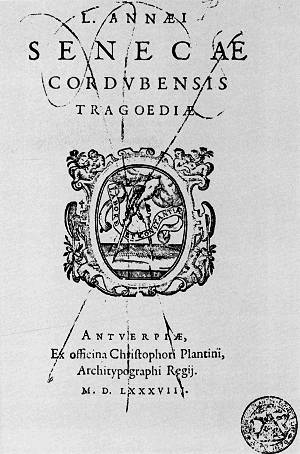 (59) Seneca's Tragoediae prepared for press (R.19.35) with a title-page already set and printed, but crossed out as it was finally substituted for another (cf. plate 61).
| |
[pagina *56-*57]
| |
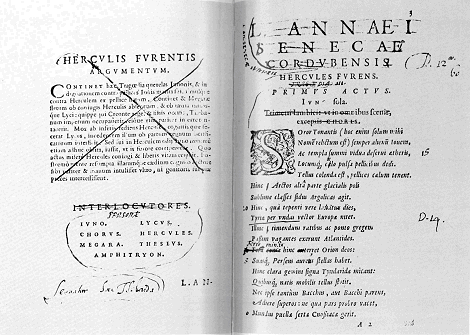 (60) Seneca's Tragoediae, pages 2 and 3 prepared for press. Page 2 (verso of the title-page) certainly printed in the Plantin press, but page 3 and the following pages belong to the French or Italian edition that must have served as model. The corrections are in the hand of the editor, Frans Raphelengius the Younger, grandson of Plantin. The last printed page (455), with the privilege in Plantin's name, was also printed in the Officina Plantiniana. The title-page (plate 59) is dated 1588. The work appeared only a year later, in 1589, and differs entirely in arrangement from the 1588 ‘paste-up’.
| |
[pagina *58]
| |
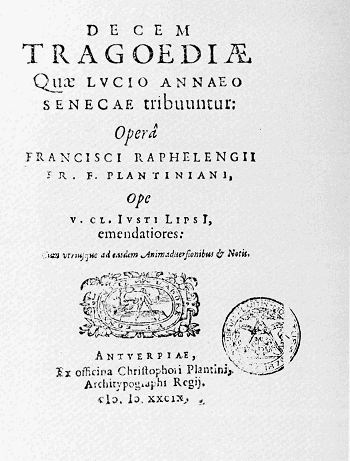 (61) Title-page of the Decem Tragoediae attributed to Seneca, published by Plantin in 1589 (R. 4.37). The title-page designed in 1588 was completely altered and the format changed from octavo to 16mo.
| |
[pagina *59]
| |
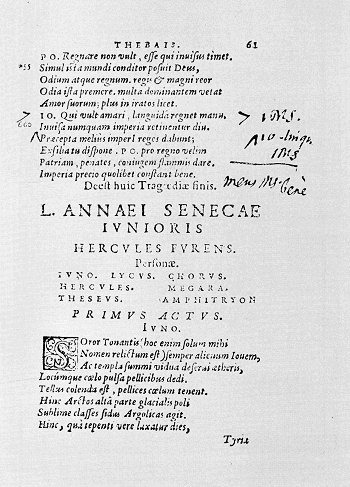 (62) Page from the Decem Tragoediae, 1589. Comparison with the projected layout of 1588 (plate 60) shows that the corrections and changes made there were incorporated, but the order of the plays was altered. Hercules furens, the first piece in the 1588 arrangement, was moved to third place after Medea and Thebais.
| |
[pagina *60]
| |
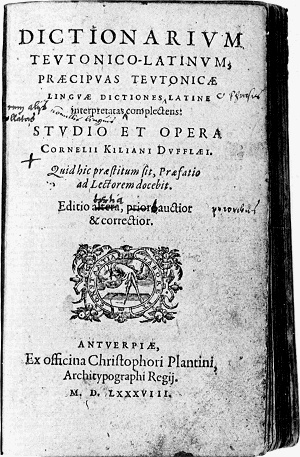 (63) Title-page of Cornelis Kiliaan, Dictionarium Teutonico-Latinum, 1588, prepared for the 1599 edition (R. 55.13). The emendations are in Kiliaan's own handwriting.
| |
[pagina *61]
| |
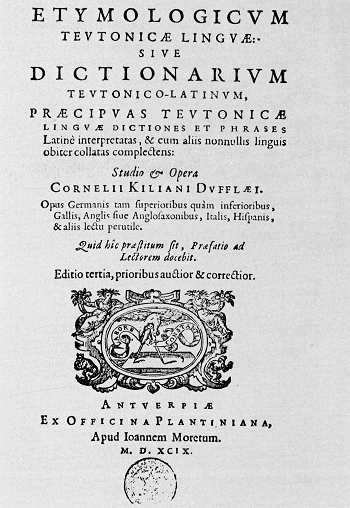 (64) Title-page of Kiliaan, Etymologicum Teutonicae Linguae sive Dictionarium Teutonico-Latinum, 1599 (A. 835). This was an augmented and revised edition of the Dictionarium Teutonico-Latinum, the second edition of which appeared in 1588. Kiliaan's sketch (see plate 63) was largely followed, but with a few additions, including alteration of the title itself.
| |
[pagina *62]
| |
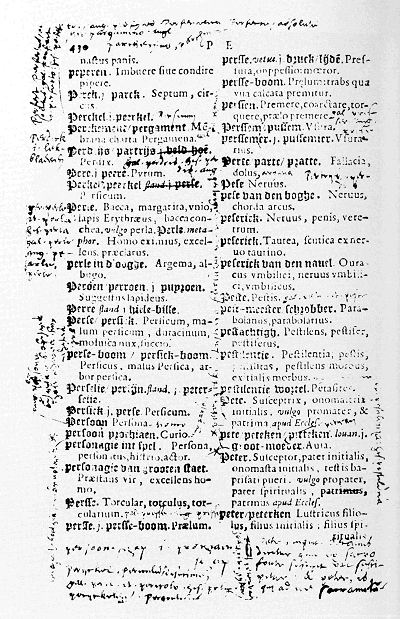 (65) Page from Kiliaan, Dictionaruim Teutonico-Latinum, 1588 (see plate 63), with additions and notes by the author.
| |
[pagina *63]
| |
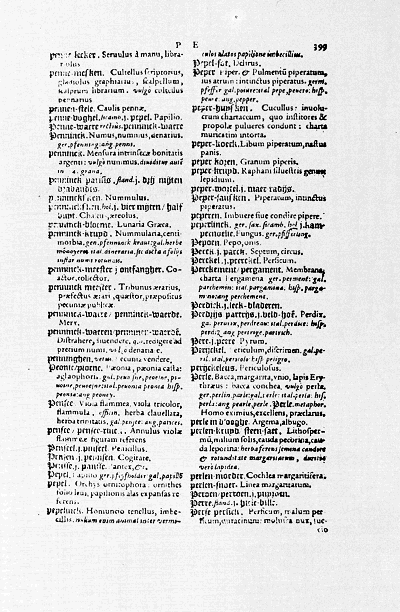 (66) Page from Kiliaan, Etymologicum Teutonicae Linguae, 1599 (see plate 64). The additions and corrections Kiliaan marked in a copy of the 1588 edition (see plate 65) were largely incorporated in the new edition.
| |
[pagina *64]
| |
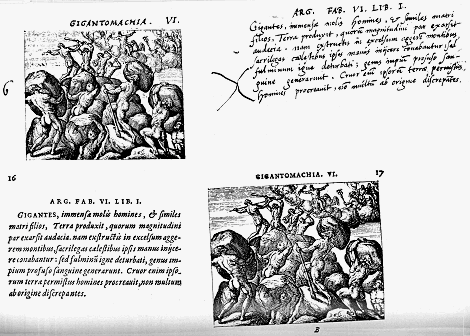 (67) Top: Manuscript prepared for press (M. 257); page with illustration and text for an edition of Ovid's Metamorphoses. The illustrations were pasted into the appropriate pages. See also plate 68.
(68) Bottom: Page from Ovid's Metamorphoses of 1591 (R. 5.34). This corresponds with the laid-out manuscript page shown in plate 67, but text and illustration have been transposed. | |
[pagina *65]
| |
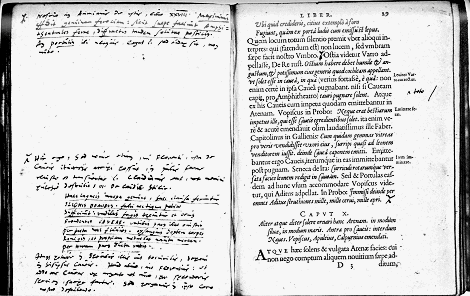 (69) Justus Lipsius, De amphitheatro liber, Antwerp (actually printed at Leiden), Plantin, 1585 (A. 1573) The author's corrections and additions are on the interleaved pages of this copy, in preparation for the reprint that appeared in 1598.s
| |
[pagina *66]
| |
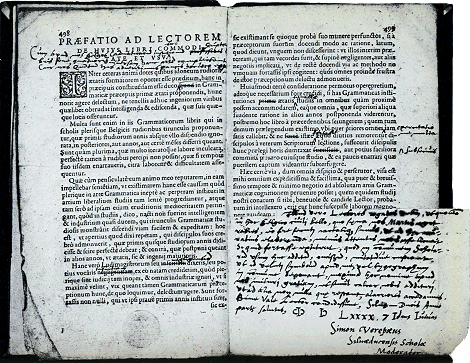 (70) Simon Verepaeus, Epitomes novae Grammatices Despauterianae liber quintus, 1578 (R. 13.29). Spread with a foreword to the reader. Revisions made by the author for the new edition of 1590.
| |
[pagina 297]
| |
sense. In these circumstances, Plantin sometimes entered into agreements with other printers,Ga naar voetnoot1. but often he ventured out alone, trying to prise subsidies from individuals or groups who were favourably disposed to the publication of the work. Plantin's masterpiece, the Polyglot Bible, came into being in this way. So did other extensive works: Plantin's last large-scale publication, his reprint of the Martyrologium Romanum, 1589, which he issued with the permission of its author, Cardinal Baronius, was made possible by money advanced by church authorities in the Southern Netherlands.Ga naar voetnoot2. Nearly twenty years earlier Plantin had managed to persuade Gilbert d'Oignies, bishop of Tournai, to subsidize his publication of two very large works, the Psalterium of 1571 and the Antiphonarium of 1572.Ga naar voetnoot3. Another grandiose plan, the publication of an equally enormous Graduale, would have required even greater financial assistance. At the synod of Louvain on 14th November 1574, Plantin's proposals were put forward, presumably through the intermediary of Maximilian Morillon, who was vicar-general in the Netherlands of Cardinal Granvelle, archbishop of Marines. The plan was that the abbots of the archdiocese should each subscribe to a fund for the publication of the Graduale. The abbot of Averbode would contribute 500 fl., his colleague at Perk 400 fl., the abbot of St. Peter's, Ghent, 1,000 fl., and so on. As security for the repayment Plantin offered to pledge books to each subscriber to the value of his contribution, or to guarantee the total sum invested with the estimated 15,000 fl. worth of books he had stored at the Carmelite monastery in Antwerp.Ga naar voetnoot4. The abbots, however, do not seem to have favoured the scheme and it was not even started. For the rest, the relationships between Plantin and his authors were characterized by the usual troubles and muddles that have plagued the | |
[pagina 298]
| |
publishing world through the centuries. There were arguments about size of editions, choice of type, design of title-pages, and related problems.Ga naar voetnoot1. Fastidious clients sometimes gave very detailed instructions about the placing of the various elements of their texts or of the illustrations.Ga naar voetnoot2. Authors often complained bitterly about the number of faults that appeared in their books, to which the printer would retort that they themselves were to blame, their manuscripts being so careless. Plantin replied in this vein to Jacobus Cruquius,Ga naar voetnoot3. to Jacobus Pamelius,Ga naar voetnoot4. and to Latomus.Ga naar voetnoot5. P. Serranus even received a long letter in which all the mistakes and ambiguities in his manuscript were listed one by one.Ga naar voetnoot6. On another occasion Plantin expressed himself rather more carefully. In writing to the mighty bishop of Arras, F. Richardot, Plantin magnanimously divided responsibility for errors between the shortcomings of the manuscript and those of his own workpeople (‘soit par nous soit par l'exemplaire’) and humbly promised to have a separate page of errata printed: ‘s'il luy plaist me les [i.e., the errors] faire sçavoir, je les imprimeray très volontiers en quelque feillet pour les concoudre aux livres imprimés’.Ga naar voetnoot7. Plantin chose his words with equal care in letters to Granvelle concerning mistakes in manuscripts submitted by protégés of the cardinal.Ga naar voetnoot8. | |
[pagina 299]
| |
Corrections and alterations were sent in at the last minute.Ga naar voetnoot1. Parts of texts such as prefaces and tables arrived late,Ga naar voetnoot2. which caused printing to be postponed as the censors and other officials concerned with the issuing of privileges needed to have the full text before pronouncing their verdicts - and these setbacks would in turn move authors to sarcasm.Ga naar voetnoot3. Most of the disputes between publisher and authors in fact had their origin in delays and postponements of this sort. Every writer, then as now, expected his manuscript to be printed immediately and offered without delay to the waiting world. Sometimes the publisher had quite different problems on his mind - although it could sometimes happen that he himself was at fault through sheer forgetfulness. In a letter of 7th July 1567 Plantin asked Pierre Porret in Paris to offer his ‘recommendations et excuses’ to the writer and physician Jacques Grévin because publication of his Deux livres des venins had been so long delayed ‘faute de papier, dont grâces à Dieu j'espère doresnavent avoir assés’.Ga naar voetnoot4. Grévin must have accepted the delay philosophically, for there is no trace of any protest on his part. Monsigneur Monsieur de Pimpont, conseiller du Roy à Paris proved more choleric, although it must be said that he had some reason to be angry. In a letter dated July 1571 Plantin itemized the long series of setbacks that had held up publication of that learned jurist's commentaries on Virgil: it had taken a long time to obtain the approbatio and privilege and there had been difficulties in obtaining suitable paper; when at last it was possible to make a start the compositor had died of the plague (‘de la maladie hastive’) and Plantin had not been able to get permission from the | |
[pagina 300]
| |
royal supervisors to replace him with another man who was working on the service books for Philip ii.Ga naar voetnoot1. Whether this catalogue of disasters corresponded exactly with reality is another matter. At all events Plantin forgot to mention another factor of delay. For lack of transport, Egidius Beys, his representative in Paris, had been very tardy in dispatching the manuscript to Antwerp.Ga naar voetnoot2. De Pimpont demanded his manuscript back and became even more irate when its return was delayed through a combination of circumstances which were also carefully set out in Plantin's letter of July 1571. De Pimpont's wrath eventually subsided. Possibly he suffered even worse things with Parisian printers. Three years later, in 1574, the manuscript was once more entrusted to Plantin and finally appeared in print in the following year. Only one important difference emerges from a comparison of author-publisher relations in the sixteenth century and today: in Plantin's time authors seldom corrected the proofs themselves.Ga naar voetnoot3. This task was normally allotted to proof-readers in the house.Ga naar voetnoot4. It was not that Plantin did not trust writers with this work, nor that the latter were loth to do it. It was simply the printing technique of the time which forbade it: books were printed sheet after sheet and the type immediately distributed to be used again. Only if an author lived in Antwerp, or was temporarily present in the city, was it sometimes possible for him to correct the proofs in person.Ga naar voetnoot5. Precise scholars | |
[pagina 301]
| |
were even known to journey to Antwerp especially for this purpose.Ga naar voetnoot1. .However, sheets were sent to authors or others concerned as soon as printed so that errata lists could be compiled when necessary.Ga naar voetnoot2. |
|