

'Gaps and Parasatic Gaps'
(1984-1985)–Hans Bennis, Teun Hoekstra– Auteursrechtelijk beschermd
[pagina 29]
| |||||||||||||||||||||||||||
Gaps and parasitic gaps Ga naar voetnoot*Hans Bennis
| |||||||||||||||||||||||||||
1. IntroductionRecently, the phenomenon of parasitic gaps has become one of the most widely discussed topics in generative grammar. Their relevance to linguistic theory derives on the one hand from their systematic distribution, as pointed out by Engdahl (1983), and on the other hand from the fact that their appearance is so peripheral that ‘it is highly unlikely that new and independent principles need be invoked’ to determine their distribution ‘or that rules of particular grammars are involved’ (Chomsky 1982, 39). In Some Concepts and Consequences (Chomsky 1982), it is demonstrated that the distribution of parasitic gaps in English can in fact be made to follow from independent principles of Government and Binding Theory, without any stipulations specific to parasitic gaps. In this paper, the distribution of parasitic gaps in Dutch is investigated. It will be demonstrated that this distribution varies quite substantially from the distribution in English. Given the distribution in English. Given the reasoning above, this difference should follow from independently existing differences between the two languages. As we shall show, this is in fact the case. This demonstration requires a discussion of the distribution of gaps in general. In section 2, we provide an account of the distribution of gaps in terms of a general principle, which we call the Gap Condition. This condition, which is modeled on Kayne's (1984) Connectedness Condition, replaces the Standard ECP of Chomsky (1981). In section 3, it is demonstrated that the Gap Condition adequately accounts for differences with respect to P-stranding in Dutch and English. Section 4 illustrates the application of the Gap Condition to parasitic gap constructions in English. These three sections provide the background for the discussion of parasitic gaps in Dutch in section 5. This is the heart of the paper. In 5.1 it will be seen how the Gap Condition explains the much more restricted | |||||||||||||||||||||||||||
[pagina 30]
| |||||||||||||||||||||||||||
distribution of parasitic gaps in Dutch compared to English. In 5.2 we discuss the surprising phenomenon of gaps which have all the properties of parasitic gaps except for the apparent absence of a licensing gap. We shall argue that there is in fact a licensing gap and explain why this particular phenomenon can be found in an OV language like Dutch, but not in a VO language like English. The relevant difference will be seen to have various ramifications, including a difference in transparency of Exceptional Case Marking constructions. | |||||||||||||||||||||||||||
2. Connectedness2.1. Kayne's g-projectionMuch research in generative grammar has been directed towards restricting the class of possible transformational operations. While these restrictions used to be formulated on the application of transformational rules themselves, most of these restrictions are formulated within recent Government and Binding Theory as well-formedness conditions on representations. Among these restrictions is the Empty Category Principle (ECP), which limits the distribution of traces left by movement by requiring that the empty category resulting from movement be locally identified by a proper governor. The ECP, formulated in (1), distinguishes two different kinds of proper governors.
(1) ECP An empty category A must be properly governed by either a. a category [± N, ± V] (or INFL), or b. a local antecedent
The primary motivation for the ECP lies in subject/non-subject asymmetries of the kind illustrated by the examples in (2). The contrast in grammaticality follows from the ECP if it is assumed that the subject is governed by INFL and that INFL in English does not qualify as a proper governor.
(2) a. Who do you think that Bill likes e b. *Who do you think that e likes Bill
(3) I wonder who e likes Bill
The empty category in (2a) is licensed by the ECP because it is governed by the lexical element like. The empty category in (3), although it is not | |||||||||||||||||||||||||||
[pagina 31]
| |||||||||||||||||||||||||||
properly governed by a lexical category, is licensed by virtue of being governed by a local antecedent, who in COMP. Many similar examples of subject/non-subject asymmetries, supporting the formulation of the EGP in (1), can be found in the literature. The ECP thus has two separate ways of licensing an empty category, a local lexical governor and/or a local antecedent. It has frequently been noted that this is in fact an unnatural combination. On the one hand, the requirement for a trace to have an antecedent follows from its very nature of being a trace. On the other hand, Kayne demonstrates that the notion of a local lexical governor makes the wrong predictions in cases like (4), where the empty category has a local lexical governor in both cases, i.e. the preposition of. Hence, the ECP predicts that they should both be grammatical.
(4) a. Which actress do you think that John likes pictures of e b. *Which actress do you think that pictures of e turn Bill on
The standard ECP thus meets with both conceptual and empirical problems. Kayne therefore proposes to replace the ECP in (1) by a condition which collapses (a) and (b) in (1) in a conceptually more attractive fashion. This condition is concerned with the relation between the gap and the antecedent, which must constitute a g-projection as defined in (5).
(5) Y is a g-projection of X iff a. Y is a projection of X (in the usual sense of X-bar theory) or of a g-projection of X or b. X is a structural governor and Y immediately dominates W and Z, where Z is a maximal projection of a g-projection of X, and where W and Z are in a canonical government configuration.
The ECP is thus replaced by the requirement that the gap and the antecedent be connected by a g-projection. The definition of g-projection mentions the notion of canonical government configuration. This is a linear requirement on the relation between maximal projections on the path from the gap to the antecedent and its sister. The order of these is determined by the relative order of the verb and its object; i.e. in a VO language like English the canonical government configuration requires that maximal projections on the path be on a right branch. The canonical government requirement is not a local requirement, like the ECP, but takes the entire structure between the gap and the antecedent as its scope. It therefore not only explains the contrast in (2), but also that in (4). | |||||||||||||||||||||||||||
[pagina 32]
| |||||||||||||||||||||||||||
Consider the contrast in (4) first. The governor of the empty category in both examples is the preposition of. The PP headed by of is therefore a g-projection of the governor, by virtue of being an X-projection of it (in the sense of the X-bar theory). Since P is a proper governor in English, the g-projection can in principle be continued, if the PP and its sister stand in a canonical government configuration. This is the case in both (4a) and (4b). Therefore, the NP pictures of e is a g-projection. Again, the g-projection can be continued if the NP and its sister stand in a canonical government configuration. This is true only in (4a), where the NP is on a right branch. In (4b), however, the NP is on a left branch. Therefore, the g-projection stops at the level of NP, and no connection by means of a g-projection can be established between the gap and its antecedent. Let us now turn to the contrast in (2). In (2b), the empty category is not embedded in a left branch, but is on a left branch itself. Again, no g-projection can be built because the governor of the gap, INFL, is not a structural governor. Although both (2b) and (4b) are therefore ungrammatical, the reasons are slightly different; in (2b) no g-projection can be built because the governor of the gap is not a proper governor, whereas in (4b) the g-projection stops because INFL and the NP subject do not stand in a canonical government configuration. The g-projection requirement thus constitutes an improvement on the Standard ECP, because it eliminates the conceptual problem encountered by the standard ECP, and because it has a wider empirical scope. In section 4 we shall see that its scope is wider still (cf. Kayne 1984). | |||||||||||||||||||||||||||
2.2. Two modifications of Kayne's g-projectionIn spite of the unifying effect that the g-projection has in comparison to the standard ECP, it still distinguishes between two different notions. Every g-projection consists of two parts which can be distinguished by the different conditions that are being imposed on them in the definition in (5). The full g-projection starts with an X-projection, which is the maximal projection of the governor of the gap. The condition that is placed on the gap and its sister is that its governing sister be a lexical category. No such condition is imposed on sisters of maximal projections on the path, i.e. on W in the definition in (5). Alternatively, whereas the relation between maximal projections and their sisters is subject to the linear canonical government configuration, no such linearity is imposed on the relation at the bottom of the g-projection, i.e. on the relation between the gap and its governor. This differentiation lacks empirical support and is therefore conceptually undesirable. We shall demonstrate that if identical conditions are imposed on all links on the path, the notion of g-projection makes stronger | |||||||||||||||||||||||||||
[pagina 33]
| |||||||||||||||||||||||||||
predictions than the notion as defined in (5). These predictions appear to be correct. Consider first the fact that the requirement of being lexical is not imposed on W in (5). This would allow for extraction out of adjuncts, as in (6), which would have a structure like (7). (6) *Who did you go home after seeing e
(7) 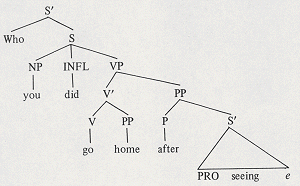 Here, the PP headed by after is a g-projection of the governor of e, seeing. Since this PP is on a right branch, VP should also be a g-projection and we would therefore expect the structure to yield a grammatical result. If, however, a maximal projection must have a lexical sister and be on a right branch, the ungrammaticality of (6) would be predicted. The effect of imposing a linear requirement on the relation between the gap and its governor cannot be observed in a head-initial VO language like English or in a head-final OV language but it can be observed in a language with mixed branching, like Dutch. Dutch has OV-order. The canonical government configuration requires maximal projections to be on a left branch, rather than on a right branch as in English. PPs may generally occur both preverbally and postverbally. Adpositions are usually prepositional, but postpositions occur as well. Thus, there are four theoretical possibilities, which are depicted in (8).
(8) 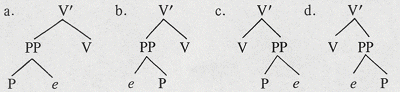 | |||||||||||||||||||||||||||
[pagina 34]
| |||||||||||||||||||||||||||
If the canonical government requirement is imposed only on maximal projections on the path, we predict that (8c) and (8d) are ungrammatical, because the PP is on a right branch. No distinction is made between (8a) and (8b), however. If we strengthen the definition of g-projection such that the gap and its governor must also stand in a canonical government configuration (cf. Koster 1984), we predict that only (8b) is allowed. This prediction is correct, i.e. stranding of adpositions is only possible with postpositional PPs in preverbal position. P-stranding in Dutch is discussed in much greater detail in section 3. Postpositional PPs in Dutch usually have a so-called [+R]-complement. As the examples in (9)-(12) show, extraction of these complements is possible only from preverbal PPs.
(9) a. dat Jan naar het meisje keek that John at the girl looked b. *het meisje dat Jan naar e keek the girl who John at looked
(10) a. dat Jan daar naar keek that John there at looked b. het huis waar Jan e naar keek the house where John at looked
(11) a. dat Jan keek naar het meisje that John looked at the girl b. *het meisje dat Jan keek naar e the girl that John looked at
(12) a. dat Jan een boek heeft gekocht daar over that John a book has bought there about b. *het onderwerp waar Jan een boek heeft gekocht e over the subject where John a book has bought about
It turns out, then, that the definition of g-projection can be strengthened and unified in the following way:
(13) Gap Condition
A gap Z in a tree P is linked to its antecedent by a connected sub-tree of P which constitutes a g-projection. XP is a g-projection of the structural governor W of Z iff the head of XP c-governs Z or a g-projection of W. X c(anonically)-governs Y iff X precedes Y in a VO language and follows Y in an OV language. | |||||||||||||||||||||||||||
[pagina 35]
| |||||||||||||||||||||||||||
The requirement that the governor of a gap be a structural governor is motivated in Kayne (1984, 167). Whether or not a specific category is a structural governor appears to some extent to be a language particular matter; e.g. English, but not French prepositions qualify as structural governors. From the above discussion relating to the island character of adjuncts, it will be clear that our notion of government as used in (13) differs from the generally adopted definition in Aoun & Sportiche (1981). According to their proposal, a lexical category governs all phrases within its maximal projection. We assume that government is restricted to the argument projection, as in Chomsky (1979). Therefore, an adjunct phrase is not governed, although it is in the maximal projection. Government is not a relational notion itself, but rather a domain restriction within which certain relations hold. Among these relations are Case Assignment, Theta-role Assignment to internal arguments, and the UCC (Unlike Category Condition), which is discussed in the next section. | |||||||||||||||||||||||||||
2.3. Extraction from complement clausesOne reason to distinguish (as Kayne's definition in (5) does) between the X-projection part of a g-projection and the higher levels of the g-projection derives from the different behavior in English of empty categories constituting a left branch themselves and empty categories embedded in a left branch. This differential behavior can be illustrated by the examples in (14). In (14a), the subject of a clausal complement is extracted, whereas a part of the subject is extracted in (14b).
(14) a. Which runner do you believe e to have won the race b. *Which book do you believe the first chapter of e to be full of lies
According to Kayne (1984, 169), the empty category in (14a) is licit since a g-projection of the verb believe contains the antecedent. This is so, since there is no requirement that there be a node which immediately dominates both the governor and the gap. The immediate dominance requirement on higher levels of the g-projection explains the ungrammaticality of (14b), i.e. the subject NP (the first chapter of e) and believe do not stand in a canonical government configuration, because there is no category which immediately dominates both. Our proposal makes the same distinction, however, without having recourse to a distinction between X-projection and g-projection. Consider the relevant parts of the tree structures of (14) given in (15). | |||||||||||||||||||||||||||
[pagina 36]
| |||||||||||||||||||||||||||
(15) 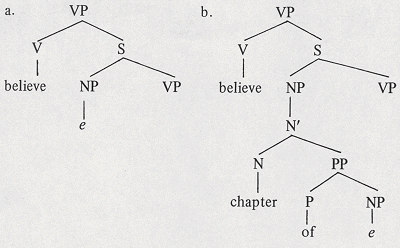 The VP in both (15a) and (15b) is a g-projection of the governor of the gap (believe in (l5a) and of in (15b)). For our purpose, the structure above this VP is irrelevant. In (15b), the PP and the NP are also g-projections. The distinguishing property resides in S. In neither construction is S a g-projection, since the head of S (INFL) does not c-govern a g-projection of the governor of the gap. In the case of (15b), this means that the maximal g-projection (i.e. the S' which contains the antecedent) does not constitute a connected subtree, or, put differently, the subtree from the governor of the gap to the antecedent is not a g-projection. In the case of (15a), the fact that S is not a g-projection is irrelevant since it is not part of the relevant subtree, which starts with believe, the governor of the gap. It turns out that our Gap Condition in (13) handles extractions out of complement clauses (including small clauses) without having recourse to a separate notion of X-projection. A problem for Kayne's approach as well as for ours arises in the case of WH-extractions out of sentential complement clauses in Dutch. Dutch is an OV language. As a result, the canonical government configuration is for the governor to occur on the right of the governee. However, although NP and AP complements have to precede the verb in Dutch, full sentential complements, finite and non-finite, have to follow the verb. Therefore, we expect extraction out of sentential complements to be impossible in Dutch, which, however, it is not. Consider (16) and its tree structure representation in (17). We shall assume that S is the maximal projection of V and that S is governed from the right by INFL, which we take to be the head of S' (see Hoekstra 1984 for discussion).
(16) Wat dacht je dat Piet t zag? What thought you that Peter saw? | |||||||||||||||||||||||||||
[pagina 37]
| |||||||||||||||||||||||||||
(17) 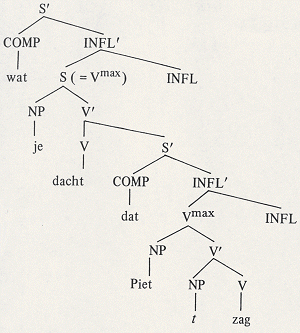 In accordance with canonical government, we can build a g-projection up to the embedded S'; the V zag governs the gap to the left, the Vmax is also governed from the left by INFL. Hence S', being the maximal projection of INFL, is a g-projection of V. The matrix Vmax is not a g-projection of the embedded V, since dacht governs the S' in the wrong direction. We shall assume that movement from the extraction site to the matrix COMP does not take place in a single step, but rather by successive movement via the embedded COMP. Since the embedded S' is a g-projection of the embedded V, movement to the embedded COMP is allowed. The second extraction leaves an empty category behind. This empty category in COMP is governed by the verb dacht, but not canonically. Essentially following a suggestion made by Van Riemsdijk (p.c.), we shall assume that licensing requirements for categories in A'-positions are less strict than for categories in A-positions. In this case, this means that we shall assume that the directionality of canonical government does not apply to the empty category in COMP. Therefore, the matrix S' constitutes a g-projection of the governor of this empty category in COMP. Thus, the path from the empty category in A-position to its ultimate antecedent in the matrix COMP consists of two separate subtrees, each of which constitutes a well-formed g-projection. This analysis makes an interesting prediction. It not only explains why extraction from embedded sentential complements is possible in Dutch, | |||||||||||||||||||||||||||
[pagina 38]
| |||||||||||||||||||||||||||
in spite of the apparent violation of the canonical government requirement, but it explains at the same time why the WH-island condition is so strictly obeyed in Dutch, much more so than e.g. in English. The reason is that extraction in Dutch necessarily involves an intermediate step through COMP, whereas in English a g-projection can be built directly, i.e. without an intermediate step through COMP, given the fact that the embedded clause is canonically governed by the matrix verb. In section 5.1. we shall discuss a further interesting corollary of our analysis of extractions out of Dutch sentential complements. | |||||||||||||||||||||||||||
3. Complex cases of PPsIn the previous section it was shown how P-stranding in Dutch can be explained in terms of the Gap Condition. In this section we shall present a more elaborate discussion of the problems concerning P-stranding in general, and in Dutch in particular. The phenomenon of P-stranding is discussed at some length in Van Riemsdijk (1978). The account given by Van Riemsdijk focuses on the internal structure of PP. In 3.2 we shall discuss those aspects of the syntactic context of the PP which are relevant to stranding, but first, in 3.1, we shall go into Van Riemsdijk's account. The discussion in this section will prove to be relevant to the distribution of parasitic gaps in Dutch, which will be discussed in section 5. | |||||||||||||||||||||||||||
3.1. Van Riemsdijk 's analysis of P-strandingDutch is mainly prepositional. As is indicated in (18b), extraction of the NP complement of a preposition is not allowed.
(18) a. Jan heeft {op Marie}/{*Marie op} gerekend John has {on Mary}/{Mary on} counted
b. *Wie heb je op t gerekend Who have you on counted
If the complement of a preposition is a [-human] pronoun, it obligatorily appears in the so-called R-form and precedes the P of which it is a complement. The notion R-form refers to a set of pronominal elements that characteristically have a phoneme /r/ which is not found with other pronouns. The phenomenon is illustrated by the examples in (19). | |||||||||||||||||||||||||||
[pagina 39]
| |||||||||||||||||||||||||||
(19) a. *Jan heeft op het gerekend John has on it counted b. *Jan heeft op er gerekend John has on there counted c. Jan heeft er op gerekend John has there on counted d. *Jan heeft het op gerekend John has it on counted
In (19c), the P is a postposition and the R-pronoun may be extracted, either by Wh-movement or by regular R-movement:
(20) a. Waar heeft Jan t op gerekend Where has John on counted b. Jan heeft er vandaag niet t op gerekend John has there today not on counted
The explanation of this set of facts given in Van Riemsdijk (1978) can be summarized as follows. The impossibility of (18b) is explained by postulating the Head Constraint, which states that no material may be extracted from the domain of the head. In order to account for the obligatory shift of [-human] pronouns to R-forms, Van Riemsdijk invokes an R-suppletion rule which changes the pronoun het in (19a) into er, as in (19b). Then there is a filter that excludes an R-pronoun in the complement position to the right of the preposition. A rule of R-movement has the effect of relocating the R-pronoun to the left of the preposition and outside of the P'-domain in order to escape the effects of the Head Cornstraint. This movement is depicted in (21). Apart from the Head Constraint, Van Riemsdijk also assumes that extraction from PP is restricted by subjacency, PP counting as a bounding node. Given the binding nature of PP, WH-extraction in (20a) cannot have taken place in a single step. Therefore, the R-pronoun is first moved outside the PP to the position taken by er in (20b), thus crossing only a single bounding category, and then moved to COMP, again crossing only a single bounding node (S). | |||||||||||||||||||||||||||
[pagina 40]
| |||||||||||||||||||||||||||
(21) 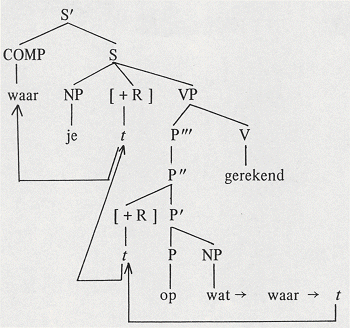 Although the R-pronouns in Van Riemsdijk's analysis originate as NPs, it is important to note that an R-pronoun can only bind empty [R]-positions, i.e. empty positions inside PP. This will become clear in our discussion of parasitic gaps in section 5. This is one of the reasons to assume that R-pronouns do not result from suppletion, but are base-generated in front of their P head. The different orientation of R-complements and non-R-complements with respect to P can be derived from Case Theory on the assumption that P assigns Case to the right and that R-forms inherently resist Case. Ga naar eind1 In the previous section, we demonstrated how the difference in extraction possibilities between prepositional and postpositional PPs is a direct consequence of the requirement of canonical government (cf. (8)-(12)). Although Van Riemsdijk's account is also capable of making this distinction, his analysis has nothing to say about the difference between post-verbal and preverbal PPs, i.e. his analysis does not preclude extraction of R-pronouns from postverbal PPs. In this sense, then, Van Riemsdijk's account relates the possibility of extraction entirely to PP internal aspects. | |||||||||||||||||||||||||||
3.2. Adjacency and P-strandingIt has previously been observed (see Hornstein & Weinberg 1981) that the possibilities of extraction from PP seem to depend in large measure on the context in which the PP appears. Hornstein & Weinberg point out that preposition stranding is possible if the P is reanalyzed to become part of a complex verb. This reanalysis rule applies only to material contained in the domain of the verb. In this way, they can make a distinction be- | |||||||||||||||||||||||||||
[pagina 41]
| |||||||||||||||||||||||||||
tween S-PPs and VP-PPs, of which only the latter allow P-stranding. In our terms, this distinction is an automatic consequence of the requirement that maximal projections on the path from the governor of the gap to the antecedent be canonically governed (cf. (6)). There is therefore no need for a reanalysis rule. Furthermore, we shall follow Kayne (1984, ch. 5) in assuming that the difference between French and English with respect to P-stranding is a consequence of the fact that P is a structural governor in English, but not in French. Hornstein & Weinberg argue that the difference between S-PPs and VP-PPs is unexpected under Van Riemsdijk's approach. Now we want to draw attention to a similar kind of problem. In Dutch, the position of a stranded preposition differs quite strikingly from the possible positions of the corresponding full PPs. This is illustrated in (22).
(22) a. dat ik over dat onderwerp met Piet sprak that I about that subject with Peter talked
b. dat ik met Piet over dat onderwerp sprak that I with Peter about that subject talked
c. *het onderwerp waar ik over met Piet sprak the subject where I about with Peter talked
d. het onderwerp waar ik met Piet over sprak the subject where I with Pieter about talked
The stranded preposition over in (22c) cannot occupy the same relative position as the corresponding full PP in (22a), but has to occupy the position to the immediate left of the verb. This descriptive generalization holds throughout: the stranded preposition must be left adjacent to the verb. Ga naar eind2 This generalization follows from our Gap Condition, i.e. from the requirement that the PP itself is canonically governed and that the P must also canonically govern its complement. Let us consider the structure of (22c). We shall assume, following Kayne (1984), that syntactic structure is binary branching. Given the linear order of the constituents in (22c), this means that the syntactic structure of the verb projection of (22c) must contain something like (23). | |||||||||||||||||||||||||||
[pagina 42]
| |||||||||||||||||||||||||||
(23) 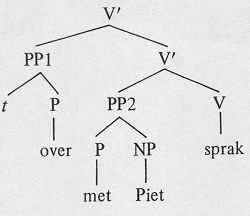 In this structure, PP2 is strictly governed (in the sense of minimally c-commanded) by the lexical verb, unlike PP1. Therefore, if it is assumed that canonical government requires strict government, the ungrammaticality of (22c) is an automatic consequence. There appears to be some variation between Dutch and English as to what counts as the government domain within which canonical government must hold. Consider (24), which is the mirror image of (22c) in the relevant respects.
(24) Which subject did you talk with Peter about e
Here, the about-PP, although belonging to the V-domain, cannot be strictly governed by the verb, given the binary branching requirement. We have no explanation to offer for this variation between Dutch and English. The requirement that a PP containing a stranded preposition must be canonically governed predicts that no extraction is possible from a PP in the complement of an NP, since PP complements to nouns follow the noun in Dutch. This is illustrated by the following examples.
(25) a. *De stelling waar mijn argument t tegen op The proposition where my argument against with bezwaren stuitte objections met
b. *Het onderwerp waar ik een lezing t over op die vergadering The subject where I a lecture about at that meeting heb gehouden have given
c. *Die affaire waar ik dat stuk t over gisteren heb That matter where I that piece about yesterday have geschreven written | |||||||||||||||||||||||||||
[pagina 43]
| |||||||||||||||||||||||||||
The only NPs from which it seems possible to extract an R-pronoun from a PP complement are direct object NPs which are adjacent to the verb.
(26) a. het onderwerp waar ik op die vergadering een lezing t over heb gehouden the subject where I on that meeting a lecture about have given
b. die affaire waar ik gisteren dat stuk t over geschreven heb that matter where I yesterday that piece about have written
These facts are reminiscent of the discussion concerning PP extraction from NP (cf. Bach & Horn 1976, Chomsky 1977). Chomsky (1977) argues that extraction from NP as in (27) should be excluded, given subjacency with NP and S as bounding nodes, but proposes that the PP is reanalyzed as a separate constituent prior to movement into COMP.
(27) About which book did you write a review
We could adopt a similar line of reasoning and assume that in cases like (26), where it seems that extraction takes place from inside an NP, the PP is restructured out of NP first, a process which is needed independently to account for the examples in (28).
(28) a. dat ik een lezing op die vergadering over dat onderwerp heb gehouden that I a lecture on that meeting on that subject have given
b. dat ik over dat onderwerp op die vergadering een lezing heb gehouden that I on that subject on that meeting a lecture have given
c. dat ik op die vergadering een lezing heb gehouden over dat onderwerp that I on that meeting a lecture have given on that subject
After restructuring, the PP is strictly governed by the verb, and hence a g-projection can be built if an R-pronoun is extracted as in (26). | |||||||||||||||||||||||||||
[pagina 44]
| |||||||||||||||||||||||||||
3.3. Extraction from complex PPsWe now turn to more complex cases, where it will be demonstrated that our Gap Condition makes correct predictions. These cases involve adpositions which take a PP complement. Since a P may occur either as a preposition or postposition, we can distinguish between eight different situations involving a P with a PP complement from which the NP complement is extracted. Four of these involve postverbal PPs. As we explained earlier, these constructions are ungrammatical because the matrix PP is not canonically governed. The four preverbal cases are given in (29).
(29) 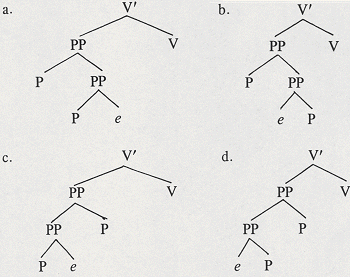 These four different combinations are instantiated by the (b) examples of (30)-(33).
(30) a. dat hij de koekjes [voor [bij de koffie]] koopt that he the cookies for with the coffee buys
b. *ik vroeg wat hij de koekjes voor bij t kocht I asked what he the cookies for with bought
(31) a. dat hij de koekjes [voor [daar bij]] koopt that he the cookies for there with buys
b. *ik vroeg waar hij de koekjes voor t bij kocht I asked where he the cookies for with bought
(32) a. hij is net [[onder het hek] door] gekropen he is just under the fence through crawled | |||||||||||||||||||||||||||
[pagina 45]
| |||||||||||||||||||||||||||
b. *ik vroeg welk hek hij net onder t door was gekropen I asked which fence he just under through was crawled
(33) a. hij is net [[daar onder] door] gekropen he is just there under through crawled
b. ik vroeg waar hij net t onder door was gekropen I asked where he just under through was crawled
Two factors are relevant in determining the possibility of extracting the complement of the embedded P:
a. Is this complement canonically governed by P? b. Is the embedded PP canonically governed by the matrix P?
If we inspect the tree representations in (29), we see that in (29a) both the empty category and the embedded PP are not canonically governed; in (29b) the empty category is canonically governed, but the embedded PP is not; in (29c), the empty category is not canonically governed, although the embedded PP is; finally, both the empty category and the embedded PP are canonically governed in (29d). The grammaticality of (33b) is therefore predicted by the Gap Condition, just like the ungrammaticality of the other (b) examples. Thus, we succeed in predicting that only one out of eight possibilities yields a grammatical result without any statements specific to these constructions. The next question concerns the possibility of extracting the PP complement of an adposition itself. In this case, there are four situations, two with the PP in postverbal position, which again we shall not discuss, and two with a preverbal PP. These two situations are depicted in (34).
(34) 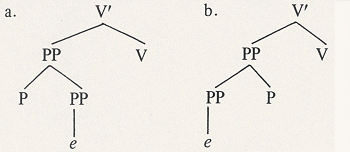 These structures are instantiated by the (b) examples in (35)-(36). It is predicted that only the structure in (34b) yields a grammatical outcome. In (34a), the embedded PP is not canonically governed. The facts are as predicted. | |||||||||||||||||||||||||||
[pagina 46]
| |||||||||||||||||||||||||||
(35) a. dat hij de soep [voor [bij het diner]] kookt that he the soup for with the dinner boils
b. *ik vroeg [bij welke maaltijd] hij de soep voor t kookte I asked with which meal he the soup for boiled
(36) a. dat hij [[achter dat gordijn] vandaan] is gekomen that he behind that curtain from is come
b. ik vroeg [achter welk gordijn] hij t vandaan is gekomen I asked behind which curtain he from is come
It should be noted that Van Riemsdijk's analysis cannot account for the contrast between (31) and (33). Van Riemsdijk suggests that extraction from PPs is made possible via a base-generated [+R]-position outside the head domain, i.e. on the P" level (see section 3.1). Nothing would prevent the extraction of the R-pronoun in (31b) in two successive steps as depicted in(37).
(37) 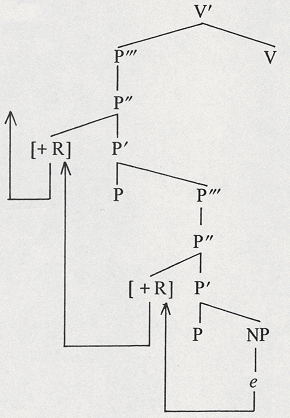 Van Riemsdijk appeals to the notion of bridge to account for the ungrammaticality of (31b): the relevant prepositions would not qualify as suitable bridges, unlike elements like vandaan and door, as in (33) and (36), which he analyzes as postpositions (cf. Van Riemsdijk 1978, 299ff). If an appeal to the notion of bridge were on the right track, we would not ex- | |||||||||||||||||||||||||||
[pagina 47]
| |||||||||||||||||||||||||||
pect the consistent preposition-postposition asymmetry that we find in (31)-(33) and (35)-(36). Turning to comparable structures in English, we would expect extraction from a PP which is embedded in a PP to be possible, since this would constitute the exact mirror image of (29d). This expectation is borne out by the following examples.
(38) a. Fido jumped from under the table b. Which table did Fido jump from under t
(39) a. Fido ran out into the meadow b. Which meadow did Fido run out into t
Unexpected, however, is the fact that the embedded PP itself cannot be extracted, unlike the mirror image counterpart in Dutch in (36).
(40) a. *Under which table did Fido jump from t b. *Into which meadow did Fido run out t
Sag (1982) discusses these examples and argues for an explanation in terms of a GPSG version of the A-over-A principle. Whereas the ungrammaticality of (40) is unexpected under our approach, the grammaticality of (36b) constitutes an anomaly for Sag's A-over-A account. We shall now demonstrate that the ungrammaticality of (40) is related to other phenomena, which are independent of our Gap Condition. | |||||||||||||||||||||||||||
3.4. Reanalysis in complex PPsAlthough the examples discussed in the previous section involve PPs in the complement of P, this configuration is usually not allowed. In general, P may not govern PP. This is in fact an instance of a much wider restriction, which states that no category may govern an element of the same category. So, N may not govern an NP, A may not take AP complements, V may not take V projections as complements, and similarly, P cannot take PP complements. This restriction, called the Unlike Category Condition (UCC), is amply discussed and illustrated in Hoekstra (1984, ch. 2). To illustrate the restriction on Ps, we can give examples like those in (41).
(41) a. *We spraken over in het huis We spoke about in the house
b. *Ik vertrouw op onder het bed als een goede schuilplaats I trust on under the bed as a good hiding place | |||||||||||||||||||||||||||
[pagina 48]
| |||||||||||||||||||||||||||
c. *Voor het opeten van de taart rekenden we op tijdens de lunchpauze For the eating of the cake counted we on during the lunch break
The counterexamples to this restriction in the case of Ps concern only a few prepositions, which are semantically similar for Dutch and English. Some examples are given in (42).
(42) van voor de oorlog from before the war tot na die datum until after that date voor na de maaltijd for after the meal
The main reason to consider these examples exceptional is that the configuration is subject to severe restrictions of a lexical nature. In order to maintain the UCC as a general principle, we shall assume that the constructions in (42) escape the effect of the UCC by being reanalyzed into a pre-positional complex. This situation closely resembles the case of V-raising complement structures in Dutch, both in its motivation and in its effect. In Dutch, sentential complements do not occur in preverbal position, unlike APs and NPs, whereas PPs may in principle occur on either side of the verb. The reason that APs and NPs must occur preverbally can be accounted for by assuming that Case Assignment is directional. Ga naar eind3 The fact that PPs, which do not require Case, may occur both preverbally and postverbally suggests that Theta-role Assignment is not directional. The obligatory postverbal occurrence of sentential complements can be derived from the UCC, if we assume that the UCC is directional, just like Case Assignment, its direction being determined by the direction of Case Assignment. A sentential complement in preverbal position will be governed by V from the right, which is also the direction of Case Assignment. Therefore, if a sentential complement is non-distinct from V in its feature content, the preverbal occurrence is forbidden by the UCC. Let us now turn to V-raising structures. These involve a verbal projection to the left of the matrix verb. Consider the structure in (43). This structure is rejected by the UCC. Therefore, the complement either has to occur in postverbal position, as in (44a), or V-raising has to apply, giving rise to (44b) (for discussion, see Evers 1975).
(43) *dat Jan [een artikel te schrijven] beloofde that John an article to write promised
(44) a. dat Jan beloofde [een artikel te schrijven] b. dat Jan [een artikel] beloofde [te schrijven] | |||||||||||||||||||||||||||
[pagina 49]
| |||||||||||||||||||||||||||
The rule of V-raising, by which (44b) is derived, is a rule of reanalysis which applies to a structure like (45).
(45) 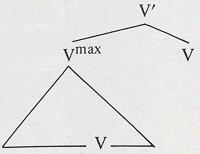 The effect of this reanalysis, which is again severely restricted by lexical factors, is that the resulting structure no longer violates the UCC. In these respects, then, the reanalysis operation of V-raising is identical to the reanalysis that we wish to invoke to account for the exceptions to the UCC in (42). One might object that there is a clear difference between V-reanalysis (V-raising) and the proposed P-reanalysis, since V-raising has a linear effect of reordering the matrix and the embedded verb. However, it has been established that V-raising applies in German without a similar linear effect. Recently, Huybregts (1983) and Haegeman & Van Riemsdijk (1984) have argued that the process of V-raising must be broken up into two steps, one involving the actual reanalysis, which now looks even more similar to our P-reanalysis, and a second operation which realizes the linear shift in Dutch. In fact, from this perspective the reanalysis operation does not differ in any important respect from the reanalysis rule proposed by Rizzi (1982, ch. 1) for Italian. We shall formalize the reanalysis operation by assigning a cosuperscript to the head of the complement and its governor, in order to capture the fact that no actual restructuring takes place. This is evident from the fact that both heads can be separated by intervening material, as is illustrated in (46). The reanalysis operation in the case of constructions like those in (42) is illustrated in (47).
(46) a. van vlak voor de oorlog from right before the war
b. van daar voor from there before
c. van vlak daar voor from right there before | |||||||||||||||||||||||||||
[pagina 50]
| |||||||||||||||||||||||||||
(47) 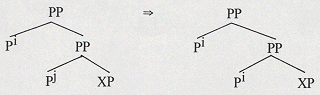 The XP in (47) may be an NP as in the examples given in (42), but also an S'. This is illustrated in (48).
(48) a. Dit model dateert nog van voor dat ik geboren werd This model dates still from before that I born was
b. Wacht maar tot na dat we gegeten hebben Wait just until after that we eaten have
c. We bewaren de bonbons voor tot na dat we koffie gedronken hebben We keep the chocolates for until after that we coffee drunk have
This is in itself not surprising, but what is unexpected is the fact that an infinitival complement clause may not replace the finite complement clause. This is shown by the examples in (49).
(49) a. *Wij wilden wachten tot na gegeten te hebben We wanted wait until after eaten to have
b. *Hij kan zich dat nog herinneren van voor te zijn geboren He can himself that still remember from before to be born
c. *Dit is een lotion voor na te hebben gedoucht This is a lotion for after to have showered
Clearly, the reason for the ungrammaticality of these examples cannot be some semantic violation, since it is entirely clear what is meant. Nor can an appeal be made to a locality requirement on the control of PRO, especially not in the case of (49c), which would be an instance of PRO-arb. Before this puzzle can be solved, it is relevant to introduce one further observation, which also shows an asymmetric distribution of finite and non-finite clauses in the complement of prepositions, in spite of the fact | |||||||||||||||||||||||||||
[pagina 51]
| |||||||||||||||||||||||||||
that finite and non-finite clauses in general have the same distribution in Dutch, just as they have in English (barring lexical idiosyncrasies). Infinitival clauses are found as complements to all major categories, as the examples in (50) illustrate. It is a striking fact that, whereas with other category types infinitival complements may optionally be introduced by om (again barring lexical idiosyncrasies), the prepositional complementizer om is obligatorily absent in the complement of P, whereas the finite complementizer dat is obligatorily present (i.e. there is no rule comparable to English that-deletion in Dutch, not with any category). Ga naar eind4 This is shown in (51).
(50) a. Hij dwong mij (om) weg te gaan He forced me (for) away to go
b. De belofte (om) die avond aanwezig te zijn The promise (for) that night present to be
c. Het is leuk (om) hem weer te ontmoeten It is nice (for) him again to meet
(51) a. Zonder [dat hij het boek gelezen had] Without that he the book read had
b. Na [dat ik hem ontmoet had] After that I him met had
c. Zonder (*om) het boek gelezen te hebben Without (for) the book read to have
d. Na (*om) hem ontmoet te hebben After (for) him met to have
Intuitively, the two observations in (49) and (51) are clearly related: linearly speaking, an infinitival clause is preceded by two prepositions. In (49), there is a combination of prepositions which normally allow reanalysis in order to avoid a violation of the UCC, whereas in (51) the infinitival complement of a preposition may not be introduced by a prepositional complementizer. Let us take seriously the notion of prepositional complementizer and assume om, which introduces infinitival clauses, to be a preposition occupying the embedded COMP position. This assumption is itself without any other consequences. For instance, it does not imply that PRO should be excluded from the subject position of such infinitival complements, since COMP is the specifier of the INFL projection. | |||||||||||||||||||||||||||
[pagina 52]
| |||||||||||||||||||||||||||
Therefore, no government relation exists between P in COMP and the subject position of S, which is Vmax in Dutch. We shall follow Stowell (1981) in assuming that in English, COMP is the head of S', rather than INFL. This assumption allows us to explain the difference between Dutch and English in this respect. If COMP is the head of S' in English, for in COMP governs the subject position of S and assigns Case to it under government. Therefore, the subject of infinitival clauses introduced by for must be lexical. Configurationally, there is no difference between the relation of COMP and the subject position on the one hand and the verb consider and the subject of its small clause complement AP, as in (52b).
(52) a. for [John to leave] b. consider [John foolish]
In both cases, the relation is as in (53). We shall assume that at least V and P in the position of X govern the position W in (53).
(53) 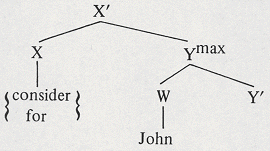 The assumption that om is a preposition in COMP position allows us to explain the fact that infinitival clauses introduced by om do not occur in the complement of a preposition. The structure of an example such as (51c), with om present, would look like (54).
(54) 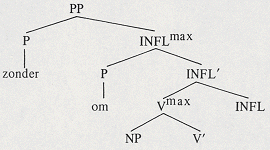 The configurational relation between zonder and om is identical to the relation between X and W in (53), i.e. zonder governs om, which is not allowed by the UCC. Therefore, the sentence is ungrammatical. It should | |||||||||||||||||||||||||||
[pagina 53]
| |||||||||||||||||||||||||||
incidentally be noted that om does not stand in a government relation to the NP subject of Vmax, as we stated above. We note here that, even if the combination of zonder and om fulfilled the lexical requirements for reanalysis (which it happens not to), reanalysis is inapplicable in this configuration, since om is not the head of the complement of zonder. It is a characteristic property of reanalysis rules that they apply to heads only. If the COMP position may be filled by the preposition om, other prepositions might in principle occupy this position as well. Then, zonder in (51c) could also occupy this position if om is not present, thus yielding a structure like (55) instead of (54).
(55) 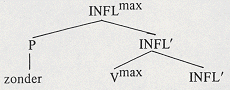 Suppose this is in fact correct. Then we can account for the contrast between (48) and (49). This contrast is again illustrated by the pair in (56).
(56) a. Voorna dat je gedoucht hebt For after that you showered have
b. *Voor na te hebben gedoucht (=(49c)) For after to have showered
Their respective tree structure representations are given in (57a) and (57b), under the assumption that the preposition na projects a PP structure of its own. However, under the assumption made above, that the preposition na may occupy the COMP position of the infinitival clause, the structure of (57b) would be as in (58).
(57) 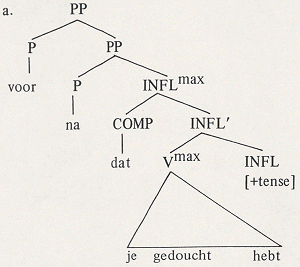 | |||||||||||||||||||||||||||
[pagina 54]
| |||||||||||||||||||||||||||
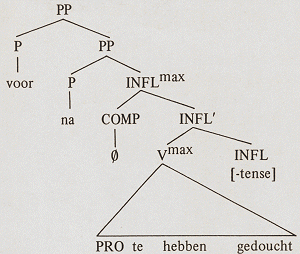 (57a) violates the UCC as it stands, but given the fact that lexical conditions are fulfilled, reanalysis of the two Ps can take place. If (57b) were the correct representation of (56b), we would expect reanalysis to apply in this case as well, and hence expect (56b) to be grammatical. However, (58) is the structure we are advocating in this section. Although lexical conditions are met, reanalysis cannot take place in this configuration, because the preposition na is not the head of the sister projection of the preposition voor. Since voor does govern na just as zonder governs om in (54), (58) violates the UCC.
(58) 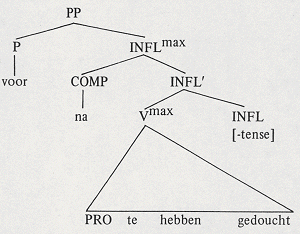 The conclusion that the preposition introducing tenseless adjunct clauses is in COMP, so that the construction as a whole is of the category S' (=INFLmax), rather than PP, derives further support from the following observation. PPs can have specifiers like vlak, drie uur, etc., as is shown | |||||||||||||||||||||||||||
[pagina 55]
| |||||||||||||||||||||||||||
in (59). (59a) exemplifies this with P taking an NP complement, and (59b) with P taking a tensed clause as complement. However, these specifiers are not allowed if the preposition introduces a tenseless clause. This follows from our analysis if it is assumed that the relevant specifiers only combine with a P projection, which we claim is absent in the constructions in (60). Ga naar eind5
(59) a. Vlak voor [NP de maaltijd] dronken we een glas sherry Right before the meal drank we a glass sherry
Drie uur na [NP de wedstrijd] zaten de spelers nog te hijgen Three hours after the game sat the players still to gasp
b. Vlak voor [S' dat we gingen eten] dronken we een glas sherry Right before that we went eat drank we a glass sherry
Drie uur na [S' dat ze de wedstrijd gespeeld hadden] zaten de spelers nog te hijgen Three hours after that they the game played had sat the players still to gasp
(60) a. *Vlak alvorens te gaan eten dronken we een glas sherry Right before to go eat drank we a glass sherry
b. *Drie uur na de wedstrijd gespeeld te hebben zaten de spelers nog te hijgen Three hours after the game played to have sat the players still to gasp
One question remains to be answered, before this analysis can be considered fully satisfactory: what makes (57b) unacceptable? Let us suppose that Dutch differs from English in that at S-structure COMP must be filled. This is evident in the case of tensed embedded clauses, as there is no rule in Dutch comparable to English that-deletion. It is also clear in main clauses, where the sentence-initial COMP must always be filled - by the finite verb in all cases and by a fronted constituent in clauses different from yes-no questions and imperatives. This assumption implies that there is an optional rule of om-deletion in the PF component of the grammar to account for the optionality of om in cases like (50). Ga naar eind6 Given the requirement of COMP being filled at S-structure, we can explain why (57b) is ungrammatical as it stands. The UCC applies at S-structure. Consequently, since there cannot be an empty COMP at S-structure, (57b) can only have om in COMP position, but then the structure violates | |||||||||||||||||||||||||||
[pagina 56]
| |||||||||||||||||||||||||||
the UCC for the same reason as (54), i.e. om is governed by na and no reanalysis can take place. Thus, there is no way in which (57b) can be accepted. Therefore, (58) is the only possible structure, but this structure also violates the UCC, as discussed. We are now in a position to return to the problem that we left unsolved at the end of the previous section. There we noted a contrast between Dutch and English with respect to the possibility of extracting the PP complement of P. Thus, in Dutch a PP complement to a postposition could be extracted, as illustrated by the example in (36b), repeated here, whereas the PP complement of a preposition in English cannot be extracted, as was shown by the examples in (40), also repeated here. This contrast was unexpected, given the fact that their structures are mirror images.
(36) b. Ik vroeg [achter welk gordijn] hij e vandaan was gekomen I asked behind which curtain he from was come
(40) a. *Under which table did Fido jump from t *Into which meadow did Fido run out t
From our perspective, it was the ungrammaticality of (40) which was unexpected, since the Gap Condition would allow it, just as it allows (36b). As we have argued in this section, PP complements to prepositions are in principle excluded by the UCC. Therefore, reanalysis must have applied to the structures in (40) in order to escape the effect of the UCC. We assume that the formation of a prepositional complex by reanalysis makes the complex inseparable. This accounts for the ungrammaticality of (40). We have argued that the UCC is a directional principle, the direction in which it applies being the direction in which Case is assigned. Since Ps in Dutch and English assign Case in the same direction, the UCC does not apply to the structure underlying (36b), since the matrix P is post-positional. This accounts for the contrast between Dutch and English in this respect. | |||||||||||||||||||||||||||
4. Parasitic gapsAfter this digression on the distribution of gaps in Dutch and the comparison with that of English, we now turn to the distribution of parasitic gaps. The parasitic gap phenomenon may be illustrated by the example in (61). Apart from the gap created by WH-extraction, indicated by t, there is a second gap, indicated by e, which is parasitic on the first gap. Ga naar eind7 | |||||||||||||||||||||||||||
[pagina 57]
| |||||||||||||||||||||||||||
(61) Which articles did John file t without reading e
The reason for calling e parasitic on the trace is that its occurrence is indeed dependent on t, as can be demonstrated by the examples in (62). (62a) shows that e is not licensed if its antecedent is in an argument position. (62b) shows that extraction from the position of e itself is not allowed.
(62) a. *John filed these reports without reading e. b. *Which reports did John go home without reading t
In (61), both t and e are bound by which articles, which is in a non-argument (A') position. Therefore, both empty categories are variables according to the functional definition of empty categories in Chomsky (1982, ch. 3). This qualification explains a further restriction on parasitic gaps, which is illustrated by (63).
(63) *Who do you think t went home without John having met e
The reason for the ungrammaticality of (63) follows from the required status of e as a variable: t, the real gap, is coindexed with e and c-commands e. Therefore, e has t rather than who as its local binder and is therefore locally A-bound. Thus, the ungrammaticality of (63) reduces to the same principle that rules out (64), viz. the requirement that variables be locally A-free.
(64) *Whoi did hei expect John to see ti
Similarly, the parasitic gap may not c-command the real gap, since in that case the parasitic gap would function as the local antecedent of the real gap, so that the real gap would be locally A-bound. This explains the ungrammaticality of (65).
(65) *Which girl did you present e to t (cf. Which girl did you send a picture of e to t)
The descriptive statement of a parasitic gap given by Chomsky (1982, 66) is as in (66).
(66) In the construction (A), where order is irrelevant and we assume α, t, e to be coindexed, the parasitic gap e is licensed if and only if(B): (A).... α … t … e | |||||||||||||||||||||||||||
[pagina 58]
| |||||||||||||||||||||||||||
(B) (i) α c-commands t and e (ii) t does not c-command e or conversely (iii) α does not head the chains (α, t) and (α,e) (iv) e is governed (is not PRO) and heads a chain with a theta-role
Here, (iii) states in effect that the antecedent expression α must be in a non-argument position, whereas (iv) states that the parasitic gap is subject to the ECP, just like the real gap. An interesting aspect of the parasitic gap phenomenon is that the relation between the parasitic gap and the antecedent is not subject to the bounding condition, i.e. subjacency, which is what we expect given that no movement is involved, and that subjacency is a condition on extraction operations. This fact is illustrated by the contrast between (61) and (62b). However, Kayne (1984, ch. 8) observes that contrasts like those in (67) and (68) are unexpected.
(67) a. The person that John described t without examining any pictures of e b. *The person that John described t without any pictures of e being on file
(68) a. The books you should read t before it becomes difficult to talk about e b. *The books you should read t before talking about e becomes difficult
These contrasts cannot be explained in terms of a subjacency violation since subjacency is irrelevant for parasitic gaps. Nor can they be explained by the ECP, although there is a subject/non-subject asymmetry, since the parasitic gap is governed by a preposition in all cases. The ungrammaticality of the (b) examples in (67)-(68) cannot be attributed to the fact that the parasitic gap is embedded in a subject, since cases like the one in (69) are grammatical.
(69) A person who close friends of e admire t
In section 2.1, we saw that Kayne replaces the standard ECP in (1) by his g-projection requirement in (5), which has a wider scope than subject/non-subject asymmetries. The contrasts between the (a) examples and the (b) examples of (67) and (68) are reminiscent of the contrast between the examples in (4), repeated here. This contrast was explained in terms of the g-projection requirement. | |||||||||||||||||||||||||||
[pagina 59]
| |||||||||||||||||||||||||||
(4) a. Which actress do you think that John likes pictures of t b. *Which actress do you think that pictures of t turn Bill on
The contrast in (67)-(68) reduces to the g-projection requirement if it is assumed that both-gaps must be related to their antecedent by a g-projection. The maximal g-projection of the governor of e in the (b) examples is the embedded subject NP, because this NP is not in a canonical government configuration. The maximal g-projection of the governors of both gaps in the (a) examples is the matrix S', which contains their antecedent. This simple extension of the application of the g-projection requirement does not explain the grammaticality of (69). Let us consider the tree structure of the relevant part of (69).
(70) 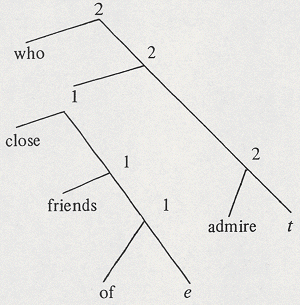 The nodes numbered 1 represent the g-projection of the governor of e, and the nodes numbered 2 represent the g-projection of the governor of t. Kayne proposes that the g-projection is extended to what he calls the Connectedness Condition, which requires that distinct g-projections that relate to the same antecedent be connected, such that the g-projections form a connected subtree. This is the case in the structure in (70): the maximal g-projection of the governor of e connects directly to the g-projection of the governor of t without intervening nodes. This connection requirement can be built into our Gap Condition in (13) very easily by requiring that the relation between an antecedent and its gaps forms a connected subtree. Both in terms of the Connectedness Condition and our revised formulation of it as the Gap Condition, the contrast between the (a) and (b) examples of (67)-(68) is explained straightforwardly, as can be seen in the tree representations in (71). | |||||||||||||||||||||||||||
[pagina 60]
| |||||||||||||||||||||||||||
(71) 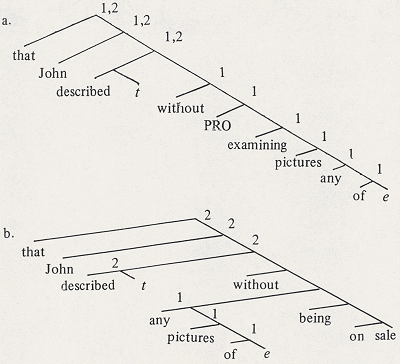 With this background in the theory of parasitic gaps, we shall discuss the distribution of parasitic gaps in Dutch in the next section. | |||||||||||||||||||||||||||
5. Parasitic gaps in DutchIn the previous sections we have discussed the distribution of normal gaps in Dutch and explained how this distribution is adequately accounted for in terms of the Gap Condition. In this section we examine the effects of this condition on the distribution of parasitic gaps. In 5.1 we shall concentrate on the normal cases of parasitic gaps, while 5.2 focuses on an apparent problem for the theory of parasitic gaps in constructions that do not appear to have a real gap to license the parasitic gap. | |||||||||||||||||||||||||||
5.1. The distribution of parasitic gapsIn this section we discuss the reasons why the distribution of parasitic gaps in Dutch is much more limited than in other languages, specifically English. The first reason has to do with the fact that there are two types of gaps in Dutch. As we showed in section 3, gaps inside PPs necessarily take a [+R] antecedent, while other gaps take a [-R] antecedent. This fact limits the possible combinations of two gaps, one real, the other parasitic, | |||||||||||||||||||||||||||
[pagina 61]
| |||||||||||||||||||||||||||
since either both of them are of the [+R] variety or both are of the [-R] variety. Thus, there is no equivalent to an English example like (72):
(72) This is the guy that I suggested to e that my brother could offer t a job
The reason is that e requires a [+R] antecedent, whereas t can only take a [-R] antecedent. So, both the option with the [-R] relative pronoun die and the option with the [+R] relative pronoun waar are ungrammatical.
(73) *Dit is de jongen die/waar ik e aan suggereerde dat mijn broer t een baan kon aanbieden
If t is replaced by a pronoun, the sentence with the [+R] relative pronoun is grammatical:
(74) Dit is de jongen waar ik t aan suggereerde dat mijn broer hem een baan kon aanbieden
If both gaps are of the [+R] variety, a construction of this type is possible, as is shown by the example in (75).
(75) Dit is het artikel waar ik e over zei dat Harry een reactie t op moest schrijven This is the article where I about said that Harry a reaction to should write
It should be noted that it is impossible to have a construction of this type with two [-R] gaps. The reason for this is that the [-R] gap in the matrix clause would c-command the gap in the embedded clause and hence function as its local antecedent. Consequently, the embedded gap is not locally A-free. Therefore, an example like (76) is ungrammatical, just as its English counterpart.
(76) *Dit is de man die ik e vertelde dat mijn broer t zou bezoeken This is the man who I told that my brother would visit
In section 3, we explained why there can only be a single [+R] gap in a given clause, due to the requirement that the PP from which the R-pronoun is extracted must itself be canonically governed. Since PPs in NPs follow the noun, only PPs which are governed by V allow extraction. Since there is only one V per clause, there can only be one [+R] gap per clause. Therefore, there are no Dutch counterparts to constructions like (77). | |||||||||||||||||||||||||||
[pagina 62]
| |||||||||||||||||||||||||||
(77) Who did you give a picture of e to t
Similarly, there can only be one [-R] gap per clause, since [-R] gaps cannot be couched in a PP and consequently will always stand in a c-command relationship. Summarizing the discussion so far, we have seen two restrictions on parasitic gap constructions:
a. the two gaps must be of the same type ([+/-R]) b. the gaps must be contained in different clauses
These restrictions follow from the theory presented thus far. It is easy to see that both requirements are fulfilled in constructions of the type exemplified in (75). The second clause in this type is a complement clause. There are two other conceivable combinations of two clauses: a) a matrix clause and a relative clause, and b) a matrix clause and an adjunct clause. Both types allow parasitic gaps in English. We shall now examine these two types in Dutch. Let us examine clauses embedded in NPs first. An example of this type of construction in English is given in (78).
(78) This is the book [that everyone [who reads e] becomes enthusiastic about t]
Constructions of this type are obviously impossible in Dutch: the clause embedded in NP is not canonically governed, since clauses follow the noun in Dutch as well as in English. These constructions are impossible, both with [-R] gaps, as in (79), and with [+R] gaps, as in (80).
(79) *Dit is het boek dat iedereen [die e leest] t bewondert This is the book that everyone who reads admires
(80) *Dit is een vraag waar iedereen [die e over denkt] een antwoord t op weet This is a question where everyone who about thinks an answer to knows
Let us now turn to constructions with adjunct clauses, which constitute a very productive class of parasitic gap constructions in other languages. We mentioned earlier that adjunct clauses are islands for extractions, both in English and in Dutch. The fact that they are islands in Dutch does not come as a surprise, given the proposal we made in 2.5 concerning extraction from embedded clauses. Consider (81): | |||||||||||||||||||||||||||
[pagina 63]
| |||||||||||||||||||||||||||
(81) *Wat is Jan [na [dat hij t zag ]] vertrokken What is John after that he saw left
The embedded S' is a g-projection of the governor of the gap, but this S' is on a right branch. So, the maximal projection of the governor of S', the PP headed by na, is not a g-projection. Consequently, the path breaks off at S'. In English, adjunct clauses are islands for extraction as well, as is illustrated in (82):
(82) *What did John leave after he had seen t
The ungrammaticality of (82) is predicted by our Gap Condition, just as the ungrammaticality of (81) is, but the reasons are slightly different. While in Dutch the g-projection of the governor of the gap breaks off at the level of the embedded S', it breaks off in English at the level of PP. The reason for this difference is that, unlike in Dutch, the S' is canonically governed by the preposition in English. Therefore, the PP is a g-projection of the governor of the gap. The reason why this g-projection cannot be continued is that the PP itself is not governed by V. Hence, Vmax is not a g-projection. This difference allows us to make a precise prediction. An English adjunct clause may contain a parasitic gap, if the adjunct PP is connected to the path of a real gap, but a Dutch adjunct clause should not be able to contain a parasitic gap, since the PP itself is not a g-projection. This prediction turns out to be correct, as is illustrated by the contrast between the forms in (83) and their Dutch translations in (84).
(83) a. Which book did you return t before you could read e b. A person that they spoke to t because they admired e c. This is the kind of food you must cook t before you eat e d. The paper that we should destroy t before someone steals a copy of e
(84) a. *Welk boek moest je t terugbrengen voor dat je e kon lezen b. *Een persoon waar zij t tegen spraken om dat zij bewondering e voor hadden c. *Dit is het soort voedsel dat je t moet koken voor dat je e eet d. *Het papier dat we t moesten vernietigen voor dat iemand e steelt
Let us illustrate why there is a difference in grammaticality between (83) and (84) by drawing the relevant tree structures of the (a) examples. The point where the g-projection breaks off is boxed. It is clear that the boxed | |||||||||||||||||||||||||||
[pagina 64]
| |||||||||||||||||||||||||||
constituent connects up with the path of the real gap in the tree structure of (83a), but not in the tree structure of (84a).
(83a) en (84a) 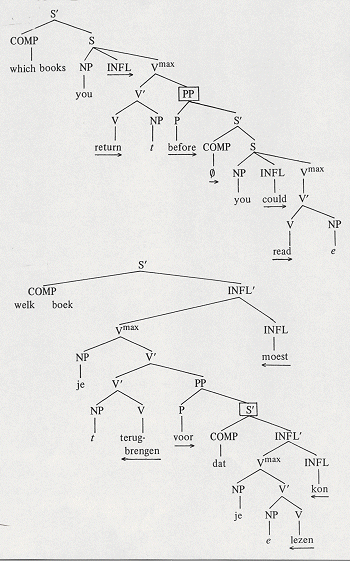 | |||||||||||||||||||||||||||
[pagina 65]
| |||||||||||||||||||||||||||
These tree structures are in accordance with the assumptions about the head of S and S' that we made above. Although the prediction about the non-occurrence of parasitic gaps turns out to be correct in tensed adjunct clauses, parasitic gaps can be found in tenseless adjunct clauses, as has been observed by Dutch (and German) linguists since the introduction of the notion of parasitic gaps. Examples with [-R] gaps are provided in (85) and examples with [+R] gaps in (86).
(85) a. Welke boeken heb je [zonder e te bekijken] t weggezet Which books have you without to inspect away put
b. Dit is de oom die ik [na jaren niet e gezien te hebben] gisteren weer t tegenkwam This is the uncle who I after years not seen to have yesterday again met
c. Dit is de oom die ik [na jaren niet e gezien te hebben] hoopte dat ik in Kopenhagen t zou ontmoeten This is the uncle who I after years not seen to have hoped that I in Copenhagen would meet
(86) a. Waar heb je [na twee jaar e over nagedacht te hebben] een oplossing t voor gevonden Where have you after two years about thought to have a solution to found
b. Ik hou niet van vragen waar ik [zonder eerst rustig e over na te denken] een antwoord t op moet geven I love not of questions where I without first quietly about to think an answer to must give
c. Dit is het speelgoed waar ik [na jaren niet e naar omgekeken te hebben] dacht dat ik Piet t mee zag spelen This is the toy where I after years not to looked-for to have thought that I Peter with saw play
The fact that these parasitic gaps are allowed is surprising given our explanation of the impossibility of a parasitic gap in a tensed adjunct clause. Ga naar eind8 It will be recalled, however, that we argued in section 3.4 that the preposition introducing an infinitival clause occupies the COMP position of that clause, rather than being the head of a PP, taking this clause as its complement. As can be seen in the tree structure in (84a), it is the PP which stands in the way of connecting the g-projection of the governor | |||||||||||||||||||||||||||
[pagina 66]
| |||||||||||||||||||||||||||
of the parasitic gap to the path of the real gap. However, in the case of infinitival adjuncts, this PP structure would be absent, i.e. the tree structure of the examples in (85) and (86) would not be as in (87), but rather as in (88), (cf. the tree structures in (55) and (58)).
(87) en (88) 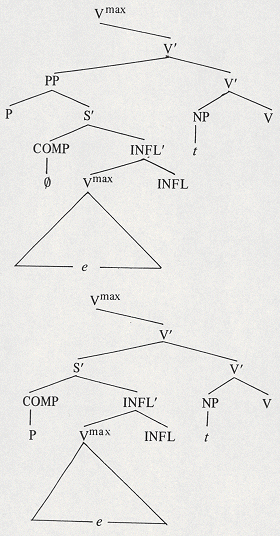 It should be stressed that the distribution of parasitic gaps in Dutch is entirely as predicted by the constraints that are relevant for normal gaps. Therefore, it would be counterproductive to provide an alternative analysis to account for these second gaps if this alternative were non-consequential for the distribution of real gaps. In that case the theory would redundantly allow for an analysis of these second gaps as parasitic gaps as well. | |||||||||||||||||||||||||||
[pagina 67]
| |||||||||||||||||||||||||||
Before we turn to a discussion of the surprising phenomenon that we announced at the beginning of this section, we want to discuss an issue that is relevant for the debate of the derivational status of parasitic gaps. In Chomsky (1982), parasitic gaps are assumed to be empty categories at D-structure, their status of variables being determined at S-structure or LF by the functional definition of empty categories. Their status of variable, then, does not result from movement of the content from the position of the parasitic gap to an A' -position, as is the case with normal variables, but rather from their local binding by an antecedent in an A' -position. More recently, this non-derivational approach to parasitic gaps has been called into question (Chomsky, class lectures where he refers to work by Longobardi). Parasitic gap constructions appear to be sensitive to Complex Noun Phrase Constraint effects, something which is unexpected under the approach taken in Chomsky (1982). It is therefore proposed that parasitic gaps do result from movement to A' -position, thus creating an operator-variable relation independently. It turns out that the latter approach conflicts with the situation found in Dutch. In section 2, we argued that extraction from sentential complements in Dutch is possible by successive cyclic movement only. Therefore, it is predicted by the derivational approach to parasitic gaps that a parasitic gap could be found in a complement clause within an adjunct clause. This situation is depicted in (89).
(89) 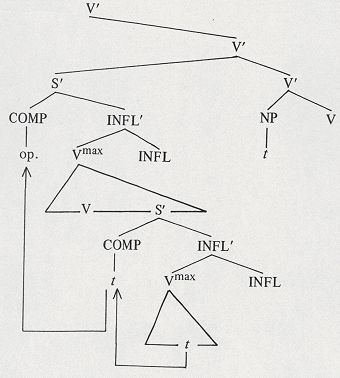 | |||||||||||||||||||||||||||
[pagina 68]
| |||||||||||||||||||||||||||
The most deeply embedded t would be the extraction site of the parasitic gap. The t in COMP results from successive cyclic movement of the operator op. into the matrix COMP, which connects to the path of the real gap. Under the non-derivational approach, there is no movement, hence no successive cyclic movement, and we therefore predict that the g-projection of the governor of a parasitic gap contained in a complement clause inside the adjunct breaks off at the level of this complement clause, as this clause itself is not canonically governed. Therefore, the derivational approach predicts sentences of the type exemplified in (90) to be grammatical, whereas the non-derivational approach adopted here predicts them to be ungrammatical. The latter prediction turns out to be correct.
(90) *Welke boeken heb je [zonder te weten [dat je e mocht bekijken] t doorgebladerd Which books have you without to know that you were allowed to inspect browsed-through
This evidence thus favors the original approach to parasitic gaps taken in Chomsky (1982). | |||||||||||||||||||||||||||
5.2 Parasitic gaps without real gapsUp to this point, the discussion of the differential distribution of parasitic gaps in Dutch and English has been in accordance with the methodological requirements that follow from the peripheral nature of the parasitic gap phenomenon. The differences were all shown to follow from independently existing differences between the two languages. Therefore, no language specific statements are needed either in the grammar of Dutch or the grammar of English to account for the phenomenon. It was pointed out above, however, that Dutch appears to have gaps which look like parasitic gaps, since they occur in positions from which no extraction seems possible, but which do not seem to be licensed by the presence of a real gap. Such gaps are found in the examples in (91).
(91) a. Jan heeft die boeken [zonder e te bekijken] weggelegd John has those books without to inspect away put
b. Ik ben mijn oom [na e jaren niet gezien te hebben] gisteren weer tegen gekomen I have my uncle after years not seen to have yesterday again against come | |||||||||||||||||||||||||||
[pagina 69]
| |||||||||||||||||||||||||||
c. Het is een schande dat de arts de patient [zonder e behandeld te hebben] vijftig gulden liet betalen It is a disgrace that the doctor the patient without treated to have fifty guilders let pay
d. Ik heb deze scriptie [alvorens definitief e te beoordelen] eerst aan Jan voorgelegd I have this term paper before definitively to judge first to John shown
The gaps are interpreted as coreferential with die boeken, mijn oom, de patient, and deze scriptie, respectively. However, if no movement is involved, these gaps are bound by a category in an A-position, which is generally excluded as a consequence of the Binding Theory (i.e. principle C, which requires that variables are locally A-free). The English counter-parts of the examples in (91) are indeed excluded:
(92) a. *John put those books in the bookcase without looking into b. *I met my uncle yesterday after not having seen for many years c. *It is a disgrace that the doctor made the patient pay fifty guilders without having treated d. *I showed this term paper to John before judging definitively
It would be counterproductive at this moment to assume that the requirement that the parasitic gap be A-free does not hold in Dutch, since such a step would not only introduce language specific stipulations with respect to the parasitic gap phenomenon, but would also make the wrong predictions. Thus, if it is assumed that the antecedent of a parasitic gap may be in an A-position in Dutch, the sentence in (93) would be predicted to be grammatical, contrary to fact.
(93) Ik vertelde Jan dat ik [zonder hem/*e te willen beledigen] anders had besloten I told John that I without him to want insult differently had decided
Since the understood PRO-subject of the adjunct clause is obligatorily controlled by the subject of the embedded clause ik, the nearest antecedent for e would be Jan, which c-commands e. Nevertheless, the sentence is ungrammatical. It would be highly unattractive to assume that in Dutch, unlike in English, parasitic gaps are subject to some sort of locality requirement in order to account for the ungrammaticality of (93), since, as we have seen above, parasitic gaps in the examples that we discussed earlier are not subject to such a requirement. | |||||||||||||||||||||||||||
[pagina 70]
| |||||||||||||||||||||||||||
In the case of R-gaps, it can be demonstrated quite clearly that a real gap, as well as a path with which the path of the parasitic gap can be connected, are required. The element er can have a number of distinct functions, some of which can coalesce in a given structure. We can distinguish between a locative er as in (94a), a presentative er, which appears in sentences with indefinite subjects as in (94b), a prepositional er, of which several examples have already been given (cf. (94c)) and a quantitative er, which is in most respects similar to the quantitative use of ne in Italian and en in French (cf. (94d)).
(94) a. ik heb *(er) jaren gewoond I have there years lived locative er
b. dat *(er) een jongen loopt that there a boy walks presentative er
c. ik heb *(er) met Piet e over gesproken prepositional er I have there with Peter about talked
d. ik heb *(er) gisteren twee e gezien I have there yesterday two seen quantitative er
Even if in a given construction the conditions for the appearance of er are met more than once, only a single er is present at surface structure (cf. Bennis 1980 for an analysis and qualification of this statement), as is shown in the following examples: Ga naar eind9
(95) a. quantitative and prepositional: Ik heb er twee e e van I have there two of
b. presentative and prepositional: Toen kwamen er verscheidene mensen e naar kijken Then came there various people at look
c. presentative and locative: Er woont niemand There lives nobody
d. presentative, quantitative, and prepositional: Hoe er drie e e van kunnen samenvallen How there three of can coincide | |||||||||||||||||||||||||||
[pagina 71]
| |||||||||||||||||||||||||||
If a parasitic R-gap is present, it cannot be licensed by a presentative er, as is shown in the examples in (96a) and (96b). A parasitic R-gap can only be licensed by an R-pronoun in the matrix clause, if this R-pronoun is extracted from a position more deeply embedded than the adjunct clause containing the parasitic gap. An example is given in (96c).
(96) a. *Daarom zijn er verscheidene mensen [na lang e gewoond te hebben] vertrokken Therefore are there various people after long lived to have left
b. *Daarom zijn er verscheidene mensen [zonder e naar te kijken] weggegaan Therefore are there various people without at to look left
c. Daarom zijn er verscheidene mensen [zonder e naar te kijken] e langs gelopen Therefore are there various people without at to look along walked
In (95b) and (96b) er should have both a presentative function and an antecedent function with respect to the prepositional R-gap. The grammaticality of (95b) shows that both functions can be combined in one occurrence of er. Therefore, the ungrammaticality of (96b) must be related to the fact that the prepositional R-gap is contained in an adjunct clause. Given the fact that the adjunct clause is an island in this case as well, the prepositional R-gap in (96b) must be parasitic. The grammaticality of (96c) indicates that a parasitic R-gap in the adjunct clause is indeed possible. The main difference between (96b) and (96c) is the fact that, although in both sentences er occupies an A' -position, in (96c) er binds an R-gap that is more deeply embedded than the adjunct clause. Therefore a path is created with which the path of the parasitic R-gap can connect. In (96b), on the other hand, there is no such path and consequently no connection can be made. These R-gap phenomena thus illustrate quite nicely that not only an antecedent in A' -position, but also a path in the matrix clause, is required in order to license a parasitic gap. Returning to the examples in (91), we observe that in these sentences the gap is contained in an island (i.e. the adjunct clause). Therefore, these examples pose two related, though logically independent, problems:
a. the antecedent of the gap is in an A-position b. the gap is contained in an island and there does not seem to be a path with which the g-projection of the governor of the gap can connect | |||||||||||||||||||||||||||
[pagina 72]
| |||||||||||||||||||||||||||
Both problems would be solved at the same time if the structure of the sentences in (91) were comparable to (96c), rather than to (96a) or (96b), i.e. if the antecedent NP originated in a position more deeply embedded than the adjunct. This would lead us to postulate (97) as the tree representation of (91 a), with t indicating the A-position from which the antecedent NP is extracted. A similar proposal is independently made in Felix (1983). The antecedent (die boeken) is attached to the V-projection by Chomsky-adjunction, and is consequently in a non-argument position.
(91) a. Jan heeft die boeken [zonder e te bekijken] weggelegd John has those books [without to inspect] away put
97 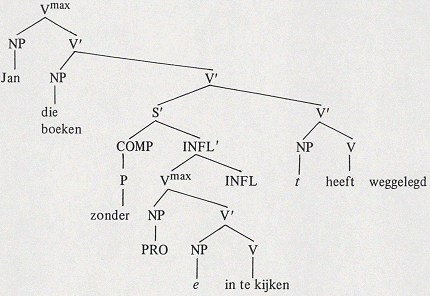 This representation fulfills all the requirements for the two gaps. Both gaps are canonically governed by their respective V-heads, and the matrix clause V-projection belongs to the path of t with which the path in the adjunct S' is properly connected. This S' is itself a g-projection of the governor of the parasitic gap. Both gaps are bound by a c-commanding NP in a non-argument position and neither gap c-commands the other. Ga naar eind10 The relevant question at this point is how the existence of the real gap in (97) can be motivated. The first principle which gives us the position of t as the base position of the direct object is the X'-principle according to which modifiers are attached at a higher level of structure than complements (cf. Jackendoff 1977). On the assumption that Dutch is OV, this implies the order adjunct - NP - V, rather than NP - adjunct - V. | |||||||||||||||||||||||||||
[pagina 73]
| |||||||||||||||||||||||||||
A further pertinent consideration is the adjacency requirement on Case Assignment proposed in Stowell (1981). If such adjacency is required for the verb to assign Case to its direct object, there must be an NP-position adjacent to the verb, as in (97). In his discussion of the universality of the adjacency requirement on Case Assignment, Stowell develops two hypotheses to take apparent violations into account. The first hypothesis is specifically designed to cope with such violations in Dutch. The relative order of NPs and optional adverbials within the traditional VP-domain is essentially free. Thus, in constructions with an object NP and an optional adverbial PP, both orders are allowed:
(98) a. dat Jan zijn vriendin in Amsterdam ontmoette that John his girlfriend in Amsterdam met
b. dat Jan in Amsterdam zijn vriendin ontmoette that John in Amsterdam his girlfriend met
Given these examples, one would be inclined to assume that Case is assigned to the NP in the position in (98b), under adjacency with the verb. However, Stowell assumes that the VP in Dutch is double headed, i.e. has two head positions, one of which is VP-initial position. He also assumes that Case is assigned by the V-head in initial position under adjacency. His two principal reasons for these assumptions are the following:
a. in main clauses the verb obligatorily appears in VP-initial position, in this way motivating the double-headed character of the Dutch VP; b. the direct object must appear in VP-initial position.
Both assumptions are wrong. The verb-second position of the finite verb in Dutch and German main clauses is not a position within VP, but rather in COMP (Den Besten 1983). As the example in (98b) shows, direct objects do not have to appear in VP-initial position. (For more detailed criticism of Stowell's proposal, see Hoekstra 1984,109ff.) Apart from these general deficiencies of Stowell's proposal, we do not quite see how he would be able to account for those constructions in which the direct object does not occupy the VP-initial position, but rather a VP-medial position. A variant of Stowell's analysis is presented in Koopman (1984). She does not assume that the Dutch VP is double headed, but nevertheless agrees with Stowell in assuming that Case is assigned from VP-initial position under adjacency. According to Koopman, Case is assigned from a VP-initial clitic position by the Case features of the verb. It will be evident | |||||||||||||||||||||||||||
[pagina 74]
| |||||||||||||||||||||||||||
that this analysis meets with the same problems as Stowell's: adjacency is not met at surface structure, neither with the Case assigning position initially in VP, nor with the Case assigning position at the end of VP. The main reason for Koopman to assume Case assignment from VP-initial position is her hypothesis that Case is always assigned in the same direction by the various categories in a particular language. Since Dutch is (mainly) prepositional, this harmony would not exist if verbs in Dutch assigned Case from right to left. Although such a cross-categorial harmony, at least as far as the direction of Case Assignment of V and P is concerned, seems to be fairly widespread among languages of the world, it is clearly not a necessary requirement. Ga naar eind11 In our analysis, Case is assigned by the verb under government from right to left. With respect to adjacency, we assume that, rather than being subject to a linear adjacency requirement, Case assignment is subject to strict government. Under the additional assumption of binary branching, this has the effect of linear adjacency between the Case assigning category and its complement NP. In English, this is not only true for object NPs but also for subjects of (small) clauses. For Dutch, however, this hypothesis has a different effect on objects than on subjects. This can be illustrated by the tree structures for small clause complements in (99), where (99a) represents English and (99b) Dutch constructions of this type.
(99) 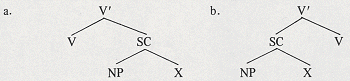 The NP is structurally governed by V in both cases, but while V and NP are string adjacent in English, the NP is separated from V in Dutch by the predicative part of the small clause complement. The same situation obtains in the case of subjects of full clauses under our analysis: the subject in Dutch is governed by INFL, which appears on the right of the Vmax, whereas the subject itself is the leftmost constituent within Vmax. In conclusion, then, it turns out that Stowell's adjacency requirement can be made to follow from government and binary branching; i.e. it is not a primitive of the theory. The cases in which the direct object is not (structurally) adjacent to its Case assigner, as in (98a), are then accounted for by optional movement. Since movement must be upgrading, this has the linear effect of movement to the left. The movement leaves behind a Case-marked trace, which is therefore a variable according to the inherent definition of empty categories. The landing site of the movement operation must be a non- | |||||||||||||||||||||||||||
[pagina 75]
| |||||||||||||||||||||||||||
argument position, which can be created through adjunction (see Belletti & Rizzi 1981). As a result, the extraction site is also a variable according to the functional definition of empty categories, since it is in an A-position and locally bound by an antecedent in A' -position. It should be noted that the choice of applying this leftward NP-movement is determined by pragmatic rather than by strictly syntactic considerations: definite NPs are more likely to be moved than indefinites; clitics are obligatorily moved. It is interesting to note that the operation is formally identical to Heavy-NP-Shift in English. Since the nature of branching is the mirror image of Dutch, this movement will always have a rightward moving effect. This explains why types of NPs that are likely to be moved by Heavy-NP-Shift are precisely those which are not likely to be moved in Dutch, whereas Heavy-NP-Shift of clitics is essentially excluded - again, not for syntactic but rather for pragmatic reasons. Ga naar eind12 Let us now turn to Stowell's second hypothesis for dealing with apparent counterexamples to the adjacency condition. This hypothesis is invoked to account for cases of non-adjacency at surface structure in Italian, where the object may be separated from the verb by an intervening adverb of manner. Stowell proposes that there may be a level of argument projection, at which the adverb does not appear. Then, adjacency may be met either at S-structure itself, resulting in strict adjacency as in English, or at the level of the argument projection, the latter option being the marked one chosen in Italian. We shall not dwell on the merits of this proposal for Italian, but shall concentrate on a possible application of this idea to account for cases of non-adjacency in Dutch. When this idea is applied to the examples in (98), the S-structure of each of the sentences might directly correspond to its surface manifestation, i.e. without traces. Adjacency of the verb, now taken to occupy the VP-final position, would in both cases be met at the level of argument projection, since at that level the PP in Amsterdam would not appear. If this explanation is maintained, we would be at a loss with respect to the parasitic gap constructions in (91), since under this proposal there is no need to assume the existence of a real gap which is required in order to make the connection with the g-projection of the governor of the parasitic gap. In fact, the notion of argument projection, as it is used here, obscures the hierarchical relation between the NP, the adverbial, and the verb, just as it obscures the linear relation. Essentially, these relations appear to vanish into thin air, since, just as one can say that the required adjacency on Case Assignment is met at the level of argument projection, it might be argued that the local relation between verb and object which follows from X' -theory (or Chomsky's 1965 sister condition on strict subcategorization) is defined at the level of argument projection. The contrast between (91) and (100) makes it crystal clear, however, that both the linear and the hierarchical | |||||||||||||||||||||||||||
[pagina 76]
| |||||||||||||||||||||||||||
relation of the adjunct and the NP are relevant, since the reason for the ungrammaticality of the examples in (100) will ultimately be the lack of c-command of the parasitic gap by an antecedent in A' -position.
(91) a. Jan heeft die boeken [zonder ze/e te bekijken] t weggelegd John has those books without them to inspect away put
(100) a. Jan heeft [zonder ze/*e te bekijken] die boeken weggelegd John has without them to inspect those books away put
(91) b. Ik ben mijn oom [na hem/e jaren niet gezien te hebben gisteren weer t tegen gekomen I am my uncle after him years not seen to have yesterday again against come
(100) b. Ik ben [na hem/*e jaren niet gezien te hebben] gisteren weer mijn oom tegen gekomen I am after him years not seen to have yesterday again my uncle against come
(91) c. Het is een schande dat de arts de patient [zonder hem/e behandeld te hebben] t vijftig gulden liet betalen It is a disgrace that the doctor the patient without him treated to have fifty guilders let pay
(100) c. Het is een schande dat de arts [zonder hem/*e behandeld te hebben] de patient vijftig gulden liet betalen It is a disgrace that the doctor without him treated to have the patient fifty guilders let pay
(91) d. Ik heb deze scriptie [alvorens hem/e definitief te beoordelen] eerst aan Jan t voorgelegd I have this term paper before it definitively to judge first to John submitted
(100) d. Ik heb [alvorens hem/*e definitief te beoordelen] eerst aan Jan deze scriptie voorgelegd I have before it definitively to judge first to John this term paper submitted | |||||||||||||||||||||||||||
[pagina 77]
| |||||||||||||||||||||||||||
It turns out that the predictions made by our analysis are clear in this case, and what is more, they appear to be correct.
Evidence for the correctness of the hypothesis that NPs may be moved upward to the left in Dutch can also be derived from Exceptional Case Marking constructions. These constructions are illustrated by the following examples. Ga naar eind13
(101) a. dat ik [S die man het eiland afturen] zag that I that man the island along peer saw
b. dat de arts [S de patient vijftig gulden betalen] liet that the doctor the patient fifty guilders pay let
We shall assume an analysis of these constructions which does not differ in any important respect from the analysis of believe-type constructions: the representation in (101) assumes S' -deletion (alternatively, the relevant matrix verbs select a Vmax, rather than a full S'), and Case is assigned to the subject of the embedded clause by the matrix verb under government. The relevant evidence for the upgrading movement derives from the interaction with the scope of adverbials. In (102a), the person using the binoculars is the referent of the matrix subject. This is expected, of course, since the adverbial PP is contained in the matrix clause. Let us assume that the scope of an adverbial is restricted to the clause within which it is contained. Then (102b) poses a problem, since it can be either the referent of the embedded subject or the referent of the matrix subject who is using binoculars. Nevertheless, it would be untenable to assume that the embedded clause is transparent for the scope interpretation of adverbials, since in (102c) it can only be the referent of the embedded clause who is using binoculars.
(102) a. Ik zag met een verrekijker dat iemand het eiland aftuurde I saw with binoculars that someone the island along peered
b. Ik zag iemand met een verrekijker het eiland afturen I saw someone with binoculars the island along peer
c. Ik zag iemand het eiland met een verrekijker afturen I saw someone the island with binoculars along peer
How can we account for the ambiguity of (102b)? It will be clear that no explanation is likely to emerge if the structures of (102b) and (102c) are as in (103a)-(103b) respectively. | |||||||||||||||||||||||||||
[pagina 78]
| |||||||||||||||||||||||||||
(103) a. Ik zag [S iemand met een verrekijker het eiland afturen] b. Ik zag [S iemand het eiland met een verrekijker afturen]
No appeal can be made to the opacity effect induced by the subject, since the adverbial is contained in the domain of the subject in both structures. The resolution of the ambiguity could be sought by appealing to a rule of raising to object, but such a rule is inconsistent with some of the basic assumptions of the GB-framework, specifically the theta-criterion and the related Projection Principle. However, nothing prevents a movement rule in Dutch which is in its effect quite similar to raising to object, if the preceding account of possible non-adjacency of verb and object is correct. That rule differs from raising to object in that the landing site is an A' -position, created via Chomsky-adjunction, rather than an A-position. The ambiguity of (102b) can be accounted for by the S-structure representations in (104). In (104a), the adverbial is part of the embedded clause and can only be linked to the embedded subject; in (104b), the embedded subject is attached to a higher level than the adverbial, which is now part of the matrix clause, thus allowing linking to the matrix subject.
(104) a. Ik zag [S iemand met een verrekijker het eiland afturen] b. Ik zag iemandi met een verrekijker [S ti het eiland afturen]
The non-ambiguity of (102c) follows from the fact that, given the position of the adverb after the object, it must be contained in the embedded clause, since the object itself may not be moved to a position outside the embedded S, because of the opacity induced by the subject. A similar kind of argument can be based on the relative scope of two adverbials. In a simple sentence like (105), niet (not) takes scope over met opzet (deliberately), i.e. the sentence has the implication that John sang out of tune.
(105) Jan zong niet met opzet vals John sang not deliberately out of tune
In the biclausal construction in (106), on the other hand, niet may either take scope over the proposition expressed by the complement of the perception verb or over met opzet only. This would be hard to explain if the only possible structure of (106) were (107a), since then we would expect the reading with niet taking scope over met opzet only, as in (105), with the necessary implication of John singing out of tune. The second reading would follow from (107b) as an alternative structure for (106), on a par with (107a). | |||||||||||||||||||||||||||
[pagina 79]
| |||||||||||||||||||||||||||
(106) a. Ik hoorde Jan niet met opzet vals zingen I heard John not deliberately out of tune sing
(107) a. Ik hoorde [S Jan niet met opzet vals zingen] b. Ik hoorde Jani niet [S ti met opzet vals zingen]
There is even a third reading for (106). In this reading both niet and met opzet take scope over the matrix clause. This reading is accounted for by the structure in (107c).
(107) c. Ik hoorde Jani niet met opzet [S ti vals zingen]
The interpretations of (106) correspond to the following three sentences:
(108) a. I heard that John did not deliberately sing out of tune b. I didn't hear that John deliberately sang out of tune c. I didn't hear deliberately that John sang out of tune
It should be noted that a similar analysis is not available for English or VO languages in general. To illustrate this, let us examine the tree structure in (109), which would represent the configuration relevant for English perception verb constructions and ECM-constructions.
(109) 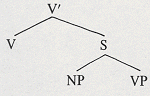 If we want to promote the NP subject of the complement clause, there are three logical possibilities, which are depicted in (110).
(110) 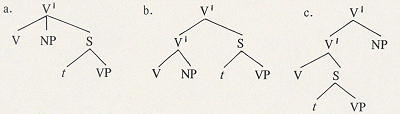 The tree structure in (110a) violates the theta-criterion and/or the Projection Principle. There are two possibilities. First, the landing site is avail- | |||||||||||||||||||||||||||
[pagina 80]
| |||||||||||||||||||||||||||
able at D-structure, in which case it should be assigned a theta-role. If so, the derived structure would violate the theta-criterion, since the NP would receive two thematic roles. If not, the D-structure would be ill-formed because there is an internal argument position which is not assigned a theta-role. Secondly, the landing site is not present at D-structure, in which case the Projection Principle is violated, since the representation at D-structure crucially differs from the representation at S-structure. The structure furthermore violates the restriction of syntactic structures to binary branching, which has been proposed recently in the literature (Kayne 1984, ch.7). This argumentation is of course the argumentation against traditional proposals involving Subject Raising to Object (cf. Chomsky 1981, ch.2). A similar line of reasoning applies to (110b). Again, the landing site constitutes a problem for the Projection Principle and/or the theta-criterion. (110b), while not violating the binary branching requirement, furthermore does not accord with the requirement that a trace be c-commanded by its antecedent, while it is not clear how the empty category would fare under the ECP. The only possibility left is (110c), but apart from the hierarchical effect of the raising, there is also a linear effect, i.e. the NP subject would end up on the right-hand side of the clause from which it is extracted. This is precisely the effect of Heavy-NP-Shift, which we claimed earlier to be the mirror-image operation of the ‘raising’ or ‘Light-NP-Shift’ we claim to be operative in Dutch. As is to be expected, therefore, the result of Heavy-NP-Shift under these circumstances yields grammatical results, as can be seen in (111). Moreover, Heavy-NP-Shift licenses parasitic gaps, just like ‘raising’ does in Dutch. This is exemplified in (112).
(111) They'd believe [t to be foolish] any candidate who would take the trouble to run in every primary
(112) John offended t [by not recognizing t immediately] his favorite uncle from Cleveland
The following examples illustrate that it is indeed impossible to have an adverb after an NP that is the subject of a perception verb complement, if it is linked to the matrix subject (as is possible in Dutch).
(113) I put the books secretly back in John's drawer
(114) I forced John unintentionally to commit suicide
(115) I saw John secretly put the paper back in my desk | |||||||||||||||||||||||||||
[pagina 81]
| |||||||||||||||||||||||||||
The example in (113) shows that adverbs of the class secretly, unintentionally may follow an object NP and be linked to the subject. The same is illustrated in (114), where John is the matrix object controlling the embedded PRO subject. The relevance of (115), then, is that the adverb secretly cannot be linked to matrix subject position. Therefore, the structure representing (115) cannot be as in (116); cf. (104b). This is precisely as predicted.
(116) I saw Johni secretly [S tiput the paper back in my desk]
A related matter concerns the possibility of adverbial modification inside small clause constructions. Stowell (1981, 258) argues for the constituency of small clause complements by pointing out the impossibility of separating the subject of the small clause from its predicate by an intervening adverb. Relevant examples are given in (117).
(117) a. *I consider John myself to be very stupid b. *I expect that sailor sincerely off my ship by midnight c. *We feared John with great concern killed by the enemy
It should be noted that adverbial modification may be found in this position in small clauses, but only if the modifier is linked to the subject of the small clause and not to the matrix subject, exactly as in (115). This restriction is a consequence of the hypothesis suggested earlier that adverbs take their scope in the propositional domain which contains them.
(118) I thought Mary unconsciously in love with Peter
By now it schould no longer be surprising that Dutch differs in this respect from English. In Dutch, adverbial modifiers intervening between the subject and the predicate of a small clause may not only be linked to the small clause subject, but also to the subject of the matrix clause. This is exemplified in (119).
(119) a. Ik maakte de tafel onbedoeld kapot I made the table unintentionally broken
b. Ik vond Jan opzettelijk onaangenaam I found John deliberately unpleasant
The representation of (119a), where the adverb is linked to a constituent outside the small clause domain, would be as in (120). | |||||||||||||||||||||||||||
[pagina 82]
| |||||||||||||||||||||||||||
(120) Ik maakte de tafeli onbedoeld [ti kapot]
This possibility is available in Dutch because of its OV-nature, which allows the NP subject to be moved to a c-commanding position created through adjunction. As discussed earlier this possibility is available in English only in the case of rightward movement. We assume that the analysis according to which the direct object originates in the position left adjacent to the verb in VP-final position, from where it may be moved and adjoined in an A' -position, has been satisfactorily motivated on the basis of the predictions it makes with respect to differences between Dutch and English. If the analysis is indeed correct, the structure in (97) is also the correct representation of (91). This is a desirable result, since on this basis, the parasitic gap phenomenon in Dutch has all the properties we expect, given the overall structure of the GB-theory. | |||||||||||||||||||||||||||
[pagina 85]
| |||||||||||||||||||||||||||
[pagina 86]
| |||||||||||||||||||||||||||
| |||||||||||||||||||||||||||
[pagina 87]
| |||||||||||||||||||||||||||
Dutch Department University of Leiden PO Box 9515 2300 RA Leiden General Linguistic Department University of Leiden PO Box 9515 2300 RA Leiden |
|