'Verb Projection Raising, Scope, and the Typology of Rules Affecting Verbs'
(1986)–Liliane Haegeman, H.C. van Riemsdijk– Auteursrechtelijk beschermd
[pagina 417]
| |||||||||||||||||||||||||||||||||||||||||||||||||||||||||||||||||||
Verb Projection Raising, Scope, and the Typology of Rules Affecting Verbs | |||||||||||||||||||||||||||||||||||||||||||||||||||||||||||||||||||
Liliane Haegeman
| |||||||||||||||||||||||||||||||||||||||||||||||||||||||||||||||||||
[pagina 418]
| |||||||||||||||||||||||||||||||||||||||||||||||||||||||||||||||||||
(2) a. *… dat hij het probleem te begrijpen probeert that he the problem to understand tries b. … dat hij het probleem probeert te begrijpen
(2a) is the structure underlying (2b) and would be ungrammatical as a surface structure. A variety of criteria show that a process of clause union is at work in German, even though its effect is not immediately visible in the order of the verbs. To give just one example, object clitics of the embedded verb may move to the position preceding the matrix subject in verb-raising contexts, as in (3):
(3) dass esi der Hans ei zu begreifen versucht that it (the) Hans to understand tries ‘that Hans tries to understand it’
We will return to several of these criteria below. The standard analysis of Verb Raising (VR) is Evers (1975). In this analysis the embedded verb is extracted from the complement clause and Chomsky-adjoined to the matrix verb-to its left in German and to its right in Dutch:
(4) Verb Raising … V1]S V2 … a. … e1][V1 V2]V … (German) b. … e1][V2 V1]V … (Dutch)
One important consequence of this analysis, and a correct one, is that it predicts that when multiply embedded VR complements occur, the surface order of the verbs will be the mirror image of the underlying order in Dutch. Consider, for example, the following derivation with three verbs:
(5)
Below we will adopt a somewhat different analysis of VR, but first we must point out that the actual situation is far more complicated than (4) suggests. Complications arise in two major respects. First, within each language the rules that determine when inversion of the verbs can, must, or may not occur are more complex. Second, there is considerable variation among the many dialects of Dutch and German. Ga naar voetnoot2 In this article we will examine in detail one variety of the process: Verb Projection Raising. In Verb Projection Raising (VPR) constructions the part of the embedded clause affected is not just the verb but some projection of it-that is, V' or V'' (= VP). As a consequence, NPs and other constituents that are part of the VP may be incorporated into the verb cluster. Furthermore, since the dialects considered here (WF and ZT) exhibit inversion in the relevant cases, these constituents of the VP may end up inter- | |||||||||||||||||||||||||||||||||||||||||||||||||||||||||||||||||||
[pagina 419]
| |||||||||||||||||||||||||||||||||||||||||||||||||||||||||||||||||||
spersed with the verbs inside the verb cluster. As an illustration, compare the following examples from Standard Dutch (6) with WF (7) and ZT (8): Ga naar voetnoot3:
(6)
(7)
(8)
An insightful description of the VPR facts of ZT can be found in Lötscher (1978). We will return to the reasons why the (c)-sentences in (7) and (8) are best analyzed in terms of an extension of VR to the VP rather than, say, by extraposing the whole embedded clause. Our program in this article is as follows. In section 1 we will outline a different conception of V(P)R, present a rough typology of V(P)R patterns in a number of Germanic dialects, and discuss some consequences of this analysis. In particular, we will present an argument from WF and ZT in favor of the analysis of V(P)R that we adopt, and we will discuss the consequences of our analysis for the proposal to analyze German as a nonconfigurational language. In section 2 we will focus on a number of systematic semantic effects that occur in VPR structures. In particular, we will show that scope-bearing constituents, which typically have wide scope in VR structures, must be interpreted with narrow scope when they are incorporated into a verb cluster by VPR. In section 3 we will sketch a theory of scope that correctly predicts those facts. Finally, in section 4 we will discuss the relevance of our analyses of VPR and scope for the typology of verb movement rules in Universal Grammar. | |||||||||||||||||||||||||||||||||||||||||||||||||||||||||||||||||||
1. An Analysis of VPR1.1. Huybregts's Analysis for V(P)RIn unpublished work Huybregts proposes an alternative to Evers's adjunction analysis. Ga naar voetnoot4 The central idea is that, as far as the syntax is concerned, only reanalysis of the verbs | |||||||||||||||||||||||||||||||||||||||||||||||||||||||||||||||||||
[pagina 420]
| |||||||||||||||||||||||||||||||||||||||||||||||||||||||||||||||||||
in question takes place. The inversion process is assumed to apply later-say, in the phonology (the left-hand side of Chomsky and Lasnik's (1977) T-model). There are various conceptions of reanalysis that one might adopt. One variety, for example, relies on cosuperscripting of the reanalyzed items. The cosuperscripts serve to indicate a special bond among these items. But since the items affected are very often subject to the additional requirement that they be adjacent, such a bond is perhaps more adequately-and possibly equivalently-expressed by means of an additional pair of brackets, a proposal made in Chomsky (1974). Adoption of such a device leads inexorably to a conception of syntactic representation that is beyond the expressive power of trees. To the extent that the literature is full of indications that reanalysis is indeed required, the real problem is not how this increase in expressive power can be avoided but how it can be contained. Lasnik and Kupin (1977) propose a formalization of syntactic representation that on the one hand is much more constrained than the formalization proposed in Chomsky (1975) but on the other hand permits the types of structures required for reanalysis. Specific proposals concerning how to execute reanalysis along these or similar lines can be found in Williams (1980), Vergnaud and Zubizarreta (1982), Zubizarreta (1982; 1985), Manzini (1983), and Goodall (1984), as well as in Huybregts's work. In these works various additional restrictions on the ensuing syntactic representations are proposed. We do not aim here to choose among these approaches, but we adopt what we understand to be Huybregts's system since it was specifically developed with the VR construction in mind. We feel that the results obtained within the chosen framework would probably carry over to (most of) the others but that no purpose would be served by our undertaking such an exercise. What we do claim, however, is that the type of approach we adopt is superior to the adjunction analysis of V(P)R. Reanalysis is a general syntactic rule schema:
(9) Reanalysis Reanalyze α where α is a syntactic category
It is conditioned by autonomous principles of grammar (X̄-theory, case theory, government theory, θ-theory, etc.) (see Huybregts (1985)). Specific formulations of reanalysis rules proposed below (in (12)-(14)) are to be taken as particular instantiations of this schema. The output of Reanalysis is a string of formatives that cannot be represented in terms of one tree diagram but must be represented multidimensionally. Such a multi-dimensional representation can be represented graphically by associating a set of trees with the reanalyzed sentence. In the simple case there will be only two dimensions; hence, the structure of the reanalyzed sentence may be associated with two trees. This can be presented pictorially as follows: | |||||||||||||||||||||||||||||||||||||||||||||||||||||||||||||||||||
[pagina 421]
| |||||||||||||||||||||||||||||||||||||||||||||||||||||||||||||||||||
(10)  (10) illustrates the familiar case of Reanalysis as it applies, for example, in the analysis of pseudopassives of the type Mary was talked to. Each such tree in the set-or, as we will call it, each dimension of the syntactic representation-must satisfy a number of conditions. Further details of the analysis of (10) need not concern us here, however. Given this theory, VR can be represented as a two-step process: first, Reanalysis; second, if applicable, Inversion. An example like (2) would consequently be derived as follows: Ga naar voetnoot5 | |||||||||||||||||||||||||||||||||||||||||||||||||||||||||||||||||||
[pagina 422]
| |||||||||||||||||||||||||||||||||||||||||||||||||||||||||||||||||||
(11a) en (11b)  | |||||||||||||||||||||||||||||||||||||||||||||||||||||||||||||||||||
[pagina 423]
| |||||||||||||||||||||||||||||||||||||||||||||||||||||||||||||||||||
(11c)  Under this conception the rule of Reanalysis can be stated roughly like this:
(12) Reanalysis If the representation of a sentence contains the line X Vq Vr Y, and if Vr is a VR verb, then add the line X Vx Y to that representation.
Observe that, although (12) (as well as (14) below) mentions the fact that Reanalysis is a lexically conditioned process, we will be largely abstracting away from considerations pertaining to the lexicon here. For a discussion of how lexical representations and Reanalysis interact, see Zubizarreta (1982; 1985) and Haegeman (1985). Nothing appears to hinge on this abstraction in the proposals we are about to develop. Consider now the analysis of VPR structures. Under Evers's approach, rule (4) would be changed to (13) in order to account for these structures:
(13) VPR … Vi]S Vr … (where 0 ≤ i ≤ 2) → … eq]S [Vr Viq]Vx … (WF and ZT)
Under the approach we are adopting here, the rule of Reanalysis would be modified as in (14):
(14) Reanalysis (VPR) If the representation of a sentence contains the line X Viq Vr Y, where 0 ≤ i ≤ 2 and Vr is a VR verb, then add the line X Vx Y to that representation.
Although (13) and (14) are obviously closely related formulations, we will show in section 1.5 that there may actually be an empirical reason to adopt (14) and reject (13). In extending the rule of Reanalysis from VR to VPR, we have now broached the issue of variation among verb-raising patterns. To further illustrate the descriptive apparatus introduced here, we will present a rough typology of these patterns in section 1.3. | |||||||||||||||||||||||||||||||||||||||||||||||||||||||||||||||||||
1.2. Reanalysis and the θ-CriterionAs stated above, both representations in (10) must observe the θ-Criterion. Here we will sketch briefly how this will be possible. (See Haegeman (1985) for more complete discussion of the matters outlined in this section.) It is assumed that lexical heads like V are associated with one or more thematic roles. The assignment of these roles is regulated by the θ-Criterion: | |||||||||||||||||||||||||||||||||||||||||||||||||||||||||||||||||||
[pagina 424]
| |||||||||||||||||||||||||||||||||||||||||||||||||||||||||||||||||||
(15) θ-Criterion (Chomsky (1981, 335)) Ga naar voetnoot6) Given the structure S, there is a set K of chains, K = {Ci}, where Ci = (αi1, …, αin), such that: (i) if α is an argument of S, then there is a Ci ∈ K such that α = αij and a θ-role is assigned to Ci by exactly one position P. (ii) if P is a position of S marked with the θ-role R, then there is a Ci ∈ K to which P assigns R, and exactly one αij in Ci is an argument.
Following Williams (1981), two types of thematic roles are distinguished: internal roles are assigned by X inside the projection of X, and the external role is assigned by the maximal projection XP to its subject. We will represent the θ-structure of V by means of a θ-grid? We further assume that θ-roles are associated with the R-index of the arguments involved. Under these assumptions, the θ-grid for the top dimension of (11) would be as follows:
(16)
(proberen is taken to be a control verb, hence m = k)
In the bottom dimension VPx is a projection of the reanalyzed Vx, which dominates V1 and V2. It is assumed here that V2 is the head of the reanalyzed verb cluster (Haegeman (1985)) and that it has the properties of a bound morpheme (Zubizarreta (1982; 1985)). The thematic structure of Vx is determined by the θ-structures of V2 and V1. Following Lieber (1980) and Zubizarreta (1985), we may adopt a percolation convention to the effect that features of V1 and V2 percolate to Vx and that features of the head take precedence over features of the complement. Let us assume furthermore that the internal θ-role of the head proberen is associated with its Vx-internal complement V1. The percolation convention alluded to will allow both the external role of proberen and the internal role of begrijpen to percolate up to Vx, though not the external role of V1, since it is not the head. Furthermore, the external role of begrijpen cannot be assigned by VP to the empty category (PRO) in the [NP,VP] position in the bottom dimension, since the latter position is an internal rather than an external ([NP,S]) position. Even if we were to allow assignment of the external role of begrijpen to such a VP-internal position (after an internalization procedure; see Williams (1981)), this would be equally problematic since the empty category in such an internal position would not be identifiable. | |||||||||||||||||||||||||||||||||||||||||||||||||||||||||||||||||||
[pagina 425]
| |||||||||||||||||||||||||||||||||||||||||||||||||||||||||||||||||||
These observations thus lead to the conclusion that the empty category identified as PRO in the top dimension is not present in the bottom dimension; hence, PRO is left unattached in the tree representation. A final issue, then, is what happens to the θ-role associated with PRO in the top dimension. One possibility would be to say that it is allowed to percolate up to Vx, where it merges with the already present external θ-role of proberen, thus forming a complex θ-role associated with the position [NP,S] (see Zubizarreta (1985)). Such a merger of θ-roles will not violate the θ-Criterion as formulated in (15): the argument position with R-index k is associated with a complex θ-role assigned externally by VPx. | |||||||||||||||||||||||||||||||||||||||||||||||||||||||||||||||||||
1.3. A Typology of V(P)R StructuresThe variation among the V(P)R structures found in Germanic dialects can be represented in the form of a number of relatively simple parameters. In order to illustrate this, we will present a rough outline of the grammar for V(P)R in four dialects: Standard Dutch, High German, and WF/ZT. For a more detailed discussion of the variation, see Den Besten and Edmondson (1981). As a matter of convenience, we will use the following rough subdivision of verb types:
(17) VA: auxiliary VM: modal verb V: any verb
Also, for ease of exposition, we will represent the output of iterated Reanalysis as in (18). Even though this is only one dimension out of several, we single it out because it is the one that Inversion is defined on.
(18)  Furthermore, we will refer to Vβ as the head of Vα, to VΗ as the head of Vγ, etc. Consider first the Reanalysis part. Here there is one parameter: Ga naar voetnoot7 | |||||||||||||||||||||||||||||||||||||||||||||||||||||||||||||||||||
[pagina 426]
| |||||||||||||||||||||||||||||||||||||||||||||||||||||||||||||||||||
(19) Reanalysis: Parameter If X Viq Vr Y, where Vr is a VR verb, then add X Vx Y. (cf. (11) and (13))
Turning now to the Inversion part, we find that matters are more complex. There are four parameters in terms of which Inversion may be defined in a particular language:
(20) Inversion: Main Parameters a. The nonhead must be (non)branching or need not be branching. b. The head of V must be VA or VM or is unrestricted. c. Inversion is optional or obligatory. d. Vα is maximal or unrestricted.
We have followed Huybregts's suggestion in assuming that Inversion applies in the phonology. Observe that this is not necessarily so: Inversion could equally well be located somewhere within the syntactic component proper, say at S-Structure. But the fact that the relevant parameters are statable in terms of such notions as head (defined independently from X̄-theory) and branchingness is at least consistent with the view that Inversion makes use of a formalism typical of phonology. Consider the actual cases:
(21) Inversion in Standard Dutch  a. Optional: Vβ = VM and Vγ is not branching and Vα is not part of a bigger verb cluster b. Obligatory: elsewhere
Example (2) illustrates the case of (21b). (21a) is exemplified in (22):
(22) a. dat ik hem zien wilM that I him see want ‘that I want to see him’ b. dat ik hem wil zien c. *dat ik hem zien kunnenM wilM d. *dat ik hem kunnenM zien wilM e. *dat ik hem wilM zien kunnenM f. dat ik hem wilM kunnen zien that I him want can see ‘that I want to be able to see him’ | |||||||||||||||||||||||||||||||||||||||||||||||||||||||||||||||||||
[pagina 427]
| |||||||||||||||||||||||||||||||||||||||||||||||||||||||||||||||||||
In High German the situation is somewhat more complex and most easily stated as two separate rules:
(23) Inversion in High German  Examples for (23a) are given in (24), examples for (23b) in (25):
(24) a. *dass er kommen könnenM hätteA that he come can would-have ‘that he would have been able to come/could have come’ b. dass er hätteA kommen könnenM (by (23a)) (25) a. *dass er kommen wollenM könnenM hätteA that he come want can would-have ‘that he could have wanted to come’ b. dass er hätteA kommen wollenM könnenM (by (23a)) c. dass er hätteA könnenM kommen wollenM (by (23a-b))
The situation in WF/ZT is much simpler than this. Their Inversion rule can be stated as follows: Ga naar voetnoot8
(26)  | |||||||||||||||||||||||||||||||||||||||||||||||||||||||||||||||||||
[pagina 428]
| |||||||||||||||||||||||||||||||||||||||||||||||||||||||||||||||||||
This was already exemplified in (7) and (8). Note that the conditions to which Inversion is subject in ZT and WF are identical for VR and VPR. If we were to try to handle the VPR cases by means of (a version of) Extraposition, this generalization would be lost. We now turn to more evidence to the effect that VPR should not be associated with Extraposition. | |||||||||||||||||||||||||||||||||||||||||||||||||||||||||||||||||||
1.4. VPR or Extraposition?There are several other good reasons not to analyze the VPR phenomena by means of some rule of Extraposition. The first is that the V projection-that is, the verb with some of its complement constituents-often ends up split up within the verb cluster. For example, the underlying structure in (27) has four grammatical outputs, (28a-d), as predicted by the rules: Ga naar voetnoot9
(27) das er [[[en arie singe] chöneM] weleM] hätA that he an aria sing can want has ‘that he has wanted to be able to sing an aria’ (28) a. das er en arie hätA weleM chöneM singe b. das er hätA en arie weleM chöneM singe c. das er hätA weleM en arie chöneM singe d. das er hätA weleM chöneM en arie singe
As stated, Inversion can never have the effect of moving a complement constituent to the right of its governing verb. Consequently, the object in (27) can surface in any position inside the verb cluster, as shown in (28), but never all the way at the end:
(29) *das er hätA weleM chöneM singe en arie
The various possibilities in (28) arise as a consequence of applying the option of re-analyzing the VP instead of the V at different levels. (28a) is derived by selecting Vo at every level, and (28d) by picking the VP at the first available opportunity. (28b) and (28c) are derived by picking a VP at some intermediate level, as the reader can verify. We return to such complex derivations in the next subsection. The point about Extraposition is that it would be consistent with only one of the four grammatical outputs, (28d). This is so because well-established instances of Extraposition always conform to the structure shown in (30):
(30) … [verb cluster] [extraposed clause]
Take a verb like aagεε ‘pretend’, for example, which is a non-VR verb whose complements must undergo Extraposition. With such a verb the output must satisfy (30):
(31) (*)das er [[[[en arie singe] z chöneM1] aagεε] wilM2] that he an aria sing to can pretend wants ‘that he wants to pretend to be able to sing an aria’ | |||||||||||||||||||||||||||||||||||||||||||||||||||||||||||||||||||
[pagina 429]
| |||||||||||||||||||||||||||||||||||||||||||||||||||||||||||||||||||
The Extraposition analysis predicts that en arie singe z chöne must extrapose all the way to the right, though V(P)R will affect both the verb cluster aagεε wilM and the verb cluster of the extraposed clause (z chöne singe). This is entirely correct:
(32) a. das er wil aagεε, en arie z chöne singe (VR) b. das er wil aagεε, z chöne en arie singe (VPR)
If aagεε were a VR verb, it would not trigger Inversion since it is neither a modal nor an auxiliary. But if it were a VR verb (VVR), the predicted outputs would be as in (33a) and (33b) (see below). But both outputs are ungrammatical:
(34) a. *das er wil z chöne en arie singe aagεε b. *das er en arie wil z chöne singe aagεε
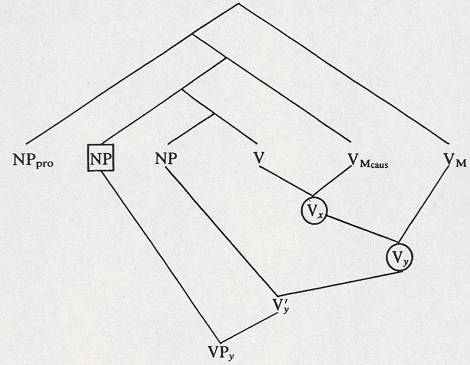
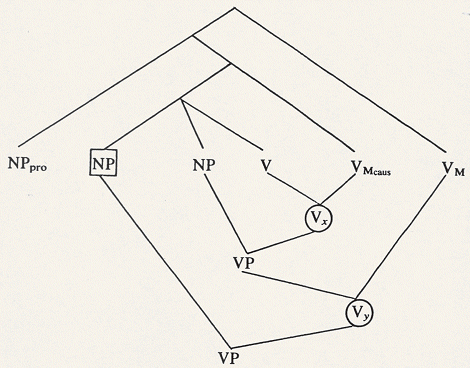
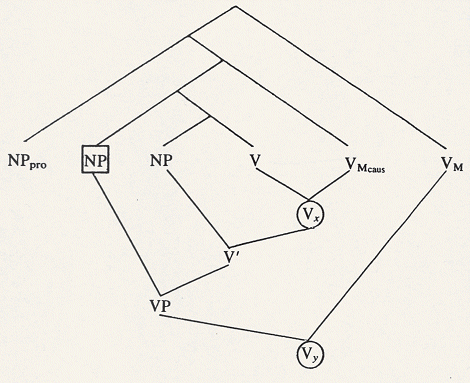
We may conclude, then, that Extraposition is not the rule by which VPR patterns can be derived. A second argument for our analysis of VPR is based on an interesting observation from Lötscher (1978). Lötscher notes that the (exceptionally case-marked) subject of a complement to a causative or perception verb can enter a verb cluster via VPR at some higher cycle but never at the lowest level (that is, the lowest cycle on which Reanalysis could possibly apply). The ensuing prediction is that such a subject may never surface to the right of the causative (or perception) verb. Note that these verbs function as
(33) a. VPR  | |||||||||||||||||||||||||||||||||||||||||||||||||||||||||||||||||||
[pagina 430]
| |||||||||||||||||||||||||||||||||||||||||||||||||||||||||||||||||||
b. VR  modals in ZT as far as Inversion is concerned. (35) illustrates why Lötscher's observation follows from our analysis: (35) a.  | |||||||||||||||||||||||||||||||||||||||||||||||||||||||||||||||||||
[pagina 431]
| |||||||||||||||||||||||||||||||||||||||||||||||||||||||||||||||||||
b.  c.  In (35b) VPR applies at the lowest level only; the (boxed) subject NP is left outside the verb cluster and hence will remain to the left of that verb cluster. In (35c) VPR applies at both levels; but though the boxed NP will end up inside the verb cluster, it will still remain to the left of VMcaus. | |||||||||||||||||||||||||||||||||||||||||||||||||||||||||||||||||||
[pagina 432]
| |||||||||||||||||||||||||||||||||||||||||||||||||||||||||||||||||||
The prediction holds, of course, because the subject is not dominated by some projection of V at the lowest level. Ga naar voetnoot10 The following examples, adapted from Lötscher's, show that the prediction is fully borne out: Ga naar voetnoot11
(36) a. (*)das er sini chind mediziin studiere laaMcaus wilM that he his children medicine study let wants ‘that he wants to let his children study medicine’ b. das er sini chind mediziin wil laa studiere c. das er sini chind wil mediziin laa studiere d. das er sini chind wil laa mediziin studiere e. das er wil sini chind mediziin laa studiere f. das er wil sini chind laa mediziin studiere g. *das er wil laa sini chind mediziin studiere
The fact that this complex pattern of facts follows directly from the formulation of VPR constitutes further evidence for our analysis. Under some extension of Extraposition, it would remain quite mysterious why the S dominating the boxed NP is not available for Reanalysis. A third, and final, argument comes from extraction facts. Extraposed complement clauses do not allow long extraction, but VR complements do. VPR structures pattern | |||||||||||||||||||||||||||||||||||||||||||||||||||||||||||||||||||
[pagina 433]
| |||||||||||||||||||||||||||||||||||||||||||||||||||||||||||||||||||
with VR and not with Extraposition in this respect. We will show this by means of the rule of Was Für Extraction, discussed for German in Den Besten (1982). Like High German, ZT has NPs of the form was für NP, meaning ‘what kind of NP’. Apart from pied-piping the whole NP under Move Wh, it is also possible to move just was (in violation of the Left Branch Condition). Consider (37) and (38):
(37) a. ?*Wasi hät er aaggεε das er ei für büecher list? what has the pretended that he kind of books reads ‘What kind of books has he pretended that he reads?’ b. ?*Wasi hät er aaggεε ei für büecher z läse? what has he pretended kind of books to read ‘What kind of books has he pretended to read?’ | |||||||||||||||||||||||||||||||||||||||||||||||||||||||||||||||||||
[pagina 434]
| |||||||||||||||||||||||||||||||||||||||||||||||||||||||||||||||||||
(38) Wasi hät er ei, für büecher wele läse? what has he kind of books wanted read ‘What kind of books has he wanted to read?’
(37) shows that extraction is marginal from extraposed complements, regardless of whether they are tensed or infinitival. In contrast, (38) demonstrates that extraction is possible from a VR complement. The crucial fact, now, is that (39), the VPR case corresponding to (38), is equally grammatical:
(39) Was hät er wele ei für büecher läse?
On the basis of these arguments, we take the analysis in terms of VPR to be solidly supported Ga naar voetnoot12 and turn to an argument in favor of Reanalysis plus Inversion and against an adjunction analysis such as Evers's. | |||||||||||||||||||||||||||||||||||||||||||||||||||||||||||||||||||
1.5. Against AdjunctionA potential argument against an adjunction analysis arises from cases where the lowest verb has two complements-say, an indirect object and a direct object. In the following example we label the constituents as indicated: (40)  To simplify the exposition, we will use the labeled nodes only in the examples below. The structure before Reanalysis is as shown in (41), omitting irrelevant S nodes: | |||||||||||||||||||||||||||||||||||||||||||||||||||||||||||||||||||
[pagina 435]
| |||||||||||||||||||||||||||||||||||||||||||||||||||||||||||||||||||
(41)  The verbs will, of course, surface in the inverted order, but what about the NPs? It turns out that the following descriptive generalization holds:
(42) a. NP2 and NP3 preserve their relative order. b. They can appear in any position to the left of or inside the verb cluster, though not (as noted before) to the right of the verb cluster.
Thus, an underlying structure like (40) has six possible outputs:
(43)
(43a) is derived by choosing Vo for Reanalysis at every level, (43f) by picking VP at the lowest level. We will give the derivations for (43c,d,e) below, but first we concentrate on (43b), which is the crucial case. Consider how an adjunction analysis as given in (13) would work. In order to get NP3 to enter the verb cluster at all, (at least) the V' must be selected for adjunction on the lowest cycle. Taking V' but not VP will guarantee that NP2 will remain outside the verb cluster. But once the V' has been adjoined to the right of Vb, the newly created V node must undergo adjunction again and the incorporated NP3 is moved along. Hence, we derive (43d), not (43b). In short, there is no way to derive (43b) under the adjunction analysis, or at least under a simple version of it (see below). In order to show how (43b) is derived under the Reanalysis plus Inversion analysis, we must be a little more circumspect than we have been. Complex derivations such as those in (35) were presented in a simplified manner because in fact they involve two | |||||||||||||||||||||||||||||||||||||||||||||||||||||||||||||||||||
[pagina 436]
| |||||||||||||||||||||||||||||||||||||||||||||||||||||||||||||||||||
instances of Reanalysis and not just one. Hence, given Huybregts's theory of syntactic representations, these cases involve three dimensions, not just two as suggested by the trees in (35). With this in mind, consider the stepwise derivation of (43b). First, we apply Reanalysis to Va on the lowest level: (44)  | |||||||||||||||||||||||||||||||||||||||||||||||||||||||||||||||||||
[pagina 437]
| |||||||||||||||||||||||||||||||||||||||||||||||||||||||||||||||||||
In order to represent the second application of Reanalysis graphically, let us substitute the bottom tree of (44) for the corresponding node of S2 in the top tree and apply Reanalysis to the V'x of the resulting tree: (45)  (43b) can now be straightforwardly derived by applying Inversion to the circled nodes in the bottom tree of (45). We may conclude, then, that the adjunction analysis fails to | |||||||||||||||||||||||||||||||||||||||||||||||||||||||||||||||||||
[pagina 438]
| |||||||||||||||||||||||||||||||||||||||||||||||||||||||||||||||||||
fully express the descriptive generalization stated in (42) and illustrated in (43) but that the Reanalysis plus Inversion analysis expresses it correctly. For the sake of completeness, we give the derivations of all cases of (43) in an abbreviated way in (46):
(46) S2 cycle S3 cycle (43)  The argument we have presented tacitly assumes one specific version of the adjunction theory-that is, one without Pruning. In tightening up the argument, we must briefly address the choice between adjunction with and adjunction without Pruning, although this choice is, of course, quite independent of the issue at hand. Observe, first, that a version of the Pruning theory can be constructed under which (43b) can be derived, as has been pointed out to us by Riny Huybregts. On this option, the nonverbal constituents of the embedded clause whose S node and remaining V-projection nodes are pruned regroup under the next higher S in a structure-preserving | |||||||||||||||||||||||||||||||||||||||||||||||||||||||||||||||||||
[pagina 439]
| |||||||||||||||||||||||||||||||||||||||||||||||||||||||||||||||||||
fashion: [NP,VP] reattaches under VP, [NP,V'] under V', etc. This device is the equivalent under the Pruning theory of those principles of the Reanalysis theory that guarantee that each new dimension preserves dominance relations unless the Reanalysis rule itself affects them directly. If Evers's (1975) analysis in terms of adjunction plus Pruning is amended to include such a principle, then (43b) can indeed be derived, as the reader may verify. But independent considerations argue against Pruning, given the adjunction analysis. First, as Evers himself has pointed out (Evers (1981)), Pruning violates the θ-Criterion and thereby the Projection Principle. (Recall that Reanalysis is compatible with the θ-Criterion; see Haegeman (1985).) More interestingly, Pruning makes the wrong predictions with respect to transparency phenomena. It is well known that V(P)R complements are transparent for many processes that are otherwise clause-bound. We have briefly alluded to some such processes; more discussion can be found in (among other works) Evers (1975) and Koster (1983). Note, now, that Pruning predicts transparency in all respects: since the embedded S node is gone, there is no clause within which anything could possibly be bound. But this prediction is definitely too strong, as is shown, for example, by the behavior of bound anaphors (see, for example, Koster (forthcoming) for more discussion). Consider the following Dutch example:
(47) Jani heeft Mariej zich*i/j laten wassen. Jan has Marie *himself/herself let wash ‘Jan has made Marie wash *himself/herself.’
The same effect is obtained under VPR in ZT and WF. Without going into the details of the analysis of such cases, it should be clear that they can be handled only in a theory in which enough of the embedded clause is preserved to make it possible to identify it as the governing category. Both Reanalysis and adjunction without Pruning satisfy this requirement, but adjunction with Pruning does not. The logic of the argument, then, is this. Under the adjunction theory, the problem arising from (43b) can only be solved at the expense of adopting Pruning, a device that runs afoul of the θ-Criterion and of the analysis of the opacity effects in VR complements. | |||||||||||||||||||||||||||||||||||||||||||||||||||||||||||||||||||
1.6. VPR, Word Order, and NonconfigurationalityIn the cases of VPR we have studied so far the arguments of the verb occupy their canonical, structurally defined positions. In other words, the subject is [NP,S], the indirect object is [NP,VP], and the direct object is [NP,V']. On the other hand, however, it is well known that the order of constituents in German, and to a somewhat lesser extent in Dutch, is extremely free. Though some restrictions exist, they are largely due to semantic or pragmatic factors, as Lenerz (1977) shows. Ga naar voetnoot13 The same is true for ZT. | |||||||||||||||||||||||||||||||||||||||||||||||||||||||||||||||||||
[pagina 440]
| |||||||||||||||||||||||||||||||||||||||||||||||||||||||||||||||||||
Given the right choice of examples and the right intonation, however, every possible permutation of S, IO, and DO can occur:
(48)
How should such cases be treated under our analysis of VPR? Before discussing this question, we will consider by way of background the controversy about the (non)configurationality of German (and, by extension, of ZT). Several researchers have argued that German should be analyzed as a noncon-figurational language. (See, for example, Haider (1983), Sternefeld (1984), and Tappe (1982).) The main opposition to this view has been Den Besten's (1982) work on the rule of Was Für Extraction. This is not the place to review all the pros and cons of these positions. But it should be noted that the correctness of our analysis of VPR, which is entirely consistent with Den Besten's findings, would imply that ZT (and, by extension, German) cannot be nonconfigurational. The least that can be said is that the burden of proof rests on the shoulders of those who support the nonconfigurational analysis. How could surface structure constraints (as proposed in Sternefeld (1984)) or other devices yield a revealing account of the intricate word order patterns found in ZT? How could they explain, for example, that the descriptive generalization (42), which, as we will soon show, extends perfectly to such cases as (48), holds? Though alternative accounts should be thoroughly explored, we may tentatively conclude that the evidence from VPR phenomena seems to support the configurational analysis of German and other Germanic dialects. In view of this conclusion, the question arises how free word order phenomena as exemplified in (48) should be handled. It may be possible to argue, as suggested in Den Besten (1982), that all ordering possibilities of (48) are derivable by means of various applications of Move α. This would be the most interesting theory. But even if such a theory cannot be maintained, it still does not follow that we have to give up the configurational syntactic structure. The minimal assumption would be that the major grammatical functions (S, IO, DO) may be nonconfigurationally defined even when the relevant syntactic configurations are available. We are not excluding, then, the possibility that certain languages (like Warlpiri, perhaps; see Hale (1983)) might be truly noncon- | |||||||||||||||||||||||||||||||||||||||||||||||||||||||||||||||||||
[pagina 441]
| |||||||||||||||||||||||||||||||||||||||||||||||||||||||||||||||||||
figurational in the sense that they define grammatical functions nonconfigurationally (that is, without reference to syntactic configurations) and lack hierarchical syntactic configurations. From this perspective, the examples in (48) would have the structure in (49): (49)  Applied to such cases as (49), the descriptive generalization in (42) implies that whatever the word order restrictions with respect to NP1-NP2-NP3, they remain constant under VPR. This implication is entirely correct. For example, Lenerz's restriction noted in footnote 13 holds with equal force when the IO is separated from the DO by VPR. We will not illustrate this in any detail except to show one example based on Den Besten's analysis of Was Für Extraction. Den Besten notes that extraction from subjects in the NP1 position is blocked, whereas it is possible (by virtue of the ECP, he assumes) from (‘ergative’) subjects in NP3. We might add to this that extraction from objects in the NP2 position is also impossible. Ga naar voetnoot14 This is illustrated in (50):
(50) a. *Wasi händ ei, für lüüt das buech gläse? what have kind of people that book read ‘What kind of people have read that book?’ b. Wasi würded em Hans ei für büecher gfale? what would (to) Hans kind of books please ‘What kind of books would please Hans?’ c. *Wasi hät ei für es buech de Hans gläse? what has kind of a book Hans read ‘What kind of book has Hans read?’ | |||||||||||||||||||||||||||||||||||||||||||||||||||||||||||||||||||
[pagina 442]
| |||||||||||||||||||||||||||||||||||||||||||||||||||||||||||||||||||
These restrictions remain constant in the following cases of VPR:
(51) a. *Wasi glaubsch das ei für lüüt wänd das buech läse? what believe-you that kind of people want that book read ‘What kind of people do you believe want to read that book?’ b. Wasi glaubsch das em Hans würded ei für büecher gfale? what believe-you that (to) Hans would kind of books please ‘What kind of books do you believe would please Hans?’ c. *Wasi glaubsch das ei für es buech wil de Hans läse? what believe-you that kind of a book wants Hans read ‘What kind of book do you believe Hans wants to read?’
This concludes our discussion of the major syntactic properties of the V(P)R construction. We will now turn to a number of systematic semantic effects associated with the construction. | |||||||||||||||||||||||||||||||||||||||||||||||||||||||||||||||||||
2. Semantic Effects of Verb (Projection) RaisingVR and VPR not only result in reorderings of the constituents internal to VP. A wide range of facts of both WF and ZT shows that there are also semantic effects, which can be summed up as follows. Incorporated elements have narrow scope with respect to V(P)R verbs; nonincorporated elements have either wide scope or narrow scope. We will survey these semantic effects in the following subsections. | |||||||||||||||||||||||||||||||||||||||||||||||||||||||||||||||||||
2.1. Negation and IncorporationConsider the following sentences:
(52) WF a. da Jan geen vlees hee willen eten that Jan no meat has wanted eat b. da Jan hee willen geen vlees eten (53) ZT a. das de Hans kä fläisch hät wele ässe that Hans no meat has wanted eat b. das de Hans hät wele kä fläisch ässe
The (a)-examples illustrate the nonincorporated variant, where the negative existentials geen vlees and kä fläisch are outside the reanalyzed verb cluster; the (b)-examples illustrate incorporation. The negative existential in the (a)-examples may have wide scope or narrow scope with respect to the modal willen/wele ‘want’. (52a) thus means either that Jan does not want to eat any meat (wide scope) or that he wants to eat no meat (narrow scope). Similarly for (53a). However, when geen vlees/kä fläisch has been incorporated, as in the (b)-examples, the negative existential must have narrow scope. For (52) and (53) the only interpretation | |||||||||||||||||||||||||||||||||||||||||||||||||||||||||||||||||||
[pagina 443]
| |||||||||||||||||||||||||||||||||||||||||||||||||||||||||||||||||||
is that Jan/Hans wants to eat no meat. The negative elements in geen vlees/kä fläisch cannot now have scope wider than willen/wele, the modal verb triggering VPR. The narrow- and wide-scope readings may be informally represented as follows:
(54) a. x wants [∄y such that x eats y] b. ∄y [x wants to eat y]
An identical effect is to be observed with respect to the negative operator niet/nöd in (55) and (56):
(55) WF a. da Jan nie hee willen weggoan that Jan not has wanted go-away b. da Jan hee willen nie weggoan (56) ZT a. das de Hans nöd hät wele wεggaa that Hans not has wanted go-away b. das de Hans hät wele nöd wεggaa
The nonincorporated negative element in the (a)-sentences may negate (hence, take scope over) the modal, or it may negate the main verb weggoan/wεggaa only and be within the scope of the modal. (55a) and (56a) thus mean either that Jan/Hans does not want (or refuses) to go, or that Jan/Hans wants (or is willing) not to go. But when a negative element is incorporated by VPR, as in the (b)-sentences, only the latter reading is available. As the reader may have noted, the semantic contrasts between the two readings of (52)/(53) and (55)/(56) are not easy to perceive. This is mainly because matrix scope is difficult to distinguish from complement scope with a verb like willen/wele ‘want’. The contrasts are perhaps clearer with a verb like durven ‘dare’ in WF. For example:
(57) a. da Jan geen toelating hee durven geven that Jan no permission had dared give b. da Jan hee durven geen toelating geven
(57a), with the existential negation outside the verb cluster, is ambiguous: either it means that Jan has dared not to give permission (that is, that Jan has dared to refuse permission), in which case the verb durven takes scope over the negation, or it means that Jan has not dared to give permission (that is, he lacked the courage to give permission). In the latter case the negative element takes scope over durven. The former reading points out Jan's courage, the latter his weakness. (57b), with the incorporated negation, has only the reading with wide scope for durven. The effect for scope-bearing elements with respect to VR and VPR is quite sharp for all speakers of the dialects concerned. In WF it can be perceived even more clearly in cases of double negation. In this dialect multiple negatives in a single clause need not cancel each other, but may have a reinforcing effect. In (58), for example, nooit ‘never’ | |||||||||||||||||||||||||||||||||||||||||||||||||||||||||||||||||||
[pagina 444]
| |||||||||||||||||||||||||||||||||||||||||||||||||||||||||||||||||||
and geen vlees ‘no meat’ reinforce each other:
(58) Jan eet nooit geen vlees. Jan eats never no meat ‘Jan never eats any meat.’ (59) a. da Jan nooit geen vlees wilt eten that Jan never no meat wants eat b. da Jan nooit wilt geen vlees eten c. da Jan wilt nooit geen vlees eten
In (59a) both negative elements are outside the verb cluster and they behave as they do in (58): they reinforce rather than cancel each other. The most likely reading for (59a) is that in which the negation has wide scope: that Jan never wants to eat any meat. Of course, the narrow-scope reading is also available, as it is in (52a). In (59c) both negative elements have been incorporated. Again they reinforce each other, but now they will have narrower scope than the modal (see the discussion of (52b)). In (59b), however, only one of the two negative elements has been incorporated (geen vlees); the other is outside the verb cluster. The negation outside the cluster and the negation inside the cluster cannot now be construed as reinforcing each other and achieving a single negation; rather, the nonincorporated negative nooit ‘never’ must take scope over the incorporated geen vlees ‘no meat’, thus yielding the meaning ‘NEVER wants to eat NO meat’. | |||||||||||||||||||||||||||||||||||||||||||||||||||||||||||||||||||
2.2. Quantifier ScopeThe effect of V(P)R is sharpest with respect to negators. However, other quantifiers also tend to produce effects of the same sort, though sometimes weaker:
(60) WF a. da Jan vee boeken hee willen lezen that Jan many books has wanted read b. da Jan hee willen vee boeken lezen (61) ZT a. das de Hans vili büecher hät wele läse that Hans many books has wanted read b. das de Hans hät wele vili büecher läse
In (60) and (61) the quantified phrase vee boeken/vili büecher is not incorporated. These examples each have two readings: either the quantified phrase takes scope over the modal verb, thus specifying the frequency of wanting (‘for many books, John has wanted to read them’), or the modal verb takes scope over the quantifier (‘what John has wanted is to read many books’). However, when vee boeken/vili büecher is incorporated, as in the (b)-examples, only one reading is available: that in which the modal verb takes scope over the quantifier. | |||||||||||||||||||||||||||||||||||||||||||||||||||||||||||||||||||
[pagina 445]
| |||||||||||||||||||||||||||||||||||||||||||||||||||||||||||||||||||
The same effect is illustrated quite clearly in (62) and (63) with the universal quantifier (al de boeken/alli büecher ‘all the books’).
(62) WF a. da Jan al de boeken van Conscience hee willen lezen that Jan all the books of Conscience has wanted read b. da Jan in zijn leven hee willen al de boeken van Conscience lezen in his life
(63) ZT a. das de Hans alli büecher vom Gotthelf hät wele läse b. das de Hans hät wele alli büecher vom Gotthelf läse
The (a)-sentences with nonincorporated quantifier mean either that there was one wish to read all the books by some author or that, whenever a book of the type described was involved, Jan/Hans wanted to read it, in which case multiple wishes are involved. When the universal quantifier is incorporated, as in the (b)-sentences, the implication is that there was one wish to read all the books, and not repeated wishes to read one or more books by some author. The effect of incorporation by VPR is also to be observed in the case of floated quantifiers. Consider the following examples:
(64) WF a. K peinzen dan al de studenten goan moeten een boek van I-think that all the students go must a book of Conscience lezen. Conscience read ‘I think that all students will have to read a book by Conseience.’ b. K peinzen dan de studenten al goan moeten een boek van Conscience lezen. c. K peinzen dan de studenten goan moeten al een boek van Conscience lezen.
(65) ZT a. das alli studänte werded müese es buech vom Gotthelf läse b. das d studänte alli werded müese es buech vom Gotthelf läse c. das d studänte werded müese alli es buech vom Gotthelf läse
In (64) and (65) we see that al/alli, the quantifier, can float off the subject NP. The (c)-examples show that such a floated quantifier may be incorporated by VPR. In the nonincorporated variants (64a,b) and (65a,b) al/alli take wide or narrow scope with respect to moeten/müese, the modal verb. Thus, there may be a single obligatipn imposed on all the students or, alternatively, for each student there is an obligation to read a certain book. In the incorporated variant (64c) and (65c), however, only the narrow-scope reading of ‘all’ is possible: in these cases there will be one obligation for all the students to read a certain book. | |||||||||||||||||||||||||||||||||||||||||||||||||||||||||||||||||||
[pagina 446]
| |||||||||||||||||||||||||||||||||||||||||||||||||||||||||||||||||||
2.3. AdverbialsAdverbial scope is similarly affected by V(P)R:
(66) WF a. dase morgen wil kommen that-she tomorrow wants to come b. dase wil morgen kommen (67) ZT a. dassi moorn wil choo b. dassi wil moorn choo
Nonincorporated adverbials (morgen in (66a) and moorn in (67a)) have either wide or narrow scope with respect to the modal verb wil ‘wants’. Thus, in the (a)-examples morgen/moorn specifies either the time of the wanting or the time of the coming. In the incorporated variant (66b) and (67b) the time adverb must have narrow scope with respect to the modal verb: morgen/moorn now only specifies kommen/choo. These observations also apply to zo … dat/so … das sequences:
(68) WF a. dase morgen zo vroeg wil weggoan dat-er that-she tomorrow so early wants-to go-away that-there niemand antyden ken zijn nobody on-time can be ‘that she wants to leave so early tomorrow that nobody can be there on time’ b. dase morgen wil zo vroeg weggoan dat-er niemand antyden ken zijn (69) ZT a. dassi moorn so vrüe wil abräise das niemert rächtziitig cha choo b. dassi moorn wil so vrüe abräise das niemert rächtziitig cha choo
In the (a)-examples zo vroeg/so vrüe has not been incorporated. It may thus have wider scope than wil ‘want’ and the dat/das clause dependent on zo/so may have a result reading: she wants to leave so early that no one will manage to come on time. Of course, the narrow-scope reading is also available, in which case the zo … dat/so … das clause has a purpose reading: she wants to leave so early in order that no one be able to come on time. In the incorporated (b)-variant, though, only the latter (purpose) reading is available, since wil must take scope over zo vroeg/so vrüe. Exactly parallel observations can be made for comparative clauses:
(70) WF a. dase meer mensen wil vroagen dan dat-er stoelen zyn that-she more people wants ask than that-there chairs are ‘that she wants to invite more people than there are chairs’ b. dase wil meer mensen vroagen dan dat-er stoelen zyn | |||||||||||||||||||||||||||||||||||||||||||||||||||||||||||||||||||
[pagina 447]
| |||||||||||||||||||||||||||||||||||||||||||||||||||||||||||||||||||
(71) ZT a. dassi mee lüüt wil iilade als stüel daasind b. dassi wil mee lüüt iilade als stüel daasind
In the (a)-sentences the comparative meer mensen/mee lüüt has wide or narrow scope with respect to wil. Thus, that there are more people than chairs may be nonintentional or intentional. In the (b)-sentences, however, wil has wide scope with respect to the comparative. Only the intentional reading is available. | |||||||||||||||||||||||||||||||||||||||||||||||||||||||||||||||||||
2.4. Er Insertion and Modal ScopeWF sentences with existentially quantified subjects necessarily have Er Insertion:
(72) a. dan-der vee mensen kommen that-there many people come b. *dan vee mensen kommen that many people come
The result of Er-Insertion is that an indefinite subject ends up inside VP. Hence, such a moved subject may be affected by V(P)R:
(73) a. dan-der vee mensen goan kommen that-there many people go come b. dan-der goan vee mensen kommen
An interesting effect can now be observed whenever the verb triggering V(P)R is a modal. Consider the following examples:
(74) a. dan-der vee mensen keunen kommen that-there many people can come b. dan-der keunen vee mensen kommen
In (74a) vee mensen, the indefinite subject, is not incorporated. Thus, it has wide or narrow scope with respect to the modal keunen. (74a) has two readings. Either the modal has its epistemic reading (‘it is possible that many people come’), or it has its root reading (‘many people are able to come’). In (74b), on the other hand, vee mensen is incorporated by VPR. Thus, it has narrow scope with respect to keunen. In (74b) keunen has only its epistemic reading (‘it is possible that many people come’). We may therefore argue that the ambiguity of modals is in fact a scope ambiguity: in the case of epistemic readings the modal has scope over the subject NP; in the case of root readings the subject NP is outside the scope of the modal. | |||||||||||||||||||||||||||||||||||||||||||||||||||||||||||||||||||
2.5. The Clause Union ParadoxThe observations in the preceding sections lead to an apparently paradoxical situation. On the one hand, VPR constructions constitute an extreme case of clause union. Clause union is traditionally viewed as a complete merger of the embedded clause with the | |||||||||||||||||||||||||||||||||||||||||||||||||||||||||||||||||||
[pagina 448]
| |||||||||||||||||||||||||||||||||||||||||||||||||||||||||||||||||||
matrix clause. In the ‘standard’ treatment of quantification (see May (1977)) narrow scope is expressed by adjoining the quantifier to the embedded S by means of Quantifier Raising (QR). Note now that when there is no embedded S, narrow scope cannot be expressed. Yet we have just seen that VPR structures impose narrow-scope readings on incorporated elements: a paradox. In section 3 we will examine ways to avoid this paradox. | |||||||||||||||||||||||||||||||||||||||||||||||||||||||||||||||||||
3. A Theory of Relative Scope3.1. The Inadequacy of Quantifier RaisingIn the attempt to solve the clause union paradox, Huybregts's analysis offers one main ingredient: the biclausal and the monoclausal structures are simultaneously represented. We might think, then, that QR can refer to the embedded S node in the relevant dimension in order to express narrow scope. This is not so, however. Under Huybregts's theory, the effects of movement must be compatible with the structural constraints in all dimensions, not just in one. Consider what the effect would be of adjoining the Q in a structure like (75) to the embedded S: (75)  | |||||||||||||||||||||||||||||||||||||||||||||||||||||||||||||||||||
[pagina 449]
| |||||||||||||||||||||||||||||||||||||||||||||||||||||||||||||||||||
As (76) shows, the raised quantifier has no S node in the other dimension to attach to: (76)  The reason Qi, cannot be adjoined to S2 under QR is that S2 is unanalyzable because it is absent in the bottom dimension. Although both S1 and VP1 are analyzable, adjunction of Qi to either of these nodes offers no solution since such a derivation would result in a representation for the wide-scope reading. We must conclude, then, that QR cannot be the second ingredient in our solution of the clause union paradox. Before turning to an alternative analysis of scope, however, we must discuss several other facts. | |||||||||||||||||||||||||||||||||||||||||||||||||||||||||||||||||||
3.2. Quantifier Scope vs. Wh-ScopeA first consideration is that the relative scope of modal verbs and quantifiers as discussed in section 2 is distinct from scope effects with respect to Move Wh and wh-in-situ.
3.2.1. Extraction. It is not possible to argue that both wh-extraction and relative quantifier scope are regulated by exactly the same mechanisms as they would be under a QR | |||||||||||||||||||||||||||||||||||||||||||||||||||||||||||||||||||
[pagina 450]
| |||||||||||||||||||||||||||||||||||||||||||||||||||||||||||||||||||
analysis of scope. Wh-extraction is possible from inside verb clusters created by VPR, whereas incorporated quantifiers cannot take scope outside the verb cluster:
(77) WF a. dan-ze willen een besprekinge doavan moaken that-they want a review thereof make ‘that they want to write a review of it’ b. dan-ze doa willen een besprekinge t van moaken c. woa dan-ze willen een besprekinge t van moaken (78) ZT Was häsch wele em Rägeli t für büecher chaufe? what have-you wanted Rägeli t for books buy ‘What kind of books did you want to buy for Rägeli?’
(77b,c) and (78) illustrate wh-extraction from inside verb clusters. In (78) we see that was für split (see section 1.6) may extract material from inside the cluster; in (77) we see how prepositions (van) may be stranded inside the cluster. Ga naar voetnoot15 At this point it may be useful to dwell a moment on preposition stranding in (77b,c). It is well known that, in standard Belgian Dutch, stranded prepositions may in general occur inside the verb cluster, although in this variant of the language further incorporation of nonverbal elements through VPR is not possible. In order to account for this, it is generally assumed that the preposition first reanalyzes with the verb and then is moved with V after Reanalysis for VR: (79)  It might of course be argued that this approach is also to be advocated whenever prepositions are incorporated by VPR, as in (77b,c). Thus, one might still argue that the | |||||||||||||||||||||||||||||||||||||||||||||||||||||||||||||||||||
[pagina 451]
| |||||||||||||||||||||||||||||||||||||||||||||||||||||||||||||||||||
trace itself is outside the verb cluster. However, such a view is unattractive for two reasons:
a. In general, we have demonstrated that nonverbal elements can be incorporated by VPR in WF and ZT. Hence, the reanalysis of P and V as in (79b) is redundant; the full PP (that is, the trace of Move Wh and P) could be incorporated by VPR anyway. b. More important, such an approach for PP- and P-stranding should predict that no further material to the left of the trace (in PP) can be incorporated. However, in both (77b,c) and (78) further material to the left of the trace is incorporated: in (77b,c) the NP een besprekinge, in (78) the NP em Rägeli. Even if one were to argue for a reanalysis along the lines of (79b), then, the trace would still be contained in the verb cluster. This means that in cases like (77b,c) and (78) proposal (79) is untenable.
Another observation is relevant here. That extraction from a VPR cluster is at all possible is perhaps quite unexpected. VPR constructions are dominated by a Vx-that is, a node that has the status of a lexical head in its VP. It is a general property of lexical items that they do not allow extraction of their constituent parts. On the other hand, it is quite clear that clusters created by V(P)R are not lexical in that sense. For example, Verb Second, which places the finite verb in second position in main clauses, extracts the finite verb from the verb cluster.
3.2.2. Absolute vs. Relative Scope. The data also support the view that the scope of wh-in-situ is not to be equated with the other types of quantifier scope (see Aoun, Hornstein, and Sportiche (1980)). Consider the following multiple wh-questions:
(80) WF a. K weten nie wien dan-ze goan willen voo wekken cursus anduden. I know not whom that-they go want for which course appoint ‘I wonder whom they will want to assign to which course.’ ZT b. Ich wäiss nöd wen dass wänd vür wele kurs iisetze. I know not whom that-they want to which course assign
In both (80a) and (80b) the incorporated element may apparently have wider scope than the modal verb willen/wele since the multiple question reading is possible. These data show that wh-extraction and wh-scope constitute a different type of scope, one that is not subject to the constraints determining the relative scope of such quantifiers as those discussed in section 2. We will refer to the former as absolute scope and to the latter as relative scope. The conclusion that we must distinguish these two types of scope clearly casts doubt on the possibility of equating the treatment of scope phenomena of quantifiers with that of wh-in-situ and on the assumption that all scope phenomena should be handled by the single rule of QR. It is clear that QR would have to be severely restricted by output constraints as far as the scope determination of relative | |||||||||||||||||||||||||||||||||||||||||||||||||||||||||||||||||||
[pagina 452]
| |||||||||||||||||||||||||||||||||||||||||||||||||||||||||||||||||||
quantifiers is concerned and that no such constraints are operative for wh-elements. In this article we are crucially concerned with relative scope-bearing elements such as modal verbs and the quantifiers discussed above. Scope effects for wh-elements should be treated differently-that is, by QR or by some other scope-assigning process. This conclusion is not new. It has already been pointed out in the literature, for example, that the scope of modal operators is clause-bound (Williams (1984)). In (81a), for example, must cannot take scope wider than the clause in which it occurs; more specifically, it cannot have scope over someone, the subject of the higher clause:
(81) a. Someone thinks that John must leave. b. someonei [xi thinks [must [John leave]]] c. *[must [someonei [xi thinks [John leave]]]]
Under standard assumptions, both (81b) and (81c) would be derived by QR.
3.2.3. Scope Indexing. In order to represent scope relations for relative scope, we will adopt an alternative notation using indexing mechanisms proposed by Hellan (to appear). In Hellan's notation every NP has a token index, indicated by a left subscript; right subscripts, called binder indices, are used to express dependencies among NPs. In terms of this notation, we can express scopal dependencies as follows:
(82) Scope Indexing If iNP is in the scope of jNP, then append j as a binder index to iNP; that is, iNPj is read ‘iNP is in the scope of jNP.’
In other words, whenever a scope-bearing NP takes scope over another NP, its token index is appended as a binder index to the NP in its scope. Using this notation, let us now try to formulate a rule for scope indexing. As our starting point we will use the rule for Scope Indexing introduced by Haïk (1984):
(83) Scope Indexing applies freely when NPs belong to the same minimal S. Otherwise, jNP must be c-commanded by iNP in order to be indexed as being in the scope of iNP.
The great advantage of such a formulation is that it expresses relative scope directly as a relation between two scope-bearing elements, without reference to some scope domain (S). This avoids the difficulties that arise under the QR approach discussed in section 3.1. Unfortunately, however, the rule as it stands fails to express what we want it to express. First, it is restricted to NP scope, whereas we wish to consider all types of scope-bearing elements, such as negators and modal verbs. Furthermore, it fails to predict the limitations on the scope of incorporated elements. Quantifier elements inside verb clusters do not take free scope. In the following sections we will examine how we could reformulate Hai¨k's rule, in order to accommodate our observations. | |||||||||||||||||||||||||||||||||||||||||||||||||||||||||||||||||||
[pagina 453]
| |||||||||||||||||||||||||||||||||||||||||||||||||||||||||||||||||||
3.3. Reformulating Scope Indexing3.3.1. C-Command for Relative Scope. Our reformulation of Scope Indexing makes use of (a) Reinhart's (1979) idea that scope relations should be expressed by means of c-command and (b) Huybregts's analysis of V(P)R phenomena. Let us consider again the crucial configurations corresponding to VR and VPR: (84) 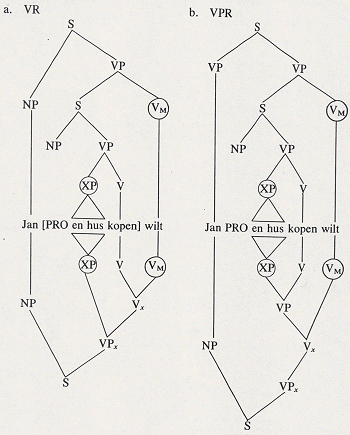 The intuitive idea is this. If we look at the bottom trees in (84), we could say that in (84a) XP c-commands VM, whereas in (84b) VM c-commands XP. Suppose, then, that we try to capitalize on this distinction. Observe that in the top trees the c-command relations are identical. | |||||||||||||||||||||||||||||||||||||||||||||||||||||||||||||||||||
[pagina 454]
| |||||||||||||||||||||||||||||||||||||||||||||||||||||||||||||||||||
In order to make this intuitive idea work, we must reformulate the notion of c-command in such a way that it takes into account the properties of nodes created in Reanalysis-that is, Vx in (84). In doing so, we will make use of Muysken's (1982) notation for X' projections. In this notation the bars are replaced by the two features [±projection] and [± maximal]. Thus, [- proj, - max] stands for Xo and [+ proj, + max] stands for Xmax. The intermediate bar levels, regardless of how many there are, are represented as [+ proj, - max]. The remaining feature combination, [- proj, + max], is used for such categories as particles, which are like heads (P in this case) but lack a projection. Note, now, that a V node created by Reanalysis must be [- proj, - max] since it heads a new V projection in its dimension. Let us first consider the VR case (84a)- more specifically, the relations between XP, the scope-bearing element, and VM, the modal verb triggering Reanalysis. On the basis of Muysken's proposal, we now reformulate the definition of c-command as follows:
(85) α c-commands β iff the first node γ dominating α, for γ = [δproj][δmax], also dominates β, and α does not dominate β.
The condition that γ = [δproj, δmax] ensures that the upward bound for c-command in the relevant case is VP ([+proj, + max]) or Vx([- proj, - max]). Under such a definition of c-command, it is clear that VM in (84a) fails to c-command XP in the bottom tree, the relevant γ being the V created by Reanalysis. The double analysis of (84a) can thus be directly linked to the ambiguity of VR constructions: in one dimension the modal verb c-commands the quantifier, in another the quantifier c-commands the modal. Accordingly, we will formulate our revised scope rule, which we will call the Unmarked Scope Rule (USR) for reasons to which we return below, as follows:
(86) Unmarked Scope Rule (USR) for relative scope
iα … jβ … → … iα … jβi … iff there is a D, D a dimension, such that iα c-commands jβ; where α and β are scope-bearing elements.
(86) yields the desired result that cases of VR such as (84a) have two readings. Let us now return to the analysis of the VPR pattern (84b). We have seen in section 2 that incorporated elements cannot have wide scope. When we inspect c-command relations in (84b), it becomes clear that Reanalysis does not have any effects with respect to the relative c-command properties of XP and VM. In both the top and the bottom dimension VM c-commands XP. On the basis of the USR (86) we predict that incorporated elements have only one scope reading. In fact, they retain the reading they had in the underlying biclausal structure. The USR is minimally different from Haïk's proposal. It generalizes the c-command | |||||||||||||||||||||||||||||||||||||||||||||||||||||||||||||||||||
[pagina 455]
| |||||||||||||||||||||||||||||||||||||||||||||||||||||||||||||||||||
constraint to all types of scope-bearing elements, extends from NP to any scope-bearing element, and makes crucial use of the analysis proposed by Huybregts for VR and VPR patterns.
3.3.2. Some Consequences of the USR. First, the USR is meant to capture relative scope only. Wh-scope, being absolute scope, is a separate issue altogether. Let us consider how wh-phrases behave with respect to scope relations:
(87) a. Which meni did someone say Mary likes ti? b. Which mani did you say Mary is trying to meet ti?
The wh-phrases in (87) in fact have dual status. On the one hand, the wh-element has sentential scope: it turns the sentence into a constituent question. On the other hand, the phrase also acts like a quantified NP with limited scope. In (87a), for example, the plural which men does not take scope over the scope-bearing someone. The wh-phrase in Comp is not relevant to the USR. Rather, what is relevant is the premovement argument position: tracei in a traditional T-model, or the unmoved phrase in the NP-Structure approach of Van Riemsdijk and Williams (1981). Again, in (87b) the NP which mani need not have wider scope than the modal element in try; both transparent and opaque interpretations are available. In the transparent reading which man is specific; the answer to (87b) will then be, for example, ‘Bill Rodgers.’ In the opaque reading which man does not ask for one specific referent; the answer to the question could be that Mary is trying to meet any man with a certain property (for example, a man who knows all about racing cars), without there necessarily being one specific referent. Second, according to the USR, English modal auxiliaries that are assumed to be in Infl will always have wide scope within their S. Specifically, such modals will fail to be within the scope of VP-internal scope-bearing elements. This seems to be confirmed in examples like the following:
(88) a. The patient in ward four may eat nothing. b. The patient in ward four may not eat anything.
In (88a) the preferred, unmarked reading is that the patient is allowed to eat nothing. A wide-scope reading for the negator may be possible, but this is definitely the marked case, requiring special emphasis on the negative existential. In (88b), on the other hand, the latter reading (‘is not allowed to eat anything’) is preferred. Ga naar voetnoot16 In languages such as Dutch and German where modals are lexical verbs in the VP, | |||||||||||||||||||||||||||||||||||||||||||||||||||||||||||||||||||
[pagina 456]
| |||||||||||||||||||||||||||||||||||||||||||||||||||||||||||||||||||
we expect a contrasting pattern:
(89) dat de patiënt in zaal vier niks mag eten that the patient in ward four nothing may eat
The negative element niks may have wide scope with respect to the modal: (89) can be synonymous with (88b). This is, of course, expected under a VR analysis with the USR. On the other hand, things may not be quite as clear-cut with other quantifiers, but we will not pursue the issue here. Third, on the basis of the USR we predict that in the unmarked case a subject quantifier will have scope over an object or VP-internal quantifier. It is clear that the prediction as it stands is too strong in that there are well-known instances of subjects having narrower scope than objects. The USR, however, does not exclude such cases. They must be treated as the marked case. | |||||||||||||||||||||||||||||||||||||||||||||||||||||||||||||||||||
4. The Typology of Rules Affecting VerbsIn recent years more attention has been paid to the syntactic behavior of verbs than ever before. In particular, the integration of rules affecting verbs into the Move α schema and the Government-Binding Theory has become an important undertaking. The most general theory so far has been proposed by Koopman (1984). But it turns out that her theory of verb movement rules is not fully compatible with the results we have reached here. It is therefore necessary to reformulate Koopman's theory in order to integrate our analysis of VPR and scope. We will present a brief sketch of Koopman's theory, show how it is incompatible with the scope facts discussed in sections 2 and 3, and finally propose an alternative classification of rules affecting verbs that avoids those problems. | |||||||||||||||||||||||||||||||||||||||||||||||||||||||||||||||||||
4.1. Koopman's TheoryKoopman's work is primarily designed to account for systematic differences between two types of verb movement rules, Verb Second (V2) type rules and a rule that is referred to as the Predicate Cleft rule. These two types of rules exhibit a number of systematic differences in syntactic behavior. In (90) the most salient of these properties are given as they present themselves in Vata, the Kru language that Koopman has studied. Though the predicate cleft construction does not occur in Germanic, V2 does, and it has a few properties that are slightly different from those in Vata. Koopman (1984) discusses these variations in detail. We will follow the main lines of the theory; for details, we refer the reader to Koopman's study.
(90)
| |||||||||||||||||||||||||||||||||||||||||||||||||||||||||||||||||||
[pagina 457]
| |||||||||||||||||||||||||||||||||||||||||||||||||||||||||||||||||||
In order to account for these sets of properties, Koopman invokes various modules of the Government-Binding Theory. (90b), for example, is derived from the difference in (90a) by means of the ECP, given that S is convincingly (and independently) argued to be a barrier to (proper) government. This analysis, then, presupposes that verb movements leave traces that are subject to the ECP. It is the difference shown in (90c) that gives rise to the idea that verb movements, like Move NP and Move Wh, should be subclassified into two major types of dependencies. Move NP describes relationships between two A-positions, and Move Wh describes those between an Ā-position and an A-position. Similarly, Koopman suggests, the various positions in which verbs occur could be subdivided into two types. In particular, the head position of the VP would be like an A-position, whereas a V in Comp would be, as it were, in an Ā-position, where the notion of A/Ā (argument/nonargument) is of course considerably extended. Koopman assumes that the position of Infl can be equated with an A-position since it is the head of S in Vata. She thus concludes that V2 is part of the system of A-dependencies, whereas predicate clefts are in the Ā-system. Further consequences arise from this conclusion. For example, the clause-bound nature of both rules (90d) is attributed to two different factors. The clause-bound nature of the Predicate Cleft rule is attributed to the bounding theory, taking both S and S' to be bounding nodes for Subjacency in the case of this construction. (For Move Wh, which is not clause-bound, only S' is assumed to be a bounding node.) On the other hand, the clause-bound nature of V2 is attributed to the binding theory. Pursuing the parallelism with the A-system, Koopman suggests that an A-bound (that is, Infl-bound) trace of V behaves like an anaphor for the binding theory. From this assumption it immediately foliows that V2 must be clause-bound. In fact, the most convincing evidence that Koopman adduces for her assumption that V2 is in the A-system comes from a further symmetry between V2 and Move NP: namely, their interaction with case theory. The argument is that movement in both cases is forced by the Case Filter. For Move NP, this is well known. For the rule of V2, the argument is new. Ga naar voetnoot17 The main idea is that the nominative case assigner (Infl) must be lexically realized. It can be so realized in two ways: either by the spelling out of the lexical complementizer, in which case the verb stays in its original position, or by moving the verb into that position. Accordingly, Koopman's rule for Nominative Case Assignment is formulated as in (91).
(91) Nominative Case Assignment NP is assigned nominative case iff it is governed by and adjacent to a lexically realized Infl. | |||||||||||||||||||||||||||||||||||||||||||||||||||||||||||||||||||
[pagina 458]
| |||||||||||||||||||||||||||||||||||||||||||||||||||||||||||||||||||
A final symmetry that Koopman notes involves θ-theory. Move NP is movement from a θ-position to a θ̄-position. Similarly, V2 is movement from a θ-assigning position to a θ̄-assigning position, a position from which no θ-role is assigned. The main symmetries in the system can accordingly be summarized as follows (Koopman (1984, 141, (7))):
(92)
| |||||||||||||||||||||||||||||||||||||||||||||||||||||||||||||||||||
4.2. The Scope Asymmetry between V2 and Move NPReturning now to VPR and the theory of scope developed in section 3, we are led to examine the interaction of V2 with the Unmarked Scope Rule (USR). Consider, for example, the following case from WF:
(93) Morgen wil Jan geen hus kopen. tomorrow wants Jan no house buy ‘Tomorrow Jan does not want to buy a house.’
(93) has the structure shown in (94). Ga naar voetnoot18 Observe, now, that (93) is just as ambiguous with respect to scope as the corresponding embedded clause in which wil has not been moved. But if we look at the derived position of wil in (94), we note that there is no dimension in which the NP geen hus c-commands wil. Thus, if the USR refers to the derived position of wil, we incorrectly predict that in (93) geen hus can have only narrow scope. It appears, then, that the trace of V after V2 always determines the scope of that verb. This property of V2 sharply distinguishes it from Move NP, since it is generally the derived position of a modal NP that determines its scope, as is amply documented by the passive construction. Ga naar voetnoot19 Now the question arises whether this asymmetry should lead to a classification of rules affecting verbs that is different from Koopman's. We take up this question in the next subsection. | |||||||||||||||||||||||||||||||||||||||||||||||||||||||||||||||||||
4.3. A Revised Typology of Rules Affecting VerbsThe observed asymmetry between V2 and Move NP leads us to examine the alternative hypothesis that V2 is part of the Ā-system. In examining this hypothesis, we will first address its overall plausibility. | |||||||||||||||||||||||||||||||||||||||||||||||||||||||||||||||||||
[pagina 459]
| |||||||||||||||||||||||||||||||||||||||||||||||||||||||||||||||||||
(94)  One of the cornerstones of the systematic distinction between the A-system and the Ā-system is the difference in behavior between Move NP and Move Wh with respect to the binding theory. Essentially, it is the derived position of Move NP but the source position of Move Wh that counts for the binding theory. To the extent that V2 does not interact in any obvious way with the binding theory, no predictions arise from the observation. But one might go further and assume that by and large Ā-dependencies do not affect the core rules of semantics. This position, though obviously too strong if taken absolutely, is the one perhaps defended most radically in Van Riemsdijk and Williams (1981). If we adopt this assumption as a heuristic, we will be led to analyze V2 as an | |||||||||||||||||||||||||||||||||||||||||||||||||||||||||||||||||||
[pagina 460]
| |||||||||||||||||||||||||||||||||||||||||||||||||||||||||||||||||||
Ā-dependency, since V2 appears to have absolutely no effect on the semantics of a sentence. Among the more vexing problems with the assumption that Ā-dependencies are independent of semantics is precisely their effect on scope. On the face of it, the core instance of an Ā-dependency, Move Wh, serves to derive a structure in which the scope of the wh-operator is directly marked. In other words, it appears to be the derived position of a wh-phrase that determines its scope. Arguments against this position have been formulated in Van Riemsdijk and Williams (1981) and Van Riemsdijk (1983). Regardless of the force of those counterarguments, however, observe that the scope considerations relevant to that issue are those that we have earlier termed absolute scope. For the grammar of relative scope, we believe it is possible to maintain the assumption in toto- that is, relative scope is determined on the basis of the input structure of Ā-dependencies. The question of the relative status of V2 and the Predicate Cleft rule gains some perspective when a third type of rule affecting verbs is taken into consideration: V(P)R. In sections 2 and 3 we have discussed a variety of semantic effects brought about by VPR. More generally, though, V(P)R, or at least its Reanalysis part, can be shown to affect the rules of Logical Form very thoroughly. To give just one example, it creates environments in which the embedded clause becomes partially transparent for binding: bound anaphors sometimes must be bound inside the complement (see (47)) but often can or even must be bound by a matrix NP (see, for example, Hellan (to appear) and references cited there). Koopman (1984) was concerned neither with the semantic effects of verb movements nor with the classification of V(P)R. This may explain why she drew the conclusions she did. If these factors are taken into account, however, it does seem to be most plausible to assume that (the Reanalysis part of) V(P)R belongs to the A-system, whereas V2 and the Predicate Cleft rule belong to the Ā-system. The contrasting typologies can be summarized as follows:
(95)
In the final section we will consider how this revised typology can be made compatible with the facts that led Koopman to establish hers. | |||||||||||||||||||||||||||||||||||||||||||||||||||||||||||||||||||
4.4. Reinterpretation of the Move NP/V2 Symmetry and the V2/Predicate Cleft AsymmetryThe analysis outlined above apparently faces two problems. First, how can we account for the symmetry between Move NP and V2 that Koopman observes, given that in our view Move NP is in the A-system and V2 is in the Ā-system? Second, how do we account | |||||||||||||||||||||||||||||||||||||||||||||||||||||||||||||||||||
[pagina 461]
| |||||||||||||||||||||||||||||||||||||||||||||||||||||||||||||||||||
for the asymmetry between V2 and the Predicate Cleft rule, given that in our view both constructions are part of the Ā-system? We will not dwell on the latter question, since we have omitted detailed discussion of the predicate cleft construction and since the answer is straightforward. Consider the four crucial properties of (90) again. (90d) is a symmetry, not an asymmetry. Furthermore, it is a property that must be stipulated in any account. Take Koopman's solution: although (90d) follows from the binding theory for V2, the same property must be made to follow from a rule-specific stipulation to the effect that both S and S' are bounding nodes for Subjacency for the Predicate Cleft rule only (whereas only S' is a bounding node for Move Wh, as Koopman argues). If, however, we must content ourselves for the time being with construction-specific stipulations, there is no reason why we should not have the even somewhat more general stipulation that S and S' are bounding nodes for all verb movement rules. Hence, clause-boundedness offers no evidence for placing V2 in the A-system. In order to account for the differences (90a-c), we can rely on Koopman's own analysis. Given (90a), which we may take to be two completely free options of the Move V case of Move α, the difference in (90b) follows from the ECP, as noted above and as argued convincingly in Koopman's work. Since the ECP affects both the A- and the Ā-system, this analysis is compatible with our revised typology. Let us now turn to the first question: the supposed symmetry between Move NP and V2. Here we are dealing with three potential similarities, though the second, (92b), really begs the question. There does not appear to be any a priori way of deciding whether the Infl position (whether under S or under S') is A-like or Ā-like. The same is even true, in fact, for the source position of V2: is [V,VP] an A-position or an Ā-position? Surely, this is typically a question to be answered by the theory. Much the same reasoning applies to (92c), in principle. To the extent that θ-assigning and θ-receiving are, in an intuitive sense, each other's opposites, we might just as easily conclude that this property is asymmetrical rather than symmetrical. Furthermore, who is to say whether Infl is or is not involved in the θ-marking of the subject? This is a special type of θ-marking to start with, a compositional one. But no coherent theory appears to exist with regard to which constituents of S partake in this compositional process. For example, in passive constructions there is a clear cooccurrence relation between some element of Infl and the passive participle. Moreover, passive morphology absorbs θ-assignment to the subject. Now, is Infl involved in θ-marking or not? On the basis of these considerations, we conclude that (92b,c) do not provide any clear evidence one way or another. Let us now turn to the symmetrical property (92a), the fact that both Move NP and V2 appear to be forced by the Case Filter. This is firmly established for Move NP, and we regard the arguments by Koopman (1984) and Taraldsen (1983) for V2 as convincing. How, then, can this result be preserved under our theory, in which Move NP is in the A-system but V2 is in the Ā-system? We will discuss the answer to this question in the | |||||||||||||||||||||||||||||||||||||||||||||||||||||||||||||||||||
[pagina 462]
| |||||||||||||||||||||||||||||||||||||||||||||||||||||||||||||||||||
derivational framework of Van Riemsdijk and Williams (1981) for reasons of transparency and affinity. Probably there is in principle no bar to constructing an analogous account in some representational framework; however, we leave that exercise to the proponents of such frameworks. In the L-model of Van Riemsdijk and Williams (1981) the A-system corresponds (roughly) to the pre-NP-Structure derivation and NP-Structure itself; the Ā-system corresponds to the post-NP-Structure derivation resulting in S-Structure. Graphically:
(96) L-Model In terms of this model, the solution is simple. The crucial observation is that case theory consists of two main components: Case Assignment and the Case Filter. Originally, Case Assignment was thought to apply at S-Structure and the Case Filter at PF. But one of the first arguments for assuming NP-Structure has been that if Case Assignment takes place there, then it can be stated as a purely local process on lexically realized material and no artifacts such as case inheritance are required. But, of course, the Case Filter may still be assumed to take effect at S-Structure (or later). This is what we will capitalize on. With this in mind, consider again Koopman's Nominative Case Assignment rule (91), repeated here as (97):
(97) Nominative Case Assignment NP is assigned nominative case iff it is governed by and adjacent to a lexically realized Infl.
This formulation can be interpreted as an amalgam of Case Marking and the Case Filter. Suppose that we use the foliowing two features:
(98)
In terms of these features, we can reformulate Nominative Case Assignment as follows: | |||||||||||||||||||||||||||||||||||||||||||||||||||||||||||||||||||
[pagina 463]
| |||||||||||||||||||||||||||||||||||||||||||||||||||||||||||||||||||
(99) Nominative Case Assignment (Reformulated) a. [NP][- case] - [Infl][+ casei] → [NP][+ casei] - [Infl][- casei] (where casei = nominative) Applies at NP-Structure b. *[Infl][- case][- lexical] Applies at S-Structure
In terms of this reformulation, the Koopman/Taraldsen result can be preserved under our typology: Infl assigns case freely, but when it has done so it must be lexically filled by V2 after NP-Structure and checked at S-Structure by (99b). At this point it may be useful to ask whether the system assumed for the nominative in (99) can be generalized. For Case Marking (99a), this is fairly straightforward: the general scheme can be stated as follows:
(100) Case-Assignment Scheme (NP-Structure) {[- CR][+ case] - [+ CR][- case]} → {[- CR][- case] - [+ CR][+ case]}
(99b) can be seen as a counterpart of the Case Filter, and the suggested generalization can easily be expressed in terms of the features we have introduced: Ga naar voetnoot20
(101) Generalized Case Filter (S-Structure) *[αCR][- case][αlexical]
Thus, it appears that an interesting generalization of case theory is made possible by the assumptions we have had to make in order for our typology to be compatible with the Koopman/Taraldsen analysis of V2 as being triggered by Nominative Case Assignment. | |||||||||||||||||||||||||||||||||||||||||||||||||||||||||||||||||||
4.5. Concluding RemarksBy way of conclusion, let us fill in the L-model (96) with the ingredients we have developed and argued for here: Ga naar voetnoot21 | |||||||||||||||||||||||||||||||||||||||||||||||||||||||||||||||||||
[pagina 464]
| |||||||||||||||||||||||||||||||||||||||||||||||||||||||||||||||||||
(102)  | |||||||||||||||||||||||||||||||||||||||||||||||||||||||||||||||||||
References
| |||||||||||||||||||||||||||||||||||||||||||||||||||||||||||||||||||
[pagina 465]
| |||||||||||||||||||||||||||||||||||||||||||||||||||||||||||||||||||
| |||||||||||||||||||||||||||||||||||||||||||||||||||||||||||||||||||
[pagina 466]
| |||||||||||||||||||||||||||||||||||||||||||||||||||||||||||||||||||
(Haegeman) Département d'Anglais Université de Genève Bd. des Philosophes 22 CH-1205 Genève Switzerland
(Van Riemsdijk) Department of Language and Literature Tilburg University P.O. Box 90153 NL-5000 LE Tilburg The Netherlands |
|