

'Hiding Behind Words? Lesbianism in 17th-Century Dutch Poetry'
(1995)–Lia van Gemert– Auteursrechtelijk beschermd
[pagina 11]
| ||||||||||||||||||
Hiding Behind Words?
| ||||||||||||||||||
Investigating ‘the silent sin’It is a well-known fact that in the past homosexuality was seen as an unspeakable evil and therefore often called ‘the silent sin’. Ga naar voetnoot1 This has had consequences, especially for lesbianism: it is very difficult to trace female homosexuality before 1800. It is no surprise that scientific research has questioned whether lesbian lifestyles really existed in former centuries. During the last two decades interesting studies on this subject have appeared. In 1981 Lillian Faderman published the well-known Surpassing the Love of Men, about romantic friendship and love between women from the Renaissance to the present. Ga naar voetnoot2 This book is a mile-stone for the study of historical lesbianism. Faderman has discovered many examples of deep and emotionally intense female friendship in the top echelons of society, especially in the 18th and 19th centuries. Women even lived together: for instance, | ||||||||||||||||||
[pagina 12]
| ||||||||||||||||||
take the well-known 18th-century ‘Ladies of Llangollen’ (Eleanor Butler and Sarah Ponsonby), who cohabited but were not seen as lesbians in the 20th-century meaning of the word. Faderman draws her conclusions from a wide variety of sources, from trial records to pornographic books. Diaries, love letters and poems proved to be rich material concerning the attitudes women took. Often, women described emotional attachments, using erotic language and revealing passions such as tenderness and jealousy. Faderman states that these emotions are not simply dictated by literary conventions, but sprang from deeply-felt sensual interest. In other words: writing seems to have become love-making and it may have prevented the women from dealing with the sexual implications of their attachments in real life. At this point, Faderman rightly brings up the difficulty for the 20th-century scientist of proving or disproving a physical component in historical relationships. But she also thinks this problem can be solved: firstly, 18th-century women like Butler and Ponsonby were ‘educated in the ideal of female passionlessness [...] and were probably happy to be oblivious to their genitals’, and secondly, it is not crucial for us to know whether the women had sex or not because they behaved as though they were in love. Ga naar voetnoot3 Meanwhile, Faderman stresses, it is important not to underestimate the passions these women felt, and to accept the fact that, until 1900, a ‘complete’ relationship may not have been necessarily sexual. Romantic friendships may have been condoned, but not all female same-sex relationships were. Faderman has already pointed to transvestite women, who dressed and often attempted to pass as men. Ga naar voetnoot4 In 1988 Rudolf Dekker and Lotte van de Pol wrote a collective biography of some 120 Dutch women between 1500 and 1800, who lived as men in the army or at sea. Ga naar voetnoot5 Dekker/Van de Pol argue that in early modern Europe the sexual act always included both sexes: nature had not created the possibility of same-sex love. Strictly speaking, any woman in love with another one was a man and could only accept her feelings by acting as one, i.e. by dressing | ||||||||||||||||||
[pagina 13]
| ||||||||||||||||||
as a man and literally marrying the woman she/he loved. This transvestism was considered a crime: in the Netherlands several women were punished for it, among them the famous ‘heroine from Breda’, Mary of Antwerp, who was convicted twice, in 1751 and 1769. Franciscus Kersteman claimed to have written her true biography, but it has been shown that he constructed a misleading mixture of fact and fiction. Ga naar voetnoot6 Stories like this throw up questions about the tradition of transvestism and the impact it had on literature. A comparison between the studies of Faderman and Dekker/Van de Pol makes clear that the issue is not whether a lesbian life style existed before 1800, but how it was practised. Faderman thinks that we do not need to know whether same-sex relationships had a physical sexual component, while Dekker/Van de Pol think there was such a component, albeit it a distorted one. Recently, two more studies sharpened the debate, and have come to opposing conclusions. In Passions between Women Emma Donoghue analyses British lesbian culture between 1668 and 1801. She argues that the sexual female relationship is just one of the patterns of life that history shows us, as the non-sexual and the transvestite are others. Like Faderman, Donoghue uses many kinds of sources: medical, religious, libertine-pornographic and literary ones. Exploring the meaning of words like ‘tribadist’, ‘hermaphrodite’, ‘female husband’, ‘romantic friend’, ‘tommy’ and ‘Sapphist’, she concludes that a wide range of lesbian and bisexual identities existed and that they aroused much confusion and contradiction. Donoghue thinks that it is precisely this confusion that gives the historian the chance to discover something new: for instance, when a woman manifested herself as a male within the marriage, she crossed a forbidden border, but outside the marriage transvestism could be a strategy amongst like-minded females. The first fact was recorded far more often than the second of course, but both cases represent a lesbian life style. Similarly, we may not know of other patterns, for example that of ‘spinsters’, unmarried women living together, because no one took a sexual relationship between them seriously, and they may never have aroused discussion. To Donoghue, this indicates that the quest for historical lesbianism is more | ||||||||||||||||||
[pagina 14]
| ||||||||||||||||||
complicated than Faderman and Dekker/Van de Pol suggest: at least it should not only take into account the question of sexuality, but also the question of gender. Literature, as a reflection of all sorts of ideas, can help us focus on these problems. The last book I want to discuss here, Ziel en zinnen (Soul and Senses) by Myriam Everard, Ga naar voetnoot7 takes the view that the lesbian identity is a 20th-century notion which cannot be found before 1800. Until the 19th century, opinions on sexuality were totally different from modern ones, Ga naar voetnoot8 so it is impossible to apply our terminology to former societies, Everard states. To avoid anachronism, the exact historical meaning of words like ‘heart’, ‘soul’, ‘love’, ‘friendship’ and nicknames like ‘lollepot’ must be investigated. The latter term, for instance, does not only mean ‘dirty dyke’; it could be used to refer to any woman from a poor neighbourhood who seduces men or women. Clearly, language has different connotations at different social levels. Amongst the Dutch 18th-century middle classes, for example, ‘friendship of the soul’ was very important: the writing couple Betje Wolff and Aagje Deken offer a famous example. Ga naar voetnoot9 From the moment Wolff became a widow, they lived together and continued to do so for many years. There has been much speculation about their sex life, but Everard rejects the possibility of a physical relationship. She believes that the object of the relationship was to extinguish fleshly lust and to thereby achieve virtue; their friendship was meant to stand for eternal values. In this way the relationship of Wolff and Deken equalled a marriage: in the 18th-century Enlightenment man and woman were also encouraged to curb their emotions with the power of reason. ‘True’ friendship could be embodied by men and women. Everard's analysis shows that | ||||||||||||||||||
[pagina 15]
| ||||||||||||||||||
according to middle class people, notions like ‘virtue’, ‘lust’ and ‘friendship’ had no sexual or physical meaning, but referred to moral categories. She concludes that it is useless to ask whether Wolff and Deken were lesbians in the 20th-century sense, because their relationship corresponded to a different social model. Ga naar voetnoot10 This does not mean however, that 18th-century women did not make love to women: inAmsterdam, thirteen had to appear in court for doing it. But it is doubtful whether they really wanted to have sex with women. Everard argues that they came from a very low social level and lived in a neighbourhood with a numerical majority of women (‘the Jordaan’). Here, having sex with both men and women was relatively normal. According to Everard, this means that the women felt no strong ‘gender identity’. Ga naar voetnoot11 I think this observation is very interesting for the notion of ‘gender’ as such: it seems to indicate that social ranking in some way correlated to people's comprehension of their own sexual behaviour. It should be questioned whether ideas about identity really were less developed in the lower classes of society. Such an investigation should also include the somewhat higher classes of the theatre world. Here, Everard found women dressing as men to attract females as well as males. She concludes that within the theatre milieu the borders between men and women (and masculinity and femininity) were not absolute but fluid. This shows how complicated the gender question is. Everard thinks these actresses were demonstrating their freedom: by turning the hierarchy upside down, they could impress and seduce men. Ga naar voetnoot12 The problem is, I think, in finding out precisely which opinions were held by whom. Meanwhile, Everard disagrees with Dekker/Van de Pol: she argues that there is no proof that transvestites dressed up as a way of accepting their homosexual feelings. | ||||||||||||||||||
[pagina 16]
| ||||||||||||||||||
Catharina Questiers and Cornelia van der VeerThe studies discussed above show that the investigation into historical lesbianism is far from easy. One has to consider not only factors of sex and gender, but also historiographical problems such as the risk of using anachronistic terminology. All authors also point to the difficulty of interpreting literature: to what degree can it be seen as a representation of true facts? But, as Donoghue and Everard argue, the lack of reliable evidence may be compensated by a careful analysis of the language. I will return to this later, through a semiotic reading of some 17th-century women's poetry. Before that however, I want to use a short text by the Amsterdam writer Catharina Questiers (1630-1669) to illustrate the various options we have seen up till now: ‘To Miss
Cornelia van der Veer, on finding the
garter she had left in my room
If Egypt's ancient goddess deigned to favour me
As long ago she granted Iphis' desperate plea,
Then - England notwithstanding - I'd have a weapon made
And ‘Knight of this New Garter’ would be my
accolade.’
Ga naar voetnoot13
This poem addresses a friend of Questiers, Cornelia van der Veer (1639-after 1702). It comes from Contest for the Laurel (Lauwer-stryt), a collection Questiers and Van der Veer published together in 1665. Ga naar voetnoot14 The text - like many others in the book - shows that the women were inspired by classical antiquity. It refers to the story of Iphis and Ianthe fromOvid's Metamorphoses: the girl Iphis grows up disguised as a boy. When she falls in love with Ianthe and a wedding is arranged, she asks the goddess Isis for help, | ||||||||||||||||||
[pagina 17]
| ||||||||||||||||||
because she does not know how to interpret her strange desire and she fears that the marriage will fail. Isis changes her into a boy. He thanks the goddess with an engraved tile: ‘Iphis promised this gift as a woman, and gave it as a man’. Ga naar voetnoot15 Questiers' last two verses refer to another well-known story: according to the legend, the English King Edward III (1312-1377) once returned a garter, lost by the countess of Salisbury, to its right place, saying ‘Honni soit qui mal y pense’. Ga naar voetnoot16 Now, it would be easy to ask ‘did Van der Veer leave her garter inQuestiers' room after they had made love?’ and ‘was Questiers a transvestite?’, but it is obvious that the poem also can be explained in another way. After Van der Veer's visit, Questiers finds the garter and thinks of the story about Edward III. To fit the story, Questiers should be a man, and this brings her to the cross-dressing tale from Ovid'sMetamorphoses. The first interpretation (they had sex) leads to the historical discovery of two lesbian women; the second (they read a lot) produces a playful poem that can be understood without the erotic fantasies attached: Van der Veer may just have loosened and lost her garter, or left it after trying one of Questiers' in another colour or ... whatever. If we go looking for more, the 375 pages of the Contest hardly support the insinuations that the two women were doing ‘dirty things’. Ga naar voetnoot17 Although both are called ‘Sappho’ several times, only the connotation ‘most excellent female writer’ is intended; besides, most Dutch poetesses received that compliment! Ga naar voetnoot18 Further, there is no sign of tormented passions. Strikingly, the two women | ||||||||||||||||||
[pagina 18]
| ||||||||||||||||||
always connect their mutual feelings with writing poetry. For instance, Questiers says: ‘The art of poetry brings into our breast the fire of love, and is a strong tie for our friendship’; and she compares the death of two friends to their future fate: ‘Poetry, clever as it is, bound them together, as it binds us. It does not matter which one of us will die first: friendship will be in our hearts for ever’. Ga naar voetnoot19 It seems to me, Questiers and Van der Veer used the language Everard described for the Dutch 18th century and the idea behind it might have been the same: these women strove for virtue and were not inspired by physical but by spiritual feelings. Meanwhile they enjoyed a joke, as the poem about the garter proves. Van der Veer took her turn too: she presented Questiers with a tobacco pipe, although - as she admitted - smoking did not suit a lady at all. Ga naar voetnoot20 Until her marriage in 1664 Questiers used the device ‘I love my freedom’. One year later the Contest was published. In the first poem - dedicated to Juno, goddess of matrimony - Questiers explains that marriage and freedom do not go together, hence she has to stop writing. This decision is not painful because she gets sweet love in return. Van der Veer agrees. In a long wedding poem she cordially congratulates the couple and considers it natural that Questiers will dedicate herself to her household now. Ga naar voetnoot21 Thus, the friendship between these women cannot be characterized as ‘tribadist’, but it demonstrates something else. Writing poetry is connected to the freedom of the single woman; once married, her duties as a wife come first. In the Dutch 17th century, obligations like this belonged to the common rules of life. Ga naar voetnoot22 In Questiers' case it eventually meant the end of her career: after her wedding she barely wrote anything. | ||||||||||||||||||
[pagina 19]
| ||||||||||||||||||
Cornelia van der Veer and Katharina LescailjeThe work of Van der Veer and Questiers reflects the poetry written by many Dutch female writers between 1600 and 1800. It had a conversational character and often the little things of everyday life served as a starting-point for the presentation of a moral lesson and/or a witty observation. Women mostly wrote on a more intimate level than their male colleagues. In general, together with occupations like painting, drawing, embroidering and making music, writing was considered one of the fine arts. These were taught to middle class women, who were allowed to pass their time this way as long as they maintained their domestic work satisfactorily. As artists however, women wanted to be taken seriously where it came to matters like knowledge of antiquity. Often, this led to somewhat overstrained comparisons between their own work and classical models; for instance, the Dordrecht writer Margaretha van Godewijck (1627-1677) saw her embroidered garden as an artistic and moral improvement of the famous gardens of Roman senators. Ga naar voetnoot23 Another area where women wanted to be taken seriously was through contributions to the leading genres in poetry. Some of them apparently were out of reach - tragedies and epics for instance were scarcely written by Dutch women until the 18th century -, but others were often practised, such as the ‘occasional’ poems, which could be written for all sorts of events, from birth to death, from public to private life. Some examples include the poem about Van der Veer's lost garter and the wedding verse for Questiers. Now, the question is whether occasional poetry reports anything about a ‘tribadist’ love life. Perhaps Cornelia van der Veer can lead us to some answers here. Some ten years after the Contest appeared, she took part in another writing competition. This time her companion was Katharina Lescailje (1649-1711), an Amsterdam writer who also managed her own publishing firm, which she inherited from her father. Ga naar voetnoot24 Unlike Van der Veer and Questiers, Lescailje belongs to the category of ‘great’ 17th-century female writers, together with Anna and Maria Tesselschade Roemers Visscher and Anna Maria van Schurman. In 1731, twenty years after Lescailje's death, her heirs published her collected works - about 1000 pages of poems | ||||||||||||||||||
[pagina 20]
| ||||||||||||||||||
and plays. Ga naar voetnoot25 The editors were forced to do this because unauthorized versions of Lescailje's works were put on the market. It indicates commercial motives ruled here as well as artistic ones. The series starts in July 1674, with some poems by Lescailje on a trip ‘the glorious’ Van der Veer makes to Den Briel: on the departure, Lescailje and all of Amsterdam are sad; when ‘the wise virgin’ - neither of them ever married - returns, everybody rejoices. Van der Veer is flattered and proposes to be ‘friends in art’, as once she and Questiers were. Lescailje charmingly accepts this ‘favour’. Ga naar voetnoot26 They intend to write religious verses, rejecting classical poetry as ‘disastrously pagan’ and ‘unchaste sodomite fruit’. One of the advantages is that their ‘maiden honour’ cannot be violated by their own pen. Ga naar voetnoot27 There seem to be no problems with this story so far. Inspiring one another, Van der Veer and Lescailje strive for artistic honour and moral virtue. But expectations of a long string of poems are disappointed: thers are just five more, of which only one is written in an assured tone. It concerns a traditional praise by Lescailje on the publication of Van der Veer's work. Ga naar voetnoot28 It bears no date, but fortunately the other four are dated. They allow a reconstruction of what may have happened between July 1674 and August 1676, when the writing cooperation apparently ended. Two poems congratulate Van der Veer on her birthday, but neither is spontaneous: in the first Lescailje apologizes for forgetting it (1674), while the second (1676) sounds as dutiful as quite a lot of Lescailje's birthday poetry. Ga naar voetnoot29 Somewhere in between, the friendship was damaged: in 1676 Van der Veer complains that she saw Lescailje coming out of the house of a friend, the young writer Sara de Canjoncle, on New-Year's Eve 1675. Van der Veer followed Lescailje to the address of her sister, where she had to let her go - jealous like the cyclops Polyphemus, from Ovid'sMetamorphoses, Ga naar voetnoot30 seeing his beloved nymph Galatea leave. Van der Veer | ||||||||||||||||||
[pagina 21]
| ||||||||||||||||||
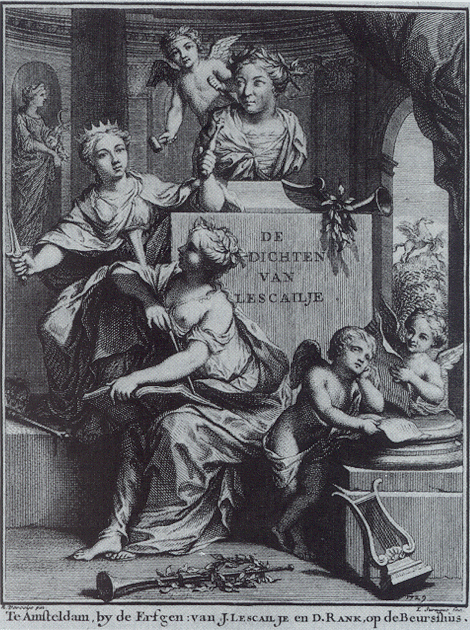 Frontispiece of: Katharyne Lescailje
Toneel- en mengelpoëzy Amsterdam 1731. | ||||||||||||||||||
[pagina 22]
| ||||||||||||||||||
even feels like Virgil's Dido, who lamented in vain when her lover Aeneas left her (Aeneid, Bk IV). Van der Veer wantsLescailje to explain: do these events mean that their friendship is over? In her reply, Lescailje neither refers to the New Year's Eve in question, nor to the lady she visited. Instead, she focuses on the bond between her and Van der Veer and assures her that she still feels the ‘true fire of friendship in her heart’. She even (slyly?) suggests that she was under the impression Van der Veer wanted to cool their relationship! Now contact has been restored, Lescailje says she will be happy to visit her. Ga naar voetnoot31 However, things were apparently never the same again. At first sight, Faderman's theory of ‘the romantic friend’ provides a satisfactory explanation for Van der Veer's jealousy. If we imagine two women happy in their bond of writing and thus dedicated to each other, it is not difficult to see how anger and despair set in when one of them chooses another writing companion. Using the terms of love to describe this, Van der Veer indicates her bitterness. Seen in this way, Faderman's hypothesis seems correct, but I think the explanation is somewhat unsatisfactory. It begs the question why Van der Veer refers to two heterosexual love stories and includes transvestism: in the case of Polyphemus she sees herself as a man; in that of Dido, Lescailje gets the role of Aeneas. Of course it can be argued that she apparently did not have any same-sex legends at her disposal or did not know how to coin her feelings otherwise, but in my view arguments like these precisely prove what they want to deny: Van der Veer experiences her emotions as feelings of love with an erotic component and expresses them that way. Although I do not agree with Dekker/Van de Pol that 17th-century transvestism necessarily points to psychological difficulties interpreting one's own feelings - someone like Van der Veer seems to be a far too matter-of-fact woman for that -, at the same time she may have felt emotions which she knew could never come true, but which could be expressed in her writing. This observation brings us to another aspect of the problem, which I have already indicated above: how to evaluate literary facts. It is nearly always impossible to read literature as a true account of reality, and in this the 17th century is no different from | ||||||||||||||||||
[pagina 23]
| ||||||||||||||||||
the 20th. Although some genres are more ‘realistic’ than others, they all respond to the law of literature: the game of making things possible. Research should exploit this situation, especially when hardly traceable subjects are at stake, like lesbianism in former centuries. A helpful instrument here can be semiotic analysis: it reveals contradictions and unusual situations in texts and allows the reader to recognize various interpretational codes in it. These codes often cannot be reconciled and they can uncover various norms with which to evaluate the situations portrayed. Ga naar voetnoot32 When applied to the poems of Van der Veer and Lescailje, semiotic analysis immediately produces results. The two women are concerned about their reputation as virgins and therefore avoid writing about the ‘sodomite fruit’. This ‘fruit’ can be interpreted as a kind of musty and rotten apple which stands for classical antiquity, but it can also point to the biblical town of Sodom and thus imply immoral sexual acts, such as homosexual love. The suspicion of being ‘tribadists’ would certainly ruin their marriage chances - and probably result in expulsion from their social networks too, so they had to be careful. On the other hand, the poems also take part in the game of literature, especially concerning the reference to Polyphemus. He not only refers to a classical model, but also to the Petrarchan situation in which the Renaissance often portrayed the lover: deeply touched by a woman and desperately trying to impress her. In this genre the writer pays attention to two points in particular: the psychological situation of the (male) lover and the description of the beloved woman, regarding her external, physical and internal, moral beauty. When we take into consideration that Lescailje wrote a poem about the bitter Polyphemus too, the question arises whether she and Van der Veer meant no more than to gesture towards a well-kown tradition, showing they could conform to the rules of literary production. Ga naar voetnoot33Examining Lescailje's work, some possible answers to these problems occur. | ||||||||||||||||||
[pagina 24]
| ||||||||||||||||||
Katharina LescailjeStrikingly, Lescailje has written quite a few poems in which a man declares his love for a woman. As Polyphemus moans about Galatea, so too does the river Y - which runs through Amsterdam - moan about Clarimene leaving town; and an anonymous shepherd tells the shepherdess Redegund (‘Reasonable’) how his beloved Rozemond (‘Mouth of Roses’) left him and married his rival Hylas. Ga naar voetnoot34 These poems all use Petrarchan conceits: they meet the passionate and desperate demands of the genre and Lescailje obviously had no problems imagining the emotions of lovers like the cyclops, the river and the shepherd. The same goes for a cycle of four poems in which shepherd Bloemaart (‘Flowers’) tries to win Rozemond (‘Mouth of Roses’): he behaves very meekly and although she makes him sad, he follows her. Remembering the sweet kisses they so often exchanged, he fears he will die of loneliness. In the last poem Rozemond, risen early, becomes the sun herself: the world applauds her as she steers the golden waggon. One of these four texts is dedicated to ‘N.N.’, an unknown person whose identity is not revealed. Ga naar voetnoot35 This conceit is found at several other places in the collected works: among them three birthday poems to anonymous ladies, all written at the request of ‘Mr. N.N.’ (‘den Heere N.N.’). Ga naar voetnoot36 In the first, the lover is sad to celebrate the lady's birthday on his own and hopes to win her with his gift of flowers (and with the poem of course). In the second, the lover wants to be Pygmalion, who warmed his sculpture in his arms and kissed her alive, to live happily together ever after. Lescailje will certainly have known that Ovid in his Metamorphoses situated this tale during the feast of Venus. Ga naar voetnoot37 In the third, the only one in which the first name of the lady is given, Margareta, this most beautiful woman gets a birthday greeting along with a marriage proposal. Of course, Petrarchan verses cannot be read as descriptions of true feelings of 17th-century people. The genre prescribed intense emotions, ice cold women and men who almost died from being | ||||||||||||||||||
[pagina 25]
| ||||||||||||||||||
kept at a distance. On the other hand this literature should not be underestimated: by expressing extreme feelings, poems like these made it possible to release tensions. In my view, this may very well apply to Lescailje. The use of transvestism allowed her to express her feelings for women without having to face the threatening aspects of them. So, literature brought a double blessing: she could disguise herself and create her own world on paper. Some curious verses reinforce the impression that Lescailje did not organize her masquerade just for fun. Pangs of love are endured in four poems in which an unspecified ‘I’ complains about the phenomenon itself. They are entitled ‘Restlessness of Love’, ‘Otherwise’, ‘Otherwise. To Love’ and ‘Otherwise. To the Nightingale ofHaarlem’. Ga naar voetnoot38 Only the last one is dated: 1677. While the speaking subject is not specified, it could be either a man or a woman; similarly, the unknown person causing the grief could be male or female. It is also possible that we're dealing with rhetorical exercises here, describing a tortured lover but bearing no real feelings. As far as this paper is concerned, the most interesting reading would be the personal one, in which Lescailje portrays herself in her writing. I hope the analysis will show that this possibility is not too far-fetched. In ‘Restlessness of Love’ the ‘I’, tired of grief, gets to sleep. But Cupid still follows her: together with Morpheus he makes her dream about the death of the beloved. Awoken, she realises the dream sprang from the unhealable wound of love, that causes her death a thousand times, and will cause her to die soon. ‘Otherwise’ shows the struggle of heart and soul to let the beloved go and to sublimate the feelings of love. No one can help her - not even Apollo or fellow writers, and Minerva curses Venus for setting the heart on fire: soon it will burn to death. ‘Otherwise. To Love’ sounds the most hopeless: woken very early, the ‘I’ immediately feels the pain again and asks her ‘sweet enemy’ (using the male form ‘Vyand’) if it is not enough ‘to have extinguished the flames on her chaste breast’ and ‘that he has stolen her heart when she was happy to see him and delighted by his kisses’? The answer is no: the beloved is constantly on her mind, and in that sense, he does spend the night with her, but someone or something else objects to this. Like all those who are in love, she can no longer sleep and she | ||||||||||||||||||
[pagina 26]
| ||||||||||||||||||
concludes: ‘So have I loved, how short, too long.’ Ga naar voetnoot39 Even the nightingale of Haarlem does not want to sing for her, perhaps because it remembers Tereus robbing it of its voice - again a tale from Ovid's Metamorphoses. Ga naar voetnoot40 So, it does not matter where she is: the desire is as strong in Haarlem as in Amsterdam. To me, these poems sound too personal to be just fictions. As in the case of Van der Veer's jealousy of Lescailje, I think intimate emotions are expressed here. Lescailje seems to have been madly in love with someone. This robbed her of her rest for some time: even in Haarlem she could not forget. The impression of her situation is somewhat paradoxical, as Petrarchan literature often is: on the one hand there is the glorious feeling of being in love, on the other the impossibility of a true relationship causes sadness. The poem ‘Otherwise. To Love’ especially is filled with unhappiness. It can be read on at least two levels. On the first, the ‘I’ complains about being caught by love (here: the lover) at an unexpected moment and having to bear the burden of that: she cannot sleep and although the moment of love was short, it has been too long for her. This interpretation of love is quite usual in Petrarchan poetry. On the second level, there is a suggestion that something more happened: the other person (the ‘sweet enemy’ (‘lieve Vyand’)) at one time went too far (‘Was it not enough to have extinguished the flames on my chaste breast’ and ‘Was it not enough to kiss and delight me’). Interpreted literally this means the enemy wanted to make love and it can imply they really got involved in an unchaste situation. The notion that ‘the enemy’ | ||||||||||||||||||
[pagina 27]
| ||||||||||||||||||
constantly tries to spend the night with her corresponds with that, and it is most intriguing to ask what is meant by: ‘spending the night together causes the grief of someone or something else’. It can point to another jealous lover competing with this one, to disapproval of their being together byLescailje's ‘neutral’ surroundings or to her own disapproval of the situation, maybe because this lover prevents her from thinking of another one. Eventually she regrets the relationship (‘So have I loved, how short, too long’). Throughout, it remains uncertain who exactly is this ‘sweet enemy’ (‘lieve Vyand’) mentioned in this poem. Was it a man or a woman? In both cases the text is remarkable. If ‘the enemy’ indicates a man, then a woman expresses herself to a man who loved her and whom she once loved - a rather rare phenomenon in 17th-century Dutch poetry. If a woman is intended, Lescailje still expresses herself, but now the transvestism spoken of above applies to the partner: to maintain the usual pattern of love poems, the beloved lover is attributed with another sex. On the first, Petrarchan, level of interpretation there is no heavy moral conclusion: loving this way means suffering, that is the Petrarchan law. But on the second level the relationship is morally unjust, in both interpretations: if the beloved lover is a man, there should be no sex before the wedding; if she is a woman, there should be no sex at all. Are there any indications in Lescailje's poetry that allow an identification of this ‘enemy’? | ||||||||||||||||||
Katharina Lescailje and Sara de CanjoncleWhen Cornelia van der Veer complained about Lescailje's visit to Sara de Canjoncle on New-Year's Eve 1675, she wrote: ‘There's no smoke without fire’, Ga naar voetnoot41 and reading Lescailje's verses for the younger poet, Ga naar voetnoot42 one indeed gets the impression Van der Veer was right. Although not all verses can be qualified as ‘emotional’ or | ||||||||||||||||||
[pagina 28]
| ||||||||||||||||||
‘tense’, most of them lead to interpretations which are similar to the readings of the love poems above, especially when one pays attention to the use of language. Ga naar voetnoot43 According to Lescailje, De Canjoncle was good at those fine arts considered suitable for women: at least she knew how to use scissors and a knife. In the conventions of 17th-century eulogies of art, the painting, embroidering or other work that is celebrated, is described as superlative. Lescailje's eulogies are usually highly conventional. Nevertheless, the praise for De Canjoncle's ‘ingenious cutting of flowers and trees’ seems more passionate than her verses for other works of art. Sara not only recreates nature (which many artists did!) but also gives satyrs the chance to hide behind the nicely cut flowers and trees and to spy on maidens, who fear sinister outbursts of erotic love (‘onguure minnevlaagen’). Lescailje is fortunate enough to observe the cutting work ‘safely’ and ‘unconcerned’: full of admiration she sees how Sara's soft breath, coming from her bosom, creates wind in the woods, while the ‘dew from her robin mouth’ makes the flowers blossom. No wonder Lescailje places herself under the rule of De Canjoncle's ‘favors, scissors, mind and hand’! Ga naar voetnoot44 This erotic atmosphere and Lescailje's submissive attitude are also found in two poems about the relationship between her and De Canjoncle. The first, dated the 18th of July 1675, is called ‘Friendship lost and found again’. Ga naar voetnoot45 It reports a desperate quest for friendship. The ‘I’, tortured by love, cannot find it anywhere in the | ||||||||||||||||||
[pagina 29]
| ||||||||||||||||||
world. Finally, a goddess appears: Sara, who possesses virtue, loyalty and true friendship. Gifted with these qualities, Sara becomes the sun who, in her growth from youth to adulthood, ‘melts and fuses with the soul of the “I”’ - who can be no one else but Lescailje, I think. Thus a new friendship flowers. Apparently there has been an estrangement, but relations are restored here. A few days before, at the 15th of July 1675, Sara had received a birthday poem. Ga naar voetnoot46 At first sight it is no exception to Lescailje's other greetings: it contains Petrarchan elements such as blossoming lilies and roses, chosen by the goddess Venus to celebrate Sara. But given the poem about the lost friendship, the line ‘no adversity will disturb her birthday’ (v. 5) becomes suspicious: it may point to the fact that before the 15th of July there was some trouble, and that perhaps this greeting serves as a peace treaty as well. From this point of view, it is understandable that the birthday poem does not contain erotic imagery and maintains a distance: Lescailje takes a careful line here. Thus, this text can also be interpreted in two ways: one within conventions of Petrarchan and occasional poetry, and one within a biographical framework. | ||||||||||||||||||
[pagina 30]
| ||||||||||||||||||
A third poem can be connected to these two: ‘To the lady Sara de Canjoncle’. Ga naar voetnoot47 It bears no date, but the heirs of Lescailje - who arranged the order of the texts for the 1731-edition - placed it immediately after ‘Friendship lost and found again’. Again there are two levels: at the first, we see the Petrarchan lover - ‘Katryn’, so: Lescailje - complaining about the absence of the beloved - ‘Saartje’, the pet name for ‘Sara’. The lamentations are to be taken ironically, as the very short lines and the use of the pet name indicate. Taken literally however, sadness replaces lightness. Lescailje asks if Sara knows ‘that she is alone and sighs uneasily’ because she fears that Sara's feelings of love are diminishing. She | ||||||||||||||||||
[pagina 31]
| ||||||||||||||||||
implores Sara to come and put an end to her sorrow. In the meantime, she can find no pleasure, not even in reading. Besides, the (male!) friend, whom she ‘deserves’ (‘Die my dient’), is not in Amsterdamat the time and, anyway, he gives no indication that he loves her. But she will be relieved of all her pain if ‘Sara only wants to be with her’. Again Lescailje takes a submissive attitude. The poem seems to indicate that Sara did not return her feelings. A surprising element is the male friend: is this a joke between the women or was there really someone else? History cannot answer this question: all there is is the last poem from Lescailje to De Canjoncle. In 1677 Sara de Canjoncle married Nicolaas Buitendoor. The convention of occasional poetry provided another chance to write here. Of course wedding verses were expected to contain cordial congratulations. They were often accompanied by acrostic jokes on the names of the couple and a (more or less fictitious) account of the courtship the lovers undertook before they consented to the marriage. The convention was widespread and had also developed a branch of ironical verses, sometimes even dedicated to unknown, fictitious persons. | ||||||||||||||||||
[pagina 32]
| ||||||||||||||||||
Lescailje's wedding poem is dated the 14th of February 1677. Ga naar voetnoot48 It has a rather sharp tone: Lescailje immediately asks ‘the proud’ De Canjoncleif it is true that she has given in to love and that she will give up her maidenly existence to be called ‘wife’. Where has her aversion to marriage gone? Is she conquered by love (Lescailje uses the Dutch word ‘verheren’ which means ‘to be conquered’ but also ‘to be dominated by a man’) and does De Canjoncle no longer respect her freedom? Freedom leads to a happier life than the bond of marriage, which often causes trouble and anxiety, she warns. Lescailje also attacks the groom. With the help of the gods he raped(‘had verkracht’) the proud bride and made her sad; he himself could do nothing but complain about his unrequited love for her and eventually De Canjoncle consented to be his servant. The final congratulation concerns the bride only: ‘Heaven, who wanted this marriage, bless my playmate’! This poem can hardly be called ironic: sarcastic is a better word. Ga naar voetnoot49 Van der Veercould find a model for jealousy here! Lescailje gnashes her teeth at what she considers the victory of a man over a woman and realizes she has definitely lost her ‘playmate’. But jealousy is not the only factor in the equation. The text also points to another set of values. Lescailje disapproves of the transition of virgin to wife, for it implies the loss of one's freedom: in our friendship, freedom and virginity were guaranteed and thus reinforced each other, she seems to say. Looking back, these values can be found in other poems, too. With Van der Veer she strives for virtuous poetry without the ‘fruit of Sodom’, to avoid attacks on their maiden honour; she also appeals to the fire of true friendship when Van der Veer complains about the visit to De Canjoncle. Praising De Canjoncle's work, Lescailje condemns lascivious satyrs and rejoices in their friendship of the soul. Finally, in the remarkable poem about the phenomenon of love, she describes herself as ‘chaste’. To conclude, I think these various sets of values prove the tensions in Lescailje's poetry. We will never know whether she was madly in love with Sara de Canjoncle in 1675, if she identified her feelings and tried to avoid the erotic elements of them, in order | ||||||||||||||||||
[pagina 33]
| ||||||||||||||||||
to maintain her maiden honour. Nor do we know if she ever was in love with a man or why she never married: perhaps she saw celibacy as the only way to keep her freedom to write and to manage her publishing-firm, free from the duties of a housewife. Likewise, the attitudeDe Canjoncle took cannot be proved. Was she uncertain of her feelings? Did she finally reject Lescailje or did she not feel anything like Lescailje at all? Whatever the real situation may have been, in my view Lescailje's poetry on the subject ‘love’ shows signs of tension that are not fully accounted for by the conventions of 17th-century Dutch literature. In other words, putting up a masquerade provided Lescailje the opportunity to give a free rein to her personal feelings. | ||||||||||||||||||
Titia Brongersma and Elisabeth JolyThere is another 17th-century female writer who presents us with the problem of lesbianism:Titia Brongersma (date of birth and death are unknown). She came from the northern part of the Netherlands, born in the Frisian town Dokkum and living inGroningen, where, in 1686, she published 240 pages of poetry, entitled:The Swan at the Well or Various Poems (De bron-swaan of mengeldigten). The swan represents the writer Brongersma, whom fellow artists praised as the ‘Frisian Sappho’. Besides writing, she practiced other fine arts, like embroidering etc. She never married and seems to have been a self-confident woman, who for instance excavated part of a megalithic tomb (‘hunebed’) in Drenthe. Ga naar voetnoot50 At first sight The Swan looks like any common 17th-century collection: divided by subject, many occasional poems appear, for instance on birthdays, funerals, weddings and artistic products. In the category ‘Eulogy’ a remarkable number of women are praised for their skill in art, bravery, virtue and so on - among them the Scythian queen ‘T(h)amyris’ (Tomyris), ‘crown of the female sex’: she conquered King Cyrus and made his head drink his own | ||||||||||||||||||
[pagina 34]
| ||||||||||||||||||
blood, to satisfy his murderousness. Here, Brongersmaparticipates in the traditional genre of ‘catalogues’, in which a series of men or women were celebrated for their virtues; she was probably inspired by the Gallery(Gallerye) of strong women (‘femmes fortes’), published in 1685 by a friend, Ludolph Smids. Ga naar voetnoot51 Another poet Brongersma admired was Lescailje. The Frisian writer once asked the ‘best flower of Amsterdam’ to send over some work. Unfortunately, we do not know if Lescailje answered this and if they ever met. Ga naar voetnoot52 Although analysis of The Swan shows that Brongersma's work can easily be compared to Lescailje's, I do not think she simply imitated the Amsterdam poet: firstly, until 1731 only bits and pieces of Lescailje's work were available, and secondly, it seems to me their poetry must be explained on a deeper level: they had to cope with intimate feelings and expressed them within the conventional framework of poetry. Brongersma wrote quite a number of Petrarchan poems, often in a pastoral setting. The theme of transvestism appears again: frequently a male lover deplores his situation and begs his beloved for her attention and favour. For instance, Silindor fills his days in servitude of Cloris, but awaits only death in return; an anonymous shepherd pictures himself as a peaceful man and certainly no Polyphemus, but nevertheless he cannot prevent his Astré from fleeing. In another text, Acis (also from Ovid's Metamorphoses) Ga naar voetnoot53 wants to kill Polyphemus because his Galatea is in love with him and in yet another, a lover chases the satyr who tries to catch his beloved. Other mythological persons include Apollo (begging Daphne), Hercules (disappointed in Dianira) and Zephyrus (chasing Flora). Ga naar voetnoot54 Like many poems, this last is dedicated to someone unknown, here initialized ‘Miss H.J.’. A further remarkable point is the frequency of a few names: Phylis breaks several hearts, and so does Elisa - Tirsis complains three times about this last beloved, and Cleonte dedicates five poems to her. Ga naar voetnoot55 But, love is not only seen from a male point of view here. | ||||||||||||||||||
[pagina 35]
| ||||||||||||||||||
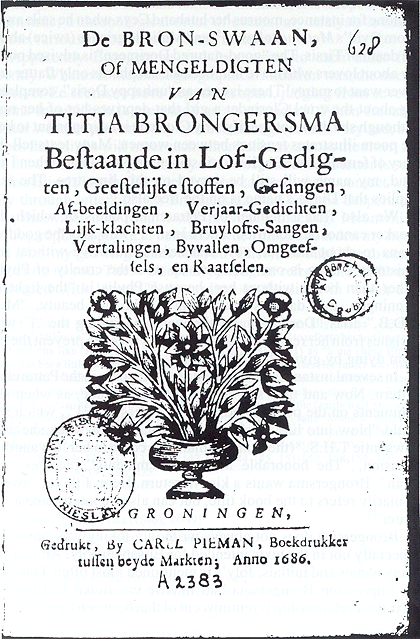 Title-page of: Titia Brongersma
De bron-swaan of mengeldigten [...] Groningen 1686, Provinciale Bibliotheek Friesland A 2383. | ||||||||||||||||||
[pagina 36]
| ||||||||||||||||||
Women too, do not know how to live without their beloved. Alcione for instance, mourns her husband Ceyx when he sails away (from Ovid's Metamorphoses) Ga naar voetnoot56 and Melinde grieves (twice) about the death of Tirsis. The ‘good-natured Dorimeen’ is advised not to cry about lovers who leave her, because shepherds only flatter and never want to marry! There is even an ‘unhappy Doris’, complaining about the cruel Clorinde: a girl that deprives her of her rest. Although she does not specify why Clorinde is so important to her, the poem illustrates tensions between women. Many texts tell the story of female duos. Phylis, for instance, says to Diana: when I am dead, my name will still be carved on this lime-tree. The text implies that Diana's name is on the tree also. Ga naar voetnoot57 We also find a number of Petrarchan poems of which the speaker cannot be identified. There is an ‘I’ who asks the goddess Diana to shoot him/her, now that he/she must live without my ‘mistress’; there is one who puts up with the cruelty of Phylis rather than being without her, because Phylis is ‘the light of Groningen, that darkens everything’. With her beauty, ‘Miss A.D.B.’ alias ‘Dorilee’ rules the world, including the ‘I’ who perishes from her reign, and ‘J.A.J.D.L.’ is asked to prevent the ‘I’ from dying by giving him/her love. Ga naar voetnoot58 In several instances, Brongersma herself poses in the Petrarchan pattern. Now and then she takes a playful attitude, as when she comments on the portrait she made of ‘Miss S.T.H.’, which she could ‘blow into life’ if she were Pygmalion, or when she asks ‘Swaantje T.H.S.’ (the same woman?) to come to her. On another occasion, ‘The honorable Miss A. Gemmenig’ receives ‘the swan’: Brongersma wants a kiss in return. Here, I think, ‘swan’ primarily refers to the book title, but can also be interpreted as its writer. Ga naar voetnoot59 Brongersma does not always write in a joking way however, especially not in the texts intended for Elisabeth Joly. Among the many names and initials Joly's is mentioned most often. One gets the impression Brongersma had intense emotional feelings for Joly; their relationship is reminiscent of that between Lescailje and | ||||||||||||||||||
[pagina 37]
| ||||||||||||||||||
De Canjoncle. Ga naar voetnoot60 Because the texts are undated, it is not possible to reconstruct a chronological order of events; my analysis is based on the various moods found in the material. Apparently Brongersma and Joly wrote to each other frequently. Whatever the exact geographical situation was, the northern river Ee seems to have kept them apart, judging from several poems in which it is presented as an obstacle. Ga naar voetnoot61 When freezing winter weather prevents any contact, Brongersma is very sad; she hopes their sighs will meet each other halfway across the river. As the thaw restores the possibility of correspondence, a letter is sent to kiss Elise's hands. The fact that she can only make contact with Joly through letters drives Brongersma mad and she desperately asks the water how long it will prevent a meeting. Meanwhile, writing replaces physical contact: ‘when can I unburden my heart and allay my growing desire for you (Elise); I would like to come and cling to you. These disorderly thoughts refresh me as though embraced with kisses.’ Ga naar voetnoot62 According to the lines in which she | ||||||||||||||||||
[pagina 38]
| ||||||||||||||||||
‘clings to’ Brongersma, begging her not to leave, Joly felt the same. This also implies they really met; apparently they were happy being together. ‘Nothing can destroy my love’, Brongersma writes when she sees Elise sleeping, and at another time she plans to braid a garland of the yellow flowers that decorate Elise's portrait. Ga naar voetnoot63 The garland will be a present for Joly, to wear all her life. Thus, a mutual, intimate friendship is suggested. Brongersma expresses her feelings for Joly in several ways. The desire to be with her is coined in a Petrarchan manner when Joly travels to France and Germany: she feels deserted by her unfaithful, cold friend and on Joly's return Brongersma compares herself to the moon, lighted by the sun. At the same time transvestite themes are introduced: when Elise goes to France, Brongersma pictures herself as the man Cleonte, crying with a broken heart and unable to protect her on her trip. This Cleonte speaks to Elise a number of times: for instance, complaining that she stole his heart instead of him stealing hers and ‘languishing like the turtle-dove’ when his partner is away, a well-known image of a good marriage in 17th-century art. Disguised as the shepherd Tirsis, Brongersma grieves in her loneliness when Elise is not there; once he sings to her in French that he adores her with ‘a chaste desire’. Ga naar voetnoot64 The remarkable point of this transvestism is that it goes further than in Lescailje's poetry: Brongersma identifies herself openly with men and in her male pose, she judges the relationship with Joly as a marriage. In her turn, Joly is compared to famous women: Dido, Diana and Daphne. The texts suggest that at a certain moment the relationship got into serious trouble. Inspired by a picture of Dido | ||||||||||||||||||
[pagina 39]
| ||||||||||||||||||
killing herself, Brongersma first screams: ‘Elisa from Carthago, do not kill yourself because an unfaithful guest left you’, but then she consents: ‘Loss of honour makes death acceptable’. In ‘On the death of Dido, also called Elisa’, Dido herself asks the traitor why he cheated her and robbed her of her honour. Her death is her revenge: it will gnaw at his conscience for ever. Does this mean Brongersma chose another friend and Joly felt rejected, as once was the case with Van der Veer, when Lescailje visited De Canjoncle? Or does it refer to Brongersma, wanting to make love and Joly refusing this, which resulted in a feeling of being cheated and caused Brongersma to leave, feeling guilty about herself? In one interpretation, the poem about Diana suggests that ‘la chaste Diane, Mad. J.E.J.’ (‘Juffer’, Miss Elisabeth Joly) certainly does want to make love, but hides this: ‘Chaste & froide Nimph Diane // Qui ne veu qu'on fait l'amour’ - the phrase can be interpreted both ways, Diana does not want anything or just wants sex. Does the French language indicate how personal and delicate matters were? Does Brongersma show sarcasm here? Her attitude is not completely clear, and beyond that, it may also have changed several times: in the following poem, also in French, it is Tirsis (Brongersma) who assures Joly of hischaste desires. When Joly leaves for Germany, she is compared to Daphne in a complicated way: on the first level Brongersma is the powerless Apollo persecuting her, on the second ‘Elisa always is a Daphne to him: he tacks leaves of laurel to her crown’. This means the persecution has already ended and Apollo has reconciled himself to the idea of writing poetry to honour her. The second message is also found in the poem on the portrait of the ‘virtuous and artistic’ Elisabeth Joly: ‘no Pygmalion can make a better picture of this second Daphne, with her crown of laurel; Apollo's love sanctifies her and his priestess loves her even more’. Ga naar voetnoot65 There are still a few points to add regarding this complex situation. The first is that more poems may have been meant for Elisabeth Joly, for instance initialized as ‘M.A.L.H.E.J.’, somebody whom all the world loves and suffers for. She also can be | ||||||||||||||||||
[pagina 40]
| ||||||||||||||||||
disguised as women like the heart breaking Phylis who, as I mentioned already, ‘is the light of Groningen, that darkens everything’. On the other hand, an alias does not necessarily always refer to the same person; for instance, Miss S.T.H. is also called Phylis. Ga naar voetnoot66 Secondly, a few poems give the impression that the relationship really ended at one point. Before drawing a conclusion, I will consider these texts. Ga naar voetnoot67 The first one deals with a dream by Brongersma: Elise kissed her with a split tongue, which penetrated her mouth like two arrows. Brongersma fears that this predicts unfaithfulness on Elise's side, although they have given each other their word. Whether this dream is realistic or not, it seems to indicate that a former trust in each other has gone. There is also ‘A.M. C.H. E.L. (à ma chère Elise?) on the last farewell’. Ga naar voetnoot68 In this song,Brongersma | ||||||||||||||||||
[pagina 41]
| ||||||||||||||||||
says good-bye - for ever, it seems. Both women are crying, but the writer sees crocodile tears on Elise's cheeks, while hers are real. She herself is not worth weeping for, but Elise rightly causes many tears, because Brongersma's love for her is real. Elise's request not to forget her soothes the pain, and Brongersma assures her ‘I will always be yours’. At the end of The Swan a number of short songs, announced as ‘translations’, describe the laborious struggle of a lonely lover: ‘there is no spring, no love for me anymore’. Here the names Tirsis and Phylis appear again, reinforcing my impression that Phylis refers to Joly (among others). Ga naar voetnoot69 Putting the implications of the material together, the story behind this poetry might be as follows. Titia Brongersma had an intimate and emotional relationship withElisabeth Joly. Their mutual happy feelings changed when Brongersma went too far in her physical demands; because her honour was at stake, Joly could no longer see her, although she regretted this. Brongersma knows Joly is out of reach for ever and has to satisfy herself with admiration from a distance. Meanwhile she knows she will never love somebody else the way she loved Elise. She does not seem to know how to judge her own feelings: are they chaste or is she a morally corrupt person? | ||||||||||||||||||
ConclusionAs in the case of Lescailje, the investigated material onBrongersma does not really allow these kinds of conclusions about her life and a possible lesbian relationship with Elisabeth Joly. One question, for instance, is why other writers so much praised The Swan. Did they not see the implications of the lines for Elisabeth or did they not mind, perhaps because they did not take it seriously? Or was everything permissible, as long as it could be interpreted as a | ||||||||||||||||||
[pagina 42]
| ||||||||||||||||||
literary game they all played? After all, no indecent word came out of Brongersma's pen: as Everard showed for the Dutch 18th century, terms like ‘kissing’ and ‘embracing’ could be read in a decent, spiritual way. Ironically, it is precisely the complicated relationship between literature and reality that reveals tensions like love and tenderness but also keeps them fictitious: theoretically, it is possible that the whole affair between the author of The Swan and Joly is produced by Brongersma's wishful thinking and existed only on paper. Ga naar voetnoot70 This means, however, that the material does allow conclusions about literature. Apparently, writers like Lescailje and Brongersma successfully used the conventions of love poetry to express their feelings. Petrarchan devices could be used to write tender poems from one woman to another, as wedding poetry could express a satisfying life style for single women. Love poetry also offered the opportunity to ponder the subject in general. There needs to be further investigation to show whether women - given the fact that their poetry often refers to private life - indeed tell us more about their love affairs and whether the masquerades of Lescailje and Brongersma are exceptional in 17th-century literature. Ga naar voetnoot71 Returning to the four studies I started with, I think literary texts can throw light on the question whether lesbianism existed before 1800. According to Faderman relationships could be complete without genital aspects. This seems to be true in the case ofQuestiers and Van der Veer, but is uncertain regardingLescailje and looks incorrect for Brongersma, for whom physical desire seems to have caused the end of her relationship with Joly. Transvestite imagery proved to be a successful tactic in love poetry; the Petrarchan style offered the opportunity, which one could take advantage of guiltlessly. On paper one did not have to face the threatening aspects of emotions. Focusing on Lescailje and Brongersma however, we find also erotic poetry from woman to woman: so a male disguise was not always necessary, contrary to the expectations of Dekker/Van de Pol. | ||||||||||||||||||
[pagina 43]
| ||||||||||||||||||
Although no specific terminology like ‘tribadism’ was found, in a number of poems by Lescailje and Brongersma erotic desire can be detected. Their passions seem to have caused feelings of joy and guilt. Maybe they thought it wiser to avoid loaded terminology such as ‘lollepot’ because it referred usually only to lower class women. So, besides Faderman's and Everard's spiritual explanation of female friendships, as was found here with Questiers and Van der Veer, I think a physical one has to be considered. Also the fact that Everard's Dutch women were typical Enlightenment products had consequences for their ideas on morality, but the 17th century does not necessarily have the same values on this point. In my view, Brongersma certainly and perhaps Lescailje too show that identification as a lesbian was possible in the 17th century, which would prove the thesis of Donoghue. But practising it was another story: it seems that both Brongersma and Lescailje never got to that, perhaps because they would not risk their honourable reputation, which allowed unmarried women to keep their freedom to write and/or to manage their business. Instead, they created a world on paper to make true what reality would not permit. | ||||||||||||||||||
Bibliography
| ||||||||||||||||||
[pagina 44]
| ||||||||||||||||||
|
|