

'Developments in Sixteenth-Century Dutch Poetics. From "Rhetoric" to "Renaissance"'
(1993)–Marijke Spies– Auteursrechtelijk beschermd
[pagina 72]
| ||||||||||||||||||||||||
Marijke SpiesDevelopments in Sixteenth-Century Dutch Poetics
| ||||||||||||||||||||||||
1. IntroductionFew treatises on the art of rhetoric and poetry are found in sixteenth-century Dutch literature. One ‘Art of Rhetoric’ in the tradition of the French arts de seconde rhétorique and two small introductions to Ciceronian rhetoric are known. But that is all there is. However, several texts do exist in which rhetoric and poetics are dealt with less formally, and which concentrate on a few basic principles. These include laudatory or defensory poems, a number of plays, a handful of introductory remarks ‘to the reader’ in certain publications, and one speech. These sources differ greatly in scope, nevertheless they do form a corpus which may reveal much about the nature and aims of rhetoric and poetry, and the relation between these two arts. My analysis will trace some of the ideas underlying sixteenth-century Dutch literature and especially the way in which it evolved and changed; developments, indeed, which mark the transition from ‘rhetoric’ tot ‘Renaissance’. The material analyzed may be divided into four parts. Firstly, a number of texts in praise of or in defence of rhetoric from the last quarter of the fifteenth and first half of the sixteenth century. Secondly, two formal treatises, published in the 1550s, one on Ciceronian rhetoric and the other on the poetical seconde rhétorique of so-called ‘rhetoricians’, marking the high point in this literary stream. However, shortly after, in the 1560s when the rhetoricians' poetry was still blossoming everywhere - and it would continue to do so for at least another fifty years - the first signs of what we know as the ‘Renaissance conception of literature’ appeared. Two collections of poems written under the influence of Marot, Sebillet and the authors of the Pléiade were published in this period. In the introduction to one of these some theoretical remarks are made on the relation between poetry and rhetoric, too. All this took place in the southern Netherlands. The last section will concentrate on the northern provinces, which lagged behind until the 1580s, when military, economic and political developments resulted in the gradual displacement of the cultural centre. As early as the 1560s members of the Amsterdam chamber of rhetoric already took a different stand from their southern colleagues in the field of literature. Their position resulted in a two-way antag- | ||||||||||||||||||||||||
[pagina 73]
| ||||||||||||||||||||||||
onism: towards the traditional rhetoricians, but soon also towards the Renaissance conception of poetry epitomised by some poets connected to the new university at Leyden. Of course, this is not the place to deal with all the details of these texts. Nor will I be able to compare their theoretical and critical remarks with actual examples from literature, other than incidentally. What follows is, however, a broad outline of what one might call the self-consciousness of Dutch vernacular literature in the period covered. In my opinion this self-consciousness may be regarded as one of the major sources for information on the development of literature. | ||||||||||||||||||||||||
2. Poems in Praise and in Defence of Rhetoric, c.1480 - c.1530There are five known poems written before the 1530s in praise or in defence of rhetoric. The oldest is by Anthonis de Roovere and is dated before 1482, the year of the author's death. The most recent is by Anna Bijns, dated 1528. Ga naar voetnoot1 They are all generally similar: all are written in the popular form of a ‘refrain’, four of them directed explicitly and one implicitly against the ignorant abusers of rhetoric, and all five expressing the same general ideas about what rhetoric is. Rhetoric, one of the seven liberal arts, is a gift from the Holy Ghost, and as such is learned, but cannot be learned. This conception seems to me to be fundamentally Augustinian and must have come down by way of the artes praedicandi and the sermons of the Middle Ages, on which the famous fourth book of Saint Augustine's De doctrina christiana exercised such a profound influence. Ga naar voetnoot2 The theme does not seem to appear in secular medieval rhetorical texts. Ga naar voetnoot3 On the other hand the similarities between De Roovere's poem and a fifteenth-century Dutch vernacular sermon on the Pentecost miracle supports the connection. Ga naar voetnoot4 This indication of religious influence is seen in other texts too. In fact it appears to turn up in all texts on rhetoric up to 1550. But we also find it in the names and arms of the organizations from which these texts originate, i.e. the chambers of rhetoric. The Bruges chamber was called the Helighe Gheest (Holy Ghost), as were the chambers of Nieuwkerke and Audenaerde. Besides these | ||||||||||||||||||||||||
[pagina 74]
| ||||||||||||||||||||||||
three, no less than seven other chambers of the nineteen which attended a festival in Ghent in 1539 bore the sign of the Holy Ghost on their arms. Ga naar voetnoot5Apparently the chambers of rhetoric of the Netherlands may have been connected with the spiritual revival of the fifteenth century. 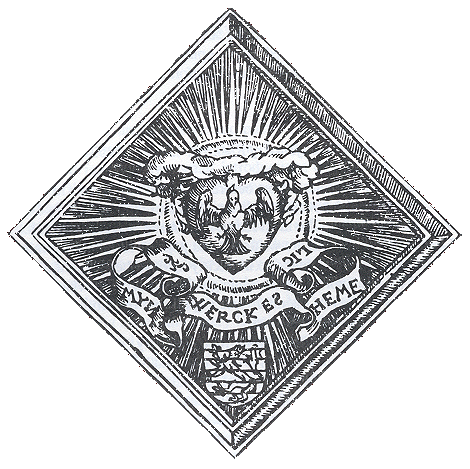 Fig. 2: Blason of the Brugge chamber
As with the artes praedicandi, Ga naar voetnoot6 the effects of this holy gift of eloquence are emotional as well as religious in character. Rhetoric offers peace and harmony. As for the religious side, apart from De Roovere, who cites the Pentecost miracle, one of the other texts cites Genesis, David and Solomon, and also the annunciation, the transubstantiation and the seven sacraments. Ga naar voetnoot7 | ||||||||||||||||||||||||
[pagina 75]
| ||||||||||||||||||||||||
This last poem, however, also offers us a taste of Ciceronian and Quintilian rhetoric as it was known in the Middle Ages. Ga naar voetnoot8 Man is superior to animals because of his rationality which is expressed in language. Indeed, society, marriage and justice, and even virtue all owe their existence to eloquence, a sentiment which is found in Quintilian's Institutio oratoria (II.16) and Cicero's De inventione (I.ii). Ga naar voetnoot9 One of the other poems, that written by Anna Bijns, makes a connection with the art of music rather than with Ciceronian rhetoric. Ga naar voetnoot10 So, despite their general similarity, these texts illustrate the two different tendencies which were already manifest in the medieval tradition, Ga naar voetnoot11 and which continued to direct the development of literature: a more rational, Ciceronian one; and a more emotional one, the latter characterised by the so-called ‘musical’ aspects of eloquence, such as rhyme and other sound-effects. | ||||||||||||||||||||||||
3. Mid-sixteenth Century, Jan van Mussem (1553) and Matthijs de Castelein (1555)The first book of Ciceronian rhetoric to be published in the Dutch language was Jan van Mussem's Rhetorica. It was a small book, printed in Antwerp in 1553 and probably intended for the classroom. Ga naar voetnoot12 As Jan F. Vanderheyden has amply demonstrated, Van Mussem's rhetoric is an amalgamation of passages taken from Ad Herennium, Cicero's De inventione and Quintilian's Institutio oratoria, interspersed with examples from Erasmus's De conscribendis epistolis and De copia rerum ac verborum. Ga naar voetnoot13 This is certainly a typically humanist school textbook, similar for instance to Thomas Wilson's The Arte of Rhetorique. Not that it uses texts that were unknown in the Middle Ages - on the contrary, all of these texts were well known. But it does use the texts themselves and that is something of a difference. Indeed, it is hard to imagine the poem mentioned above, in which Cicero and Quintilian are paraphrased, not having had some humanist antecedent. Be that as it may, with Van Mussem's booklet we have a first example of a classical rhetorical textbook in the vernacular, advertised on the title page as ‘a must for all young rhetoricians, poets, advocates, secretaries, notaries, orators and others.’ In the introduction Van Mussem inveighs against ignorant poets, | ||||||||||||||||||||||||
[pagina 76]
| ||||||||||||||||||||||||
who think rhetoric is just rhyme and whose texts demonstrate a lack of well-ordered content. Ga naar voetnoot14 The obscure verbiage makes it hard to work out exactly what the writer means. As we have seen, invectives against the ignorant abusers of rhetoric had by then become a stock in trade with the ‘rhetoricians’ - as I will continue to call the members of the chambers of rhetoric - too. Given the character of the book, however, it seems probable that the author in fact directed his polemic against these rhetoricians, who indeed more often than not indulged in beautiful rhymes at the cost of clarity. Indeed, rhyme and ornate elocution were the most distinctive features of those poets who considered themselves to be ‘rhetoricians’. In French literature the art of versification had split away from the medieval artes poeticae and versificandi at the end of the fourteenth century. Questions regarding content - disposition, invention, and even most aspects of elocution - came under première rhétorique. The techniques of rhyme and rhythm were discussed in tracts known as arts de seconde rhétorique. Ga naar voetnoot15 According to Jacques Legrand, author of one such tract published in 1405, rhyme is one of the rhetorical colores, but because of its diversity deserves nevertheless separate teatment. Ga naar voetnoot16 In the majority of these tracts verbal versification is considered a ‘natural’ form of music. Ga naar voetnoot17 ‘Natural’ because, according to Eustache Deschamps in his Art de dictier (1392), it requires a natural disposition. But being music, it is also an ‘art’, a science, and subject to principles and rules. Ga naar voetnoot18 A century later the same idea is still found in Jean Molinet's Art de rhetorique vulgaire (1493): Rhetorique vulgaire est une espece de musique appelée richmique, laquele contient certain nombre de sillabes avec aucune suavité de equisonance, et ne se puet faire sans diction, ne diction sans sillabes, ne sillabe sans lettres. Ga naar voetnoot19 This is precisely what the arts de seconde rhétorique were about. They all contain more or less similar material, concerning vocals and elision, the number of syllabes allowed in a verse, acceptable and inadmissable rhymes, and the different forms of verse and strophes. It is clear from an examination of the versification of the Dutch poems mentioned above that, despite the quotations from Cicero, this was the sort of ‘rhetoric’ with which these authors were concerned in the first place. The whole structure depends on subtleties of rhyme and elocution, to such an extent, in- | ||||||||||||||||||||||||
[pagina 77]
| ||||||||||||||||||||||||
deed, that sometimes the meaning is lost, as Van Mussem suggests. However, the first to introduce the theory of the seconde rhétorique into Dutch vernacular literature was Matthijs de Castelein, whose Const van rhetoriken (Art of Rhetoric) was written in 1548 and published in 1555 (Figure3 Ga naar voetnoot20). 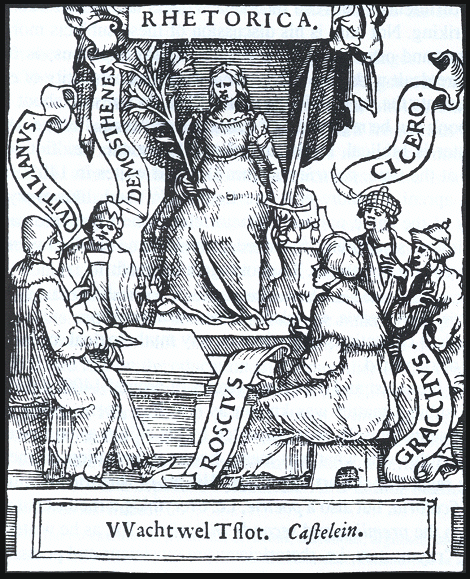 Fig. 3: Rhetorica
The title pages themselves indicate how different Jan van Mussem's rhetoric was from that of Matthijs de Castelein. While Van Mussem announces his intention to discuss how to treat a particular subject in an orderly and eloquent way, Castelein promises ‘all sorts and forms of verses, as well as everything else regarding the art of poetry.’ He was obviously inspired by the French | ||||||||||||||||||||||||
[pagina 78]
| ||||||||||||||||||||||||
rhetoricians. Indeed, he names Molinet as one of his influences, Ga naar voetnoot21 and as far as his technical instructions are concerned the same topics are discussed as appear in the arts de seconde rhétorique. Here too we find the principles of rhyme, all sorts of rhyming schemes and different forms of strophes and lyrical genres. Moreover, allusions to opinions of Molinet and his colleagues are constantly made. Ga naar voetnoot22 But the differences between the French tracts and Castelein's impressive study are striking. Not only is his discussion of these subjects more elaborate than Molinet's and often more critical, more actual questions, as for instance on purism, are dealt with, too. Moreover, a far greater quantity of examples is given to illustrate the various forms of strophes. As a result, about three-quarters of the book can be regarded as a collection of verses. For the most part the subject matter is biblical, mythological and historical, i.e. ‘fiction’, or, as it was known at the time, poetrie. Jacques Legrand writes in 1405: ‘Poetrie est science qui aprent a faindre et a fere ficcions.’ Ga naar voetnoot23 And, like everybody else, Castelein is of the same opinion: ‘Rhetoricians’, he says, ‘are called “poets” when they invent something.’ Ga naar voetnoot24 Indeed, poetrie comes under invention and is part of the première rhétorique. To quote again Legrand: [...] et est ceste science moult necessaire a ceulx qui veulent beau parler, et pour tant poetrie, a mon advis, est subalterne de rethorique. Ga naar voetnoot25 But independent collections of fiction, mostly mythological, called fabularies or poetries, also existed. In French humanist and rhetoricist circles of around 1400, a poet who used this sort of subject matter was known as novellus poeta, poète moderne. Ga naar voetnoot26 Castelein presents himself, or is presented by his editor, as an ‘excellent modern poet’, and this was what was meant by the information on the title page: ‘everything regarding the art of poetry.’ His art of rhetoric contains not only an ars versificatoria, but also a poetrie, i.e. everything a rhetorician would need to know from the première and seconde rhétorique, for, as he writes further on in his work, ‘rhymesters, i.e. rhetoricians, are musicians and poets.’ Ga naar voetnoot27 Still more important, however, is the way Castelein links this to classical rhetoric. The Const van rhetoriken contains 239 theoretical strophes. Of these, 139 are devoted to technical matters of the sort referred to in the arts de seconde rhétorique and it is in these strophes that references to Molinet cum suis oc- | ||||||||||||||||||||||||
[pagina 79]
| ||||||||||||||||||||||||
cur. Ga naar voetnoot28 Incidentally there are also references to Cicero's De oratore, Quintilian's Institutio oratoria and Horace's Ars poetica. Ga naar voetnoot29 Of the remaining 100 strophes, the first 28 and the last 7 offer a rather extensive poetical introduction and a short peroration to the work. But nearly all the others - no less than 65, that is between a third and a quarter of the theoretical part of the book - are formed by the way of quotations from De oratore, the Institutio oratoria and the Ars poetica, which are in their turn interwoven with references to the art de seconde rthétorique. Ga naar voetnoot30 Together these strophes form three uninterrupted passages. The first, immediately after the introduction, deals with what I call the ‘general philosophy’ of elocution: the existence of different styles (sweet, subtle, sharp, strong, difficult, clear), the labour involved, etc. Then, after a long series of technical questions, a second, rather short passage follows about pronunciation. And towards the end, after another series of technicalities, there is a third, even shorter passage with some final remarks. Castelein obviously knows his classics. However, this is not a manual of classical rhetoric. What he offers the reader here is a handbook for the modern poet in the context of classical theories about elocution. For this he has selected passages from classical texts according to their relevance to his literary conceptions. This can be seen from the voices he makes. The passages from Quintilian are taken from book VIII on elocution, book XI on pronunciation and books I, II and XII on the education and personality of the orator, and the passages from Cicero's De oratore from books II and III on the same subjects. This also applies to Horace's Ars poetica, from which passages are taken mainly on the labour the poet puts into his work and a few thoughts on the question of decorum. Virtually nothing on disposition, invention, or argument, nothing also on technical aspects of elocution. As a matter of fact, Castelein says as much when he writes: Here you will find no exordiums, positions, divisions, narrations, argumentations, egressions, signs, partitions, ornations, examples, amplifications, sententiae, conclusions or imitations. Ga naar voetnoot31 Even, as we have seen, the classical precepts concerning elocution are not found here, because as soon as it comes to technique, Castelein turns to the principles of the seconde rhétorique, of versification. These principles traditionally embrace all sorts of genres, including tragedies, comedies and epic poems. Ga naar voetnoot32 These are also discussed from the point of view of style and versification, or otherwise as poetrie, i.e. fiction, the only | ||||||||||||||||||||||||
[pagina 80]
| ||||||||||||||||||||||||
really structural remark being that the grammarians traditionally held that comedies should have a happy ending and tragedies should be about disasters. Ga naar voetnoot33 Nowhere does Castelein's intention to place his art of versification within the classical tradition achieve more startling results than in his discussion of the minor genres. According to him, ballads should be equated with the epigrams of Martial, Virgil's eighth eclogue is an example of a refrain and the odes of Horace offer a model for the rondel. Ga naar voetnoot34 All this shows, I think, that Castelein calls upon the classical tradition to shore up the status of modern poetry, but not to find out what modern poetry should be. Things change, he says several times, and something new is invented each day. Ga naar voetnoot35 As a modern poet, he feels that the essence of poetry - which he calls rhetoric - lies in an eloquence which may be defined in classical Ciceronian terms, Ga naar voetnoot36 but in fact exists by the grace of the ‘musical’ strength of versification. In my opinion, this point, which is stressed in the introduction, is the essence of the whole work. Castelein opens with a story about Mercury, who appears to him in a dream and urges him to write his book. Mercury, however, besides being the god of eloquence is also the messenger of the gods. He comes, not on his own behalf, but is sent by Apollo, who presides over the Muses and lives on Mount Parnassus. Ga naar voetnoot37 Further on, this theme is taken up as Castelein exclaims ‘O joyful rhetoric, descended from heaven’, and again when he writes ‘God sends the Ghost for all our sakes.’ In between he specifies the philosophical content of this ‘rhetoric’ as, in Cicero's words, an all-pervading virtue holding everything together. Ga naar voetnoot38 From the above one would be forgiven for thinking that Castelein based his ideas on the Platonic theory of inspiration. This is far from unlikely since traces of this theory can also be found in the French humanist and rhetoricist circles. Ga naar voetnoot39 He, however, links this theory to the traditional idea of the Holy Ghost as the inspirer of rhetoric. Possibly, the influence of Erasmus, who was one of the first to equate the two forms of inspiration, can be detected here. Ga naar voetnoot40 Castelein makes this combination only once. I think that for him Apollo was a more suitable foster-parent of poetry than the Holy Ghost. | ||||||||||||||||||||||||
[pagina 81]
| ||||||||||||||||||||||||
Matthijs de Castelein's book is certainly impressive and unique. His conception of poetry is not new, it is the well known recipe of versification and fiction, flavoured with a dash of inspiration, i.e. the latest fashion in seconde rhétorique. What is new is the way in which he conceives the ‘art’ of poetry. He joins the principles of the arts de seconde rhétorique and the fictional material of the poetries with the classical philosophy of eloquence in an all-embracing handbook for the modern poet. He himself was deeply aware of this uniqueness. ‘It is all mine,’ he writes towards the end of his work, ‘I have not stolen anything. Like Hercules I play with my own stick.’ Ga naar voetnoot41 And in doing so he clearly filled a need, for up to 1616 no fewer than six editions of his work were published, the two last editions (1612 and 1616) in the northern Netherlands. Ga naar voetnoot42 Nevertheless his influence was limited to the lesser reaches of literature. For again and again new developments eclipsed the sort of poetry he dealt with. It is ironic that as early as the first - posthumous - edition of his work, the editor introduces the book listing the famous French rhetoricians, including Du Bellay and Ronsard. Ga naar voetnoot43 | ||||||||||||||||||||||||
4. The 1560s: Eduard de Dene (up to 1561), the Antwerp Plays (1562) and Lucas D'Heere (1565)During the first decade following the publication of Castelein's book not much seemed to change. Poems and plays in praise and in defence of rhetoric continued to be written. For example in Eduard de Dene's Testament rhetoricael, a huge work completed in 1561, we find nine long and short poems on rhetoricians, rhetoric and the like. In some of these the influence of Castelein is clearly traceable, despite a somewhat stronger emphasis on ‘poetry’ and Ciceronian rhetoric, and a somewhat lesser on versification. The texts are not explicit enough, however, to allow many conclusions to be made. Ga naar voetnoot44 The poems themselves are typical of the art de seconde rhétorique. In 1561, fifteen chambers of rhetoric met in Antwerp - however, few new ideas came of this. The chambers had been invited to give in their plays an answer to the question, ‘What is it that most arouses man to the arts?’ All the | ||||||||||||||||||||||||
[pagina 82]
| ||||||||||||||||||||||||
plays were published the following year by the Antwerp bookseller Willem Sylvius. Ga naar voetnoot45 Of the fourteen plays submitted - the organizing chamber did not compete - no less than ten were quite conventional: God, by way of the Holy Ghost, had created the seven liberal arts, incorporating rhetoric, which included medieval Christian rhetoric as well as poetry. Ga naar voetnoot46 This was the medieval conception, dating from before the time that the poets of the seconde rhétorique so closely linked poetry and music. Ga naar voetnoot47 Of these ten plays, only the chamber the Christusooghen (Eyes of Christ) of Diest made any acknowledgement to more recent developments by ascribing the opinion about the Holy ghost to Erasmus and Plato. Ga naar voetnoot48 But on the whole even the references to Ciceronian rhetoric are often so general that one hesitates to ascribe them to first readings. The influence of the artes praedicandi still seems to dominate. An only slightly divergent opinion is formulated by the chamber of Zout-Leeuwen. This play defines poetry as the practical realization of rhetorical speculation, an idea that goes back to the Aristotelian philosophical terminology of the Middle Ages. Ga naar voetnoot49 Only three plays might be called modern. The Lischbloeme (Water flag) of Mechelen also saw poetry as the practical result of rhetorical theory, but it combined this idea with a quite modern Platonic theory of inspiration, in which the passionate love for beauty and truth induces man to poetry, while poetry iself is seen as the art which embraces all other arts. Ga naar voetnoot50 Plato and Lucian are mentioned. Here also one would expect to find the source material in the works of Erasmus. A similar although less elaborate conception of inspiration was formulated in the play by another Antwerp chamber, the Goubloeme (Marigold), written by Cornelis van Ghistele. Ga naar voetnoot51 This play is the only one of the whole collection which includes a theory of poetry as seconde rhétorique, together with one of rhetoric as Ciceronian rhetoric. The two are sharply distinguished. Van Ghistele's description of rhetoric as the faculty by which rationality and virtue are realised on earth, as well as his conception of the rhetor doctus, are expressis verbis derived from De oratore. Ga naar voetnoot52 Poetry on the other hand is defined as a form of music, aroused by divine inspiration. Here Philo and Ovid are referred | ||||||||||||||||||||||||
[pagina 83]
| ||||||||||||||||||||||||
to. Ga naar voetnoot53Finally, the Herentals chamber bluntly stated that rhetoric and poetry were two completely different things and that success in either form was a question of natural talent. Cicero was never successful in poetry, nor Virgil in rhetoric. Ga naar voetnoot54 In the event the theme of the competition failed to produce any exciting new opinions, and being the centre point of a gigantic public festival, it was probably never meant to do so. The fact that the Roose (Rose) of Louvain won the first prize with a highly conventional solution, supports the theory that other qualities were decisive. Ga naar voetnoot55 The plays written to welcome and to bid the guests farewell by Willem van Haecht of the organizing chamber, the Violieren (Violets), do not do much to change this impression. They are less formal in their argumentation, but they seem to represent an opinion close to Castelein's, in which rhetoric, poetrie and music are fused. Thus far nothing more modern than a slight tendency towards the emancipation of poetry and the citing of Platonic inspiration as its prime cause has been found. Even Van Ghistele, known from his translation of several classical plays, does not much more than defend the position taken by Castelein, although he does separate rhetoric and poetry more rigorously. There is, however, one text yet to be discussed. This has a more progressive appearance. It is the so-called ‘description’ of the grand entrance of the chambers into Antwerp featured in the edition of 1562. The text is anonymous and may have been written by Willem van Haecht, or, perhaps, by the publisher himself, Willem Sylvius. Ga naar voetnoot56 It is so much a description as a manifesto, proclaiming the excellence and prosperity of Dutch poetry on the Parnassus of Antwerp, where now the Castalian fountain plays and the Muses live. Moreover, it expresses the hope that soon we too will have our Petrarch and Ariosto, Marot and Ronsard. Ga naar voetnoot57 It is not so much the Apollinian metaphors, as the names of the famous Italian and French Renaissance authors which may have served here as a clarion call for a new era. If indeed it was ever intended and recognised as such. After all, that remains the problem, nothing is explained and how are we to know which associations were attached to these names? Ga naar voetnoot58 | ||||||||||||||||||||||||
[pagina 84]
| ||||||||||||||||||||||||
However, three years later the new French literary fashion, not of Ronsard but of Marot and Sebillet, was well known to Lucas D'Heere. In the preface to his collection of poems Den hof en boomgaerd der poësien (Garden and Orchard of Poetry, 1565) D'Heere cites Cicero's De Archia on divine inspiration. Ga naar voetnoot59 He claims to imitate Latin, French and German authors and stresses that poetry should be separate from rhetoric. He then continues with a passage in defence, not of rhetoric, but of the chambers of rhetoric, which he sees as institutions for the encouragement of the use of the vernacular. But this is quite a different point. Ga naar voetnoot60 | ||||||||||||||||||||||||
5. The Northern Netherlands: Amsterdam Versus LeydenThe relation between poetry and rhetoric is subject to two parallel, yet connected developments: poetry emancipating from rhetoric and rhetoric reassuming its original Ciceronian content. It is remarkable that the more poetry was conceived of as an independent entity, the more it made use of the insights of this classical, highly argumentative form of rhetoric. Ga naar voetnoot61 The paradox is only superficial. For there are of course two, or even three versions of rhetoric here: first, the art of versification as a part of medieval rhetoric; second, its offshoot, the art de seconde rhétorique; and third, the Ciceronian rhetoric of the humanists. This distinction is not always sufficiently realised. For example, when Sebillet or Du Bellay says that rhetoric pervades a poem as it does an oration, this cannot be said to indicate that the old fashioned rhetoric was still alive. Ga naar voetnoot62 The contrary is true. But then, there is a difference between using rhetorical techniques and proclaiming rhetoric to be the essence of poetry. This is what happened in the northern Netherlands, where some authors renounced the growing independence of literature in the name of the new Christian-Ciceronian rhetoric as developed by humanists such as Agricola, Erasmus and Melanchthon. Ga naar voetnoot63 In the vernacular, one of the first, if not the first, was D.V. Coornhert. Ga naar voetnoot64 As early as 1550, in the introduction to his first play, the Comedie van de rijckeman (Comedy about the Rich Man), Coornhert put forward his own intention to teach nothing but the truth against the ‘poetic’ (i.e. mythological) | ||||||||||||||||||||||||
[pagina 85]
| ||||||||||||||||||||||||
fabrications of the rhetoricians, or rhymesters, as he calls them. Ga naar voetnoot65 Much later on, probably in the 1580s, he was to formulate his opinion in an even more antagonistic way. Again he refused to use mythology, ‘the pomp of today's rhymesters’ as he called it, but now he rejected all the rules of the seconde rhétorique on rhyme and rhythm, the fixed number of syllabes, the verbiage, the artful forms of strophes. Real skill is to use words that fit that which they are meant to represent, and to teach virtue in doing so. This is the only way in which to be a sincere rhymester, for there is no reason to disapprove of rhyme as such. Ga naar voetnoot66Elsewhere he says that rhetoric is about how to express oneself as succinctly, clearly and truthfully as possible, and does not consist in useless ostentatious verbosity. Ga naar voetnoot67 Coornhert was the first Dutch writer to promote the use of humanist rhetoric in poetry, and by actually doing so himself he had a profound influence on the poets of the Amsterdam chamber, the Eglentier (Eglantine). Ga naar voetnoot68 Contacts between Coornhert - who was born in Amsterdam, but had always lived elsewhere from the age of seventeen - and the Amsterdam poets were only established after the 1580s. Long before that, however, sometime in the 1560s the new, Christian-Ciceronian conception of rhetoric seems already to have been expressed by the chamber's leading poet at the time, Egbert Meynertsz. Ga naar voetnoot69 It appeared in a refrain in defence of rhetoric, which should be placed in the same tradition as the poems of De Roovere and others, discussed earlier. Meynertsz's text even bears a close resemblance to the one I mentioned in that context. Here too a paraphrase is given of what Quintilian said on the emancipating role of rhetoric in the social development of mankind in his Institutio oratoria II.16. And here too this classical conception is combined with a Christian one, visualising rhetoric as a gift of God which enflames the heart. The difference lies in a somewhat more argumentative explanation of the way in which this divine rhetoric works. It informs people and in doing so leads them to regret their sins and to atone for them. Moreover, it teaches us about the rationality that underlies most of God's commandments. Meynertsz also makes an allusion to theatre plays when he says that rhetoric moves the heart by actually showing living persons. All things together give one the impression that Meynertsz' poem is to be placed in the movement of Christian rhetoric as propagated by Erasmus - and a fortiori by Melanchthon, who also placed comedy in a rhetorical perspective -, rather than in the tradition of the medieval sermons and artes praedicandi. As | ||||||||||||||||||||||||
[pagina 86]
| ||||||||||||||||||||||||
Debora Shuger has shown, in this movement the Ciceronian conception was combined with the Augustinian idea of rhetoric as a ray of the Holy Ghost which inflames the heart. Ga naar voetnoot70 In the southern provinces we saw traces of this idea in Castelein's work and in the play by the chamber of Diest at the festival in Antwerp. But in the poem by Meynertsz - a pious Protestant who eventually died in prison for his convictions - this position seems to be held more as a principle. We know that this new rhetoric was highly regarded in Dutch humanist circles, especially in the northern provinces and more especially even in Amsterdam, where by the 1530s close contacts already existed with the Erasmian movements, as well as with the Protestant school of Germany. Ga naar voetnoot71 Be that as it may, in the 1580s the influence of this Christian rhetoric on the poets of the Amsterdam chamber is evident. In 1578 Amsterdam finally chose sides with the Prince of Orange in the insurrection against the Spanish king and soon the city also made a definitive choice of Protestantism. The local chamber of rhetoric, which had been proscribed since 1567, was reopened. From then on it assigned itself the role of providing humanist education for those who had no Latin. Taking up Lucas D'Heere's cue, it described itself as ‘a public school for vernacular teaching’, and in a short time it published a grammar (1584), a dialectic (1585) and a rhetoric (1587) in Dutch. Ga naar voetnoot72 All these testify to the patrimony of northern European Christian humanism, the book on rhetoric being a short but truly Ciceronian rhetoric. Ga naar voetnoot73 The specific sources of this second Dutch rhetorical textbook are not at issue here. More important in the context of my research is its connection to poetry. This connection is explicitly stated in a small verse on the verso side of the title page: ‘You rhetoricians, if you want to rhetorise, buy me and be artful, for instead of shooting without a target, you'll find here the kernel of the art.’ Ga naar voetnoot74 These are virtually the same words as those used by Jan van Mussem in 1553 in his Dutch rhetoric. Apparently, during the high tide of the art de seconde rhétorique there had been an undercurrent of truly rhetorical literature, of which Van Mussem and Coornhert are representatives. And Coornhert in his turn was also deeply committed to this undertaking of the Eglentier. Ga naar voetnoot75 At that time the figurehead of the Amsterdam chamber, Hendrik Laurensz Spiegel - a close friend of Coornhert and the presumed author of the chamber's trivium publications Ga naar voetnoot76 - also wrote a refrain in the now well-known tradition | ||||||||||||||||||||||||
[pagina 87]
| ||||||||||||||||||||||||
of poems in defence of rhetoric. It is the chamber's New-year song for the year 1580. Ga naar voetnoot77 All the same points are repeated again: rhetoric is a divine gift and a ray of the Holy Ghost, it combines wisdom and eloquence, was known by Moses and David, as well as the other pillars of the church, the Romans erected theatres in its honour, it is a torch of truth, a living picture and it encourages virtue. As with Meynertsz's text, this poem should also be placed in the humanist Christian tradition. But a far more explicit allusion to Erasmus seems to be made than in the earlier poem when Spiegel identifies rhetoric as the kind of wisdom which has the appearance of foolishness. It is this statement which forms the gist of a 204-line poetical treatise, T'lof van rethorica (In Praise Of Rhetoric) by Spiegel's friend and fellow chamber member Roemer Visscher. Ga naar voetnoot78 Visscher's aim is to argue that poetry and rhetoric are one and the same, and on the whole he builds his argument on the same themes contained in Spiegel's New-year song. The traditional ones, already known from the beginning of the century, are: rhetoric is the root of all other arts, is of divine origin, was known to Moses, Isaiah, Solomon, Job, David and others, as well as to the classical authors, it is the light of truth and it teaches virtue. But there are also the Erasmian themes: it unmasks hypocrisy and speaks up against tyrants; and: rhetoric is to be compared to Jesus Christ, for just as Jesus dies to save us, which certainly was the wisest instance of foolishness that ever took place, rhetoric has to become a fool to make us wise. Ga naar voetnoot79 The most remarkable aspect of this poem, is the way Visscher connects rhetoric to this Pauline and Erasmian foolishness. He introduces the personage of Momus, the diminutive, irritating critic of the gods, here, however, not presented in his negative role, but as the personification of critical rationality, who unveils deceit and serves truth. Visscher took this Momus from Pandolfo Collenuccio's fable Alitheia, which he himself translated and published in Dutch. Ga naar voetnoot80 But the connection with rhetoric is Visscher's own, and nothing perhaps indicates more clearly the Ciceronian, or even Agricolian, quality of this Christian rhetoric as favoured by the Amsterdam chamber. Visscher may have written this text to provide an alternative to what was traditionally looked upon as rhetorical poetry, i.e. the poetry of the rhetoricians. And he might have done this in defence of his chamber's position. For a few years earlier an attack had been launched against the rhetoricians by one of his friends, the city-secretary of Leyden, Jan van Hout. In a satirical text writ- | ||||||||||||||||||||||||
[pagina 88]
| ||||||||||||||||||||||||
ten around 1578 and mainly directed against a popular Roman Catholic priest, Van Hout had argued that poetry and rhetoric were two different things, and with heavy irony he had mocked the rhetoricians' way of rhyming complicated, incomprehensible and often scandalous verses. Ga naar voetnoot81 Some time after he repeated his opinion in a speech directed to what he referred to as, ‘the supporters of Latin and Dutch poetry at the new Leyden university.’ Ga naar voetnoot82 This second text contains an elaborate historical argumentation concerning the difference between the two disciplines, and it concludes with a declaration that he himself would go on writing psalms, odes, sonnets, epitaphs, epigrams and love-poems as he had been doing now for two years. Indeed, Van Hout was one of the first Dutch admirers of the new Renaissance poetry, as was D'Heere in the southern provinces, whose work he claimed to know. In one of the few poems of his hand left to us, he invokes the complete Renaissance canon: Petrarch, Boccaccio, Dante, Ariosto, Bembo, Cavalcanti, Sannazaro, as well as Ronsard, De Baïf, Des Autels, Desportes, Peletier du Mans, Jodelle and Garnier. Ga naar voetnoot83 These attacks were most probably not directed against the humanist conception of poetry so favoured by the Amsterdam poets. For instance, in the poem mentioned above van Hout names southerners such as Peter Heyns, Willem van Haecht and Lucas D'Heere, but is also positive aboutCoornhert. However, to Visscher, being a member of the Eglentier, Van Hout's opinions may well have represented a challenge. Up till then the rhetorico-poetical ideas of the Eglentier had not been formulated as such. Perhaps it was thought time to express them in a more explicit way. | ||||||||||||||||||||||||
Bibliography
| ||||||||||||||||||||||||
[pagina 89]
| ||||||||||||||||||||||||
| ||||||||||||||||||||||||
[pagina 90]
| ||||||||||||||||||||||||
| ||||||||||||||||||||||||
[pagina 91]
| ||||||||||||||||||||||||
|
|