

Creole drum
(1975)–Ursy M. Lichtveld, Jan Voorhoeve– Auteursrechtelijk beschermd
An Anthology of Creole Literature in Surinam
Chapter 1
| |
Songs, however, are more powerful and can really hurt someone, as we have witnessed on several occasions. During the time of slavery, New Year's Day and the first of July were fixed occasions of celebration, when the rations were brought in from town and distributed among the slaves. It was possible to create other special occasions, for example at the end of harvest time, and by some unwritten law or agreement slaves were then allowed to dance.Ga naar voetnoot3 Cancellation of one of these occasions was regarded as one of the heaviest punishments. White observers were apparently not sufficiently interested to give accurate descriptions of this type of slave festivity. The earliest account in print is found in the Essai historique sur la colonie de Surinam of 1788. The best description was by H.C. Focke, a colored lawyer (Focke 1858). Drawings also provide some information. The dances and songs were often composed, rehearsed, and executed in special societies called Du, a name no longer in existence. It was mentioned for the first time in the Essai historique. Comvalius ventures the hypothesis that there is a relation between the terms banya and du (Comvalius 1935/36). Banya designates a special type of song and dance, which in the du form has been organized and dramatized.Ga naar voetnoot4 There are indications that the term du was used for every cultural group, even a church choir, and was not exclusively associated with banya. Free colored people and slaves mixed in these societies, which might have been the main reason why the government opposed them, since the slave colony is essentially a two-caste society with a sharp distinction between slaves and free people. Comvalius mentions that | |
after slavery the societies were sometimes hired by whites to ridicule their enemies (Comvalius 1935/36). The dramatized banya is based on a simple story with fixed characters: Afrankeri, who defends high morals; Asringri, singing in honor of the band; Abenitanta or Momoi, criticising persons or events; Temeku, explaining the hidden allusions in the song; Aflaw, so shocked by the revelations that she faints; and Datra, the doctor who treats the fainting woman. The last two characters are the main actors, to whom a nurse is sometimes added. The former are primarily singers. The complete performance easily develops into a sort of musical comedy. One of the pivots of the performance is a beautifully carved and decorated cupboard, called kwakwa, into which spectators are required to put their contributions.Ga naar voetnoot5 In the literature, two special types of banya performances have been mentioned: Bakafutu-banya (literally ‘back-foot banya’), which has been forbidden because of pagan rituals associated with it; and yorka-banya (literally ‘ghost banya’), which might be executed in honor of the ancestors. It has in fact been observed that until the present time most banya performances have been given in honor of the ancestors. It can be said generally that the ancestor cult preserves old cultural institutions in Creole society, because the ancestors must be placated with festivities they liked most during their lives. The laku has essentially the same pattern as the banya, but the drama is more elaborate and executed by many costumed actors, both men and women. In all probability the laku play is a fairly recent adaptation of a general banya theme; the use of the European kettle drum in the orchestra points to a recent origin. The play was performed on a number of plantations before emancipation, but the only remaining group, as far as we know, is found in Paramaribo. The songs are rendered exclusively by a solo singer and a choir of plantation women. Several characters from the banya also appear here, including Afrankeri, Aflaw, and Datra. The number of actors, however, is increased to include two nurses, a doctor's assistant, a lawyer, a judge, a high administrator, the crew of a ship, and a variety of Asian immigrants recently arrived on it. The activities are centered on a | |
carved and decorated boat into which spectators are requested to put their contributions. Aflaw's fainting and her recovery with the help of Datra begin this drama. Aflaw faints because she is pregnant. She is examined by a nurse, who advises her to call a doctor. The plantation people try to find out who is responsible for her pregnancy, and this finally brings them to court. We find many historical details in a careful description of a recent performance in Van Renselaar 1959. Finally, the lobisingi (‘love songs’) are a completely feminine affair. They originated after the time of slavery. The descriptions of Herskovits 1936 and Comvalius 1939 are fairly accurate. Comvalius stresses the point that the theme is often jealousy in a lesbian love affair. Lesbian love (mati) is more or less institutionalized in Creole society. It is quite clear, however, that heterosexual relations are also dealt with in the lobisingi. The wronged woman and her friends take revenge by organizing a lobisingi performance in the presence of the rival or in front of her house. Aflaw and Datra are again the principal actors. Songs are accompanied by a modern orchestra with brass instruments, and the melodies have become more European. There is an alternation between langa singi ‘long songs’) and koti singi (‘interrupting songs’). The two types of songs have totally different melodies and tempos. The langa singi show a partiality for the slow waltz rhythm and offer possibilities for improvisation. The koti singi are livelier and seem to have a more fixed text. Songs 1-23 are examples of banya. A public performance is preceded by a private musical rehearsal (komparsi) and a more or less religious preparation called opo dron (‘to start with drumming’). After this ceremony, held at the home of one of the participants, the men are asked to keep themselves kaseri (‘ritually clean’), which means primarily that they should refrain from sexual intercourse until after the performance. Song 1 refers to this religious ceremony held at home. All plays, and even secular dances, start with one or more songs in honor of the earth mother, called Aysa, Maysa, Wanaysa, Gronmama, and Tobosi, as in song 2. In these songs the participants ask her permission to play. In the banya performance this part of the play is also called nyanfaro (cf. song 2). The songs are not accompanied by drums. Songs 4 and 5 ask the kwakwa mayoro, the player of the kwakwabangi, a wooden bench beaten with wooden sticks, to start the drums. Song 5 refers to stories among the slaves that should now be brought into the open. This sets into motion the next part of the performance, the krioro | |
dron, or ‘Creole drum,’ in which everyone gets the opportunity to venture his criticism in songs of his own making. Although new banya songs are no longer composed, one still observes a tendency to relate songs to social events. Several examples of this type of song are presented in this chapter. Song 6, for instance, refers to the fact that a slave has been sent to town with the boat, so that another man, perhaps the black overseer or basya, could court the man's wife. Many of the songs treat relations between men and women. Song 10, for example, ridicules a man who had promised his girl friend nice presents in return for her favors but when the traveling peddler arrived pretended to be busy catching crabs at the mangrove forest. The allusions are often veiled, which makes interpretation extremely difficult. Not all the songs refer to special events: songs 18, 19, and 20 apparently cover more general complaints. Songs 21, 22, and 23 are of a special type having a long, improvised recitativo preamble. This introduction makes it possible to adapt old songs to new events. Songs 24-34 are examples of laku songs. The laku group presented here originated on the De Resolutie plantation which existed until 1886. This plantation was also called Akademi, or ‘Academy,’ because it was regarded as a model sugar plantation. The group carries the name Pori Nem (‘bad reputation’), which explains the many allusions to bad reputation in the songs, e.g. songs 28, 30, and 31. Allusions to bad reputation are popular in the names of other cultural societies as well (cf. note 2). The performance opens, as in banya, with a song in honor of the earth mother (song 24). Laku songs often have a very abstract meaning, which again may adversely affect the possibility of interpretation. Song 25, for instance, seems to suggest that a human being cannot be deprived of his human dignity. Song 33 compares the lives of a white master and a slave to a boat and a corncob floating on the water. Song 32 gives an example of the kind of song that is associated with the drama. Amekisani, one of the plantation women, is asked to call on the British high commissioner (kuli konsro, or ‘Indian consul’), who in this play helps the blacks to pay their fines. Song 34 is about the pending departure of the carved boat: it indicates that the spectators should now offer their contributions. Songs 35-52 are specimens of lobisingi but with no distinction made between langa singi and koti singi. Songs 35 and 36 are typical of opening songs in which all the participants and spectators are greeted. Song 36 starts to reveal the subject of the special occasion | |
for the song. We have left out the many repetitions sung by the chorus. Song 38 contains many pseudo-Dutch words with special sexual connotations. We have tried to give as accurate an English rendering as possible, but many of the allusions are only vaguely known to us. Song 51 was composed by Christina Loloba, a famous lobisingi singer. She sings about her former husband, Sander, who inquired about her present state (Comvalius 1939). Song 52 has the same kind of slow waltz rhythm but is possibly not a real lobisingi. It may be one of the songs of the famous street singer Sonde Prodo, a nickname meaning ‘[dressed up in] Sunday best,’ who composed many songs that are still popular. In a way, he perpetuated the lobisingi tradition. Most of the songs were recorded between 1957 and 1961 by H.C. van Renselaar and J. Voorhoeve. Songs 41, 44, and 48 are taken from Herskovits 1936. Songs 42 and 51 are taken from Comvalius 1939. Songs 39, 40, and 42 can with slight variations also be found in Herskovits 1936. | |
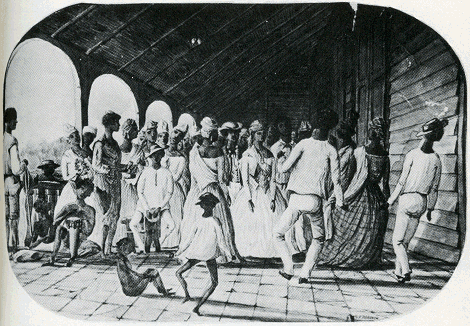 ‘Surinam dance party,’ by G.W.C. Voorduin.
Courtesy of the Surinam Museum, Paramaribo, Surinam. | |
1.
Mama Aysa fu goron,
di u kon, u no kon a yu tapu nanga tranga.
Un bun mama,
di u kon, u no kon a yu tapu nanga tranga.
U seti begi na oso,
bifo un kon dya.
2.
Nyanfaro-o, Aysa, ma tide un kon begi
mama fu gron.
Tobosi, tide u kon begi
goronmama.
Ay, nanga na mama di seti u na heri Sranan.
Na yu-o, na yu-o, u e begi-o
mi mama, na yu mu hori en gi u-e.
3.
Fosi sani mi nene leri mi, Aysa.
Fosi sani mi nene leri mi, Aysa.
A taki: kowru watra na krabasi,
kindi na goron.
A fosi sani mi nene leri mi, Aysa.
4.
Mi begi a mayoro,
hari na udu gi mi.
Mi moy mayoro,
Yu mu hari na udu gi mi.
Bika mayoro,
yu srefi sabi, te a dey opo,
yu nen mu opo,
di fu mi mu opo tu.
Mi moy mayoro,
hari na udu gi mi.
5.
Kwakwamayoro, hari na udu gi mi-e.
Kwakwamayoro, hari na udu gi mi-o.
Bika wan taki de a nengre-oso
disi no abi kaba.
Mi e begi mayoro,
hari na udu gi mi-o.
6.
Sani ben abi dyendyen, a ben sa loy.
Sani ben abi dyendyen, a ben sa loy.
| |
Basya seni mi na pondo,
trawan de a mi oso.
Sani ben abi dyendyen, a ben sa loy!
7.
Sani de na ala presi-o, sani de a masra kamra.
Ay, ma u kon yere fa tu sisa e feti
fu wan botrobari ede.
Noya sani kon a masra kamra.
Ay, ma u kon yere fa tu meti e feti
fu wan botrobari ede.
A sani di moni bay.
Ay, ma u kon yere fa tu sisa e feti
fu wan botrobari ede.
Ay, ma kruyara de a liba tapu
di e go na wan tata yana.
A de mi mama: wani e go moro wani.
8.
Sari-o, sari, u no abi fu sari.
Sari-o, sari, u no abi fu sari.
Weti bakra kon na ini pranasi,
teki lobi fu nengre.
Sari-o, sari, u no abi fu sari.
9.
Te na boto sa kon,
nomo u e way anu, fu dya u de.
Te pori nen boto sa kon,
u e way anu, fu dya u de-o.
Moy Asadu sa go a foto,
go bay lafendri gi prodo uma.
U e way anu, fu dya u, de-o.
| |
10.
A kori mi-o. Baya Kwami kori mi.
A kori mi. Fa mi baya Yaw kori mi.
A taki: Pagara kon,
a e go bay koto.
Pagara kon,
a e go bay yaki.
Pagara kon,
a e go bay krara.
Noya di pagara kon,
mi baya go a mangro.
- A go a mangro,
- a go a mangro.
- Pagara kon,
- mi baya go a mangro.
11.
Madyo mi mama, Madyo, meki a tori tan.
Efu u taki a tori anga leti,
a e go tyari feanti kon na ini.
12.
Tetey-o, na mi e weri tetey.
Tetey-o, na mi e weri tetey.
Ala den trawan, den go na waka,
den abi den koto, den abi den linga,
den abi den krara, den abi den pangi,
den abi den angisa, den abi den yaki.
Tetey-o, na mi e weri tetey.
Pe mi baya de?
Na mi e weri tetey.
13.
Baya go a foto,
ma a adyosi a tyari kon.
Baya Kwami go a foto,
ma a adyosi a tyari kon.
Tu eren, soso tu eren baya bay kon.
- Tu eren, soso tu eren baya bay kon.
| |
14.
Baya taki mi no mu go a doro.
San ede mi no mu go na doro?
Koto kon, a mi srefi bay.
Yaki kon, a mi srefi bay.
Pangi kon, a mi srefi bay.
San ede mi no mu go a doro?
15.
Puru mi a yu bere, moy baya,
puru mi a yu bere.
Puru mi a yu bere, moy baya,
puru mi a yu bere.
Mi go a firi kaba,
puru mi a yu bere.
Mi no e tyari sroto moro.
Puru mi a yu bere, moy baya,
puru mi a yu bere.
16.
Mi mama, sortu ay na a ay disi e luku mi-e.
Ay mi mama, sortu ay na a ay, mama, disi e waki mi.
Kande na munkenki ana?
Sonten na deystari ana?
Ay mi nene, sortu ay na a ay di e waki mi-e.
17.
Hura, na un ten noya.
Hura, na un ten noya.
Efu un wani, u e meki a bori,
ma efu u no wani,
u e puru en lala gi nengre.
18.
O bigi mi sa meki tide.
Bika mi tron parwa.
Springiwatra nyan ala mi lutu kaba.
So mi no kan meki bigi moro na grontapu.
19.
Te mi masra dede, nowan yobo wani bay mi.
Te mi masra dede, nowan masra wani bay mi.
Na bakabaka, tanbun masra kon bay mi.
Now dede wanwan kan bay mi.
| |
20.
A boro gron, watra lon na mi ay,
a fadon a mi ati, a boro gron.
A boro gron, watra lon na mi ay,
a fadon a mi ati, a boro gron.
21.
Wan dey mi go a busi,
tyari pori nen go poti-e.
Wan dey mi go a busi,
tyari lagi nen go poti-e.
Nomo mi si wan papa.
Nomo a taki:
Mi pikin, pe ju e go-e?
Nomo mi piki na papa,
taki mi e tyari pori nen go a busi-e.
Nomo a papa taki:
Dray baka, dray baka, mi pikin,
tyari pori nen go na oso-o.
Ma yu mu teki a wiwiri disi
te yu go, fu yu wasi yu sikin.
Ma yu sabi ofa a wiwiri nen?
Ke mi pikin, ke ma yu sabi ofa a wiwiri nen?
Adamakamani
damakamani
damakamani.
- Na yu pori nen ini yu koroku de.
22.
Te den bigi boto kon a sey broki,
dan mi e tanapu poti mi anu a mi baka,
dan mi e luku son-opo anga son-dongo.
Dan mi e tanapu luku den man a tapu broki:
someni lay den e puru nanga someni lay den e poti.
Dan te mi kaba luku ala den tori dati,
dan mi e denki wan libisma anga wan sipi.
Bika wan sipi, a watra tapu a e waka, a kan sungu.
| |
Ke, wan libisma e waka a doti tapu, a kan dede.
Ma toku a lay di wan sipi e tyari-oy,
a lay di wan sipi e tyari-e,
a lay di wan sipi e tyari,
a moro furu moro di fu wan libisma.
Ma toku na di fu wan libisma moro ebi.
Ma toku a di fu libisma moro ebi-oy.
Toku a di fu libisma moro ebi.
Bika na lay fu den sipi, na soso isri nanga siton.
Ma ke, di fu mi mama anga di fu mi tata,
dati na nowtu anga sari fu grontapu libi.
- A puru lay-o, a puru lay-e.
- A puru lay-o, a puru lay-o.
- Wan boto kon a sey broki,
- A puru lay, te a puru lay kaba.
- Ma san ati e tyari, dati no abi kaba-e.
23.
A di masra Gado ben meki grontapu-o,
a ben meki kaw nanga sikapu
poti na ini grontapu.
A ben kari kaw, a taki:
Kaw, yu kan teki san yu wani.
Kaw luku lontu na ini ala den sani
di masra Gado poti.
A feni lobi fu ay.
A teki ay, moro bigi ay,
poti na en fesi.
Ma kaba di masra Gado kari sikapu, a taki:
Sikapu, yu na moro pikinwan moro kaw,
ma yu kan teki san yu wani toku,
di kaw kaba teki ala bigi san a lobi.
Nomo skapu teki barba,
a poti en na en kakumbe ondro.
Dan a poti barba na en kakumbe ondro.
Dan ala suma kon teri skapu
fu a moro hey meti di de a grontapu.
| |
Dan kaw ati bron.
We ma di kaw ati bron,
skapu ben tagi en, a taki:
Leki fa yu bigi, yu gersi pikin fu asaw,
yu a wan bigi man efu wan bigi uma.
Ma toku a pikin fasi
di masra Gado poti mi,
dan mi srefi abi mi bigi,
na mi fasi.
Ma o o, meki mi tagi yu, masra kaw,
taki yu abi yu bigi memre
na yu fasi,
ma mi pikin skapu a no yu boy.
- San mi wani mi kan du-e.
- San mi wani mi kan du.
- San mi wani mi kan du.
- Mi wan bigi uma de a mi oso.
- San mi wani mi kan du-e.
24.
Kowru watra na krabasi, mi mama-o,
nanga kindi na goron, Maysa.
So u e begi na doti dya,
dan u e begi
u mama na ini Akademi-o.
25.
Mi na kakafowru, kron de a mi ede.
Mi na kakafowru, mi kron de a mi ede.
Kaba wansi nefi de a mi neki,
mi kron de a mi ede.
26.
Ma malengri poti mi-o fu oloysi-o.
Tide malengri poti mi-o fu oloysi.
Te gusonteit go a waka, mi e go teri na yuru
taki na yuru-o.
| |
27.
Na dungru oso ini wani no dape.
Na ini dungru oso ini wani no dape.
Sisa Elena,
ma efi yu meki wani,
den e buy yu a yu futu.
28.
Waka libi go, waka leri kon kaba-o.
Waka libi go, waka leri kon kaba.
Na ini Pori Nen ini ondrofeni
gi mi wan bangi, mi sidon.
29.
Mi naw frenti-o na mi tollenaar.
Mi beste kompe dati na mi moordenaar-o.
Kaba mi eygi bere famiri ala de na ini-o.
30.
Ke ma mi iti mi neti-o a liba-o.
Tide mi iti mi srepi-o na watra.
Kaba mi kisi tu fisi: wan na koroku,
wan na pori nen.
31.
Lagi nen fu kondre na mi gowtu keti-o.
Pori nen fu kondre na mi fingalinga,
na mi gowtu keti-o di mi e weri na neki-o.
32.
Amekisani-o, go teki mi konsro gi mi-o.
Boketi Tanta, go piki konsro gi mi-o,
taki mi yuru kon kaba,
nomo mi wani si mi boto, pe a de.
33.
Watra lolo sipi-o, san a kartiki-o.
| |
Watra lolo sipi-o, san a kartiki-o.
Kaba libi hebi gi weti yobo, ma mi nengre.
34.
Poti faya, man, poti un faya.
Un sutu faya, man, un sutu un faya.
Tanta, boto de na sey now,
ma un boto wani gowe.
35.
Odi-odi, odi-odi, ala frankeri misi,
ma dan sosrefi mi bari mi bakaman wan odi.
Ma dan sosrefi mi bari mi bakaman wan odi,
ma dan sosrefi mi de bari ala den heer odi,
Ma dan sosrefi mi de bari ala den heer odi,
ma dan sosrefi mi de bari mi moy datra odi.
Ma na sosrefi mi de bari mi moy datra odi,
ma dan sosrefi mi de bari mi Afraw odi, misi.
36.
Odi-odi, odi-odi, mi fariasi bakaman,
so wi e bari wan odi, mi fariasi bakaman.
So mi e bari wan odi gi mi beweygi bakaman,
so mi e bari wan odi gi ala den kompe na lontu.
Mi fariasi bakaman, mi moymoy fu lobi,
so mi tyari wan moy tori, mi fariasi bakaman.
So mi tyari wan moy tori, mi beweygi bakaman,
ma na tori e go dini fu mi eygi srefi.
So na tori e go dini fu mi eygi srefi,
sosrefi a tori e go dini fu mi anga wan seyker lobi.
Wan dey mi sidon na mofo mi doro, mi beweygi bakaman,
nomo wan doyfi frey pasa, a iti wan brifi gi mi.
| |
So mi teki na brifi, mi broko leysi,
ma na brifi ben skrifi nanga Hebrewse letter,
so mi bari wan lafu, dan mi leysi a brifi.
Dan na brifi warskow mi, mi beweygi bakaman,
a taki: na lobi di yu abi, dan yu mu koni anga a lobi,
bika a wani poti yu a sodro, a puru trapu na ondro.
37.
Mi e go pakti wan gron, ala misi,
fu mi kan prani mi aleysi na ini,
fu mi fowru kan feni bun nyanyan.
Bakaman,
yere san tyagotyakon-man de haksi mi:
te mi gi den fowru na nyanyan,
dan san mi e libi den fu soso?
Dan yu mu yere san mi e go piki den,
taki: opo go wroko, un lesiman,
dan un sa weri bigi koto leki mi,
dan un fowru tu sa feni bun nyanyan.
38.
Mi yere wan apskraps e kosi mi,
ma a no frede mi frede fu piki den,
ma mi no sta gelijke nanga den,
bika en na tigri, mi a tamanua,
dan mi e go si o-letiwan kan gi abra.
Baka so kronkron leki di mi de,
ma dan tussen fu lobi mi abi.
So wayway leki di mi de,
ma gemaakte fu a libi mi abi.
Dan fosi a masra fasi mi,
dan mi sabi a tussen di mi mu du.
| |
Dan wansi a meid e kosi mi,
dan tussen fu lobi mi abi,
gemaakte fu lobi mi abi.
Dan mi no abi nèks te make anga misi.
So kronkron leki di mi di,
so wayway leki di mi de,
dan tussen fu lobi mi abi.
39.
Fa yu kan taki mi no moy?
Na tu bromki meki mi.
Rosekunop na mi mama,
Stanfaste na mi papa.
Fa yu kan taki mi no moy?
Na tu bromki meki mi.
40.
Mi gudu, tranga lobi sondro noti,
a de gi fruferi.
Ma a kon gersi wan roos
di no abi smeri.
41.
Mi lobi libi mi.
- Libi en, meki a go.
- Bika yu na banketi,
- yu de na batra.
- Trawan sa bay yu.
- Libi en, meki a go.
- Trawan sa bay yu.
42.
Efi wan lobi ben lobi mi,
a no lobi mi moro,
mi no kan kiri mi srefi
fu dati ede.
43.
Efu mi lasi mi moy lobi,
mi no lasi noti.
| |
Ma efu mi lasi mi gusontu,
mi no warti moro.
Efu mi lasi mi moy gudu,
mi no abi trobi.
Ma efu mi lasi mi gusontu,
mi no warti moro.
44.
Yu moy moro mi,
yu fatu moro mi,
ma mi switi moro yu.
Dati ede meki
gudu-gudu no kan ferdwal
fu libi switi roos
fu kon na krabu Dinki oso.
45.
Eri grontapu de bari ondrufeni fu lobi,
ma mi dati mi de bari ondrufeni fu libi.
Ondrufeni ondrufeni fu den akwabutuman:
den de nyan nanga mi, den abi mi sani fu taki.
46.
Mi ben sweri fu Gado, mi no o lobi moro,
ma mi go agen.
Dan mi weri patapata, dan mi e trapu taki,
ma mi go agen.
Mi donke nebermind ba, mi no frede noti,
ma mi go agen.
Ma mi weri braka susu, dan mi e trapu taki,
dan mi go agen.
| |
47.
Na eri dey a e bari fa en lobi switi,
dan mi no e piki en.
Ma di mi meki a frigiti,
dan mi go tesi lobi,
dan mi no e libi en.
A no fu gowtu moni, a no fu sorfru moni,
dan mi no e libi en.
48.
Moy misi, fa mi mu libi?
Gowtu keti na yu neki
a de meki kamalama.
Tranga lobi na wan sani...
waka go, na wan dey blaw bromki.
A no langa, a no langa.
Switi lobi na wan sani.
49.
Pikin uma, fyofyo seni kon tagi yu,
taki wan nyun yari opo
fu yu mu tyari yu deken go wasi.
Ma dan so efu yu no kan wasi en,
wakti te doti wagi e kon pasa,
ma dan yu saka yu deken na ini,
dan u e bari ipipi-ure.
Bigi deken e go na Branspen.
Bari ipipi-ure.
50.
Broyn misi, wan seyker dey mi e kon pasa,
nomo tu doti pikin uma e kosi mi.
Dan mi no dray me fesi fu mi luku den.
Gudu, mi sabi san de a mi ede.
| |
Dan mi no dray mi fesi fu mi luku den.
Bika a no kisi wan wiki na baka,
luku, en pikin tatay na en anu.
Mi gudu, en pikin tatay na en anu,
leki den e seni sikiman go a Syatrion.
En pikin tatay na en anu.
51.
Wan lage karakter meki ondrosuku
pe mi de, fa mi tan,
pe mi de, fa mi tan.
A no yere mi nen, a no de si mi persoon,
ofa mi tan.
Nanga mi broko koto en mi doti yaki,
so mi de, so mi de, so mi tan.
Mi no kon moro hey, mi no kon moro lage:
so mi de, so mi tan.
52.
San yu e luku mi?
San yu e waki mi?
Mi a no paarderij,
mi a no payasiman.
San yu e luku mi?
San yu e waki mi?
Mi a no paarderij, payasiman.
Mi no e nyan fu yu.
Mi no e dringi fu yu.
San yu e luku mi?
San yu e waki mi?
Mi no e nyan fu yu.
Mi no e dringi fu yu.
Mi a no paarderij, payasiman.
| |
1.
Mama Aysa of the earth,
in coming here we come not unannounced to you.
Oh good mother,
in coming here we come not unannounced to you.
We've been in prayer at home,
before we came to you.
2.
Nyanfaro, Oh Aysa, today we come to you in prayer,
the mother of the earth.
Tobosi, today we come to pray to you,
the mother of the earth.
Yea, the mother has settled us in all Surinam.
Thou, thou we plead,
mother, thou must be our shield.
3.
The first thing I was taught by her
who nursed me, Aysa.
The first thing I was taught by her
who nursed me, Aysa.
She said: with cool water in a calabash
go down with your knees on the ground.
The first thing I was taught by her
who nursed me, Aysa.
4.
I plead with you, major,
beat the wood for me.
Oh handsome major of mine,
beat the wood for me.
For as you know, my friend,
when the day shall dawn,
so must your name dawn too,
and also that of mine.
Oh handsome major of mine,
beat the wood for me.
5.
Kwakwa major, let the wood resound.
Kwakwa major, let the wood resound.
There's a whisper in each nigger house,
one without an end.
I pray with thee, Oh major mine,
beat the wood for me.
6.
Were it a bell, it would have clanged out loud.
Were it a bell, it would have clanged out loud.
| |
To the pontoonGa naar voetnoot6
I'm sent by my overseer,
another's usurped my house.
Were it a bell, it would have clanged out loud!Ga naar voetnoot7
7.
What's known to everyone is also in the master's house.
Yes, but listen how two sisters squabble
over a butter tub.
Now the thing has found its way
into the master's house.
Yes, but listen how co-wives squabble
over a butter tub.
A thing that money can buy.
Come hear two sisters fighting
over a butter tub.
Yes, but there's a canoe on the river
off to a cunning man.Ga naar voetnoot8
So be it, Oh my mother: greed shall eat up greed.
8.
Grief, grief, there is no need for grief.
Grief, grief, there is no need for grief.
To the plantation a white man came,
conceived a love for blacks.
Grief, grief, there is no need for grief.
9.
When the boat is coming in
we wave with our hands
for we are here.
When the boat of ill repute
is coming in
we wave with our hands
for we are here.
When smart Asadu goes to town
to buy sweet smelling perfumes
for philandering girls,
we wave with our hands
for we are here.
| |
10.
He's deceived me. Friend Kwami has deceived me.
He's deceived me. God, how friend Yaw'sGa naar voetnoot9
deceived me.
He said: When the peddler comes
a koto you will get.Ga naar voetnoot10
When the peddler comes
a yaki you will have.
When the peddler comes
some beads will be yours.
But now that the peddler's here,
my friend's gone off to the mangrove bush.
To the mangrove bush he's gone.
Off to the mangrove bush he is.
Now that the peddler's here,
he's off to the mangrove bush.
11.
Madyo, my mother, let's not talk about it anymore.
For if we scratch too deep,
We'll only bring in enmity.
12.
Tatters, I'm clad in tatters.Ga naar voetnoot11
Tatters, I'm clad in tatters.
The others go and parade,
they have their koto, they have their rings,
they have their chains of beads, their wraparounds,
they have their kerchiefs and their yaki.
Tatters, I'm clad in tatters.
Where is my boy friend?
I'm clad in tatters.
13.
My friend has gone to town,
returned with mere goodbyes.
Friend Kwami's gone to town,
came back with mere goodbyes.
Herrings two, mere herrings two
my friend has brought for me.
Herrings two, mere herrings two
my friend has brought for me.
| |
14.
My friend decreed I can't go out
Why can't I go?
The koto was bought by me
The yaki was bought by me
So was the wraparound.
Why can't I go?
15.
Be no longer mad at me, my handsome friend.
Be no longer mad at me.
Be no longer mad at me, my handsome friend.
Be no longer mad at me.
I've already been to the fields.
Be no longer mad at me.
I do not wear the keys any more.Ga naar voetnoot12
Be no longer mad at me, my handsome friend.
Be no longer mad at me.
16.
Mother, what eye is it that eyes me?
Oh mother, what eye is it
that stares at me?
Is it perhaps the moon?
Perhaps the morning star?
Oh mother, what eye is it that eyes me?
17.
Hurrah, now it is our turn.
Hurrah, now it is our turn.
If we so wish, we'll have it cooked.
But if we do not wish,
We'll dish it to the negroes crude.
18.
How can I still enlarge myself
now I'm a parwa tree?Ga naar voetnoot13
Springtides have sucked my roots.
Foresooth I can't project myself
as big on this world.
19.
When my master passed away, no white man wanted me.
When my master passed away, no master wanted me.
A bad one later did.
Now death alone wants me.
| |
20.
It has caused the earth to tremble.
Tears streamed from my eyes.
It has caused my heart to rend,
caused the earth to trill.
It has caused the earth to tremble.
Tears streamed from my eyes.
It has caused my heart to rend,
caused the earth to trill.
21.
One day I went to bush
to leave a rotten name.
One day I went to bush
to leave a lowly name.
No sooner there, an old man
appeared to me and said:
Where do you go, my child?
I answered him and said:
Taking a rotten name
to throw away in bush.
The old man then replied:
Turn back, turn back, my child.
Take home the rotten name.
But when you go, take then
this weed, and with it bathe.
But do you know its name,
child, what the weed is called?
Adamakamani,
Damakamani,
Damakamani.
Within your rotten name
there lies your luck
22.
When the big ships are moored to the quay,
there I stand, hands on my hips,
from sunup till sundown.
There I stand, scanning all the men
busy on the quay.
They hauled in such a load,
discharged, discharged so much.
And when I'm finished seeing all,
I see in such a ship a man.
For sink can a ship which sails,
on the water it can sink.
| |
Oh man dwells on this solid earth,
but die, but die he can.
For he is but a man.
Yet the load a ship conveys
Yet the load a ship conveys
Yet the load a ship conveys
is so much more than that of man.
Yet heavier is the human load.
Yet heavier is the human load.
Yet heavier is the human load.
For iron and stone a ship conveys,
but all that of my ma and pa
are of distress and grief
and of this earthly life.
- It has discharged its load.
- It has discharged its load.
- A boat is anchored near the quay.
- It has discharged its load.
It has no more a load.
- But Oh the loads of hearts
go on without an end.
23.
When Lord the God the earth did make,
he made a cow, a goat,
then put them on this earth.
To him the cow he called and said:
Take that which you want here.
Cow looked around
all things on earth,
his eye fell on an eye.
He took the eye, the biggest eye
and placed it in his face.
Then Lord the God the goat did call
and said to him:
Though you are small compared to cow,
take that which you want here.
Cow has already taken his,
the thing most craved by him.
Then took for him the goat a beard
and placed it on his jaw.
And placed it on his jaw.
Then honored all the men the goat
the highest thing on earth.
| |
This roused the ire of the cow.
And when the goat saw this,
he spoke to cow and said:
You've always been so big to me,
you're an elephant's baby, I'm sure,
a portentous one to me.
Yet within the small confines
which God has granted me,
I chose my greatness too
in manner known to me.
But Oh, but Oh, Lord Cow,
take this from me, my friend:
You lust for power too
in manner known to you.
I am a little goat,
no boy to you I am.
- That which I want I can.
- That which I want I can.
- That which I want I can.
- Know you that in my house
I am a grownup too.
- That which I want I can.
24.
Cold water in a calabash, my mother.
Knees on the earth, Maysa.
Thus we pray to the earth,
pray to our mother
on Academy.
25.
I am a cock
with a crown on my head.
I am a cock
my crown is on my head.
Though a knife be on my throat,
my crown is on my head.
26.
This incapacity of mine
has drawn my mind to concentrate on time.
Today this sickness of mine
has drawn my mind to concentrate on time.
When good health departs from me,
the hours I count
become an hour.
| |
27.
In the jail you cannot voice your wish.
In the jail you cannot voice your wish,
Sister Helena.
But if you voice your wish,
your feet they cast in chains.
28.
Living just so has now ended,
knowledge has arrived.
Living just so has now ended,
knowledge has arrived.
In Pori NenGa naar voetnoot14 knowledge gave me
a bench on which to sit.
29.
My close friend is a traitor,
My best pal a murderer.
My family from my own womb
they're party to it all.
30.
Oh I cast my net in the river.
My net in the water I cast.
And lo behold two fishes:
of happiness
and ill repute.
31.
A base name in this world
to me is a golden chain.
A rotten name in this world
to me is a signet ring,
a chain of gold round my neck.
32.
Amekisani-o, go fetch my Konsro.Ga naar voetnoot15
Boketi Tanta, go tell my Konsro
that the hour has come.
And I will see my boat,
see where it is now.
33.
If waters cause a ship to undulate,
what then with you, Oh mealiecob.
| |
If waters cause a ship to undulate,
what then with you, Oh mealiecob.
If life presses the white man down,
what then for me, a negro boy.
34.
Light the fire, man, light your fire.
Let it blaze, man, let it blaze.
Tanta, the boat is at the quay
and shortly it will go.
35.
Howdy, howdy, howdy, howdy, my pretty ladies.
But also you I greet my bakaman.Ga naar voetnoot16
But also you I greet my bakaman.
To all the men, I greetings call.
To all the men, I greetings call.
But also you I greet, my handsome doctor.
But also you I greet, my handsome doctor.
To you, my Aflaw greetings do I call.
36.
Howdy, howdy, howdy, howdy,
my variable bakaman.
Thus do we call greetings
my variable bakaman.
Thus do I call a greeting
to my versatile bakaman.
Thus I call a greeting
to all friends around.
My variable bakaman,
sugarpie of love.
Thus I come with a nice tale
my variable bakaman.
Thus I come with a nice tale
my variable bakaman.
But I'm the theme of this tale.
But I'm the theme of this tale,
and a certain loved one too.
On a day I sat in the door,
my versatile bakaman.
Just then a dove came by.
A letter he dropped to me.
| |
I picked the letter up,
opened it, and read.
Alas, in Hebrew it was.
In laughter I burst out,
then read this letter of mine.
A warning it had for me,
my versatile bakaman.
It said: that love of yours,
beware, beware of it.
He'll put you in a loft
and scuttle the ladder away.
37.
I shall rent a farm, all my madames,
plant it full with rice,
have good grain for my chickens.
Bakaman!
Listen, what the loafers ask me!
When I've fed the birds,
what will be left for them?
Listen, friend, to what I answer then:
Sluggards, go and work.
Then you'll also wear a koto
just like that of mine,
Then you'll also give some good food
to your birds around.
38.
I heard an apskrapsGa naar voetnoot17 revile me.
But I'm not scared to answer,
for I'm not on the same par with her.
She is a tiger,
an anteater am I.
Let's see who succumbs first.
For crooked though I am,
I'm sated with love in between.
Lightweight that I am,
but the pleasures of life are in me.
And before his hands touched me
I knew I was to yield
the in between to him.
| |
Tho' the wench reviles me now,
I'm sated with love in between,
and know all the tricks in the trade.
No truck with that woman I have.
For crooked as I am,
for lightweight as I am,
I'm sated with love in between.
39.
How can you say I am not fair?
Two flowers gave birth to me.
My mother is a rosebud.
Everlasting is my pa.
How can you say I am not fair?
Two flowers gave birth to me.
40.
My love, tempestuous love
with nothing more to do,
will but provide inertia.
It is but like a rose
which has no smell.
41.
My love has flown away.
- Let him be, let him be.
- For you are
- a cookie in a jar.Ga naar voetnoot18
- Some other will you buy.
- Let him be, let him be.
- Some other will you buy.
42.
If my love
who loved me
loves me no more,
I cannot die
for this alone.
43.
If I forgo my pretty love,
I have not lost a thing.
| |
But if I lose my health anon,
I have lost all that's dear.
If I forgo my pretty dove,
I do not miss a thing.
But if I lose my health anon,
I have lost all that's dear.
44.
Thou art more lovely than I am,
and fuller than I am.
But I am sweeter than thou art.
Therefore my sweetheart
will not stray,
abandon his sweet rose,
and go to crab Dinki.Ga naar voetnoot19
45.
The whole world cries out
for experience in love.
But I, in contrast, ask
for experience in life.
Experience! Experience!
and with the thankless ones
who profit and betray
while supping with me
and talk behind my back.
46.
By God, I swore,
I will not love again.
Alas, I fell into the trap anew.
I wear my patapata,Ga naar voetnoot20
trample on all rumors.
Alas, I fell into the trap anew.
I cast all caution to the wind.
Alas, I fell into the trap anew.
I put on black shoes,
trample on all rumors.
Alas, I fell into the trap anew.
| |
47.
The whole day long he brags to me,
his love is so sweet,
but I speak not a word to him.
No answer does he get.
But just when it had slipped his mind,
then tasted I his love,
won't ever let it go.
No matter how much gold or coins,
I'll never let it go.
48.
Oh lovely one, how will I live?
The golden chain
kamalamas round your pretty neck.Ga naar voetnoot21
Strong love is something ...
transient
like unto a small flower
blue on a day.
It is ephemeral. It is ephemeral.
Sweet love is something else.
49.
Woman of no significance,
fleas for you the new year herald:
go and wash your filthy blanket.
But if this prove not possible,
then you should wait for the garbage truck
and chuck your blanket there.
And we will shout, hip, hip, hoorah,
big blanket is off to the dumping hole.
Yell hip, hip, hoorah.
50.
Oh bronze maiden,
on a day I came along,
Lo and behold! two filthy sluts
reviling me at once.
I did not turn my head
or look.
Dear bronze maiden mine,
I know the thoughts I have.
| |
I did not turn my head
or look.
For lo! a week from thence,
behold there in her hand
her earthly goods I see.
Behold there in her hand
her earthly goods I see.
Like afflicted off to Châtillon,Ga naar voetnoot22
carting a bundle small
clutched in their hands.
51.
A vile one let out feelers
how I'm faring now,
how I'm faring now.
He has not heard my name,
seen me not alive,
knows not how I fare.
With my tattered koto dress,
with my unwashed yaki dress,
So fare I now, so fare I now.
I haven't become any higher,
I haven't become any lower.
So fare I now, so fare I now.
52.
Why do you look at me?
Why do you stare at me?
I am no circus to you.
I am no clown to you.
Why do you look at me?
Why do you stare at me?
I am no circus clown.
I do not eat your food.
I do not drink your wine.
Why do you look at me?
Why do you stare at me?
I do not eat your food.
I do not drink your wine.
I am no circus clown.
|
|